
The River Is Already Dead
Sacred Rivers Turned Toxic – The Civilization-Level Crisis Politicians Refuse to Name

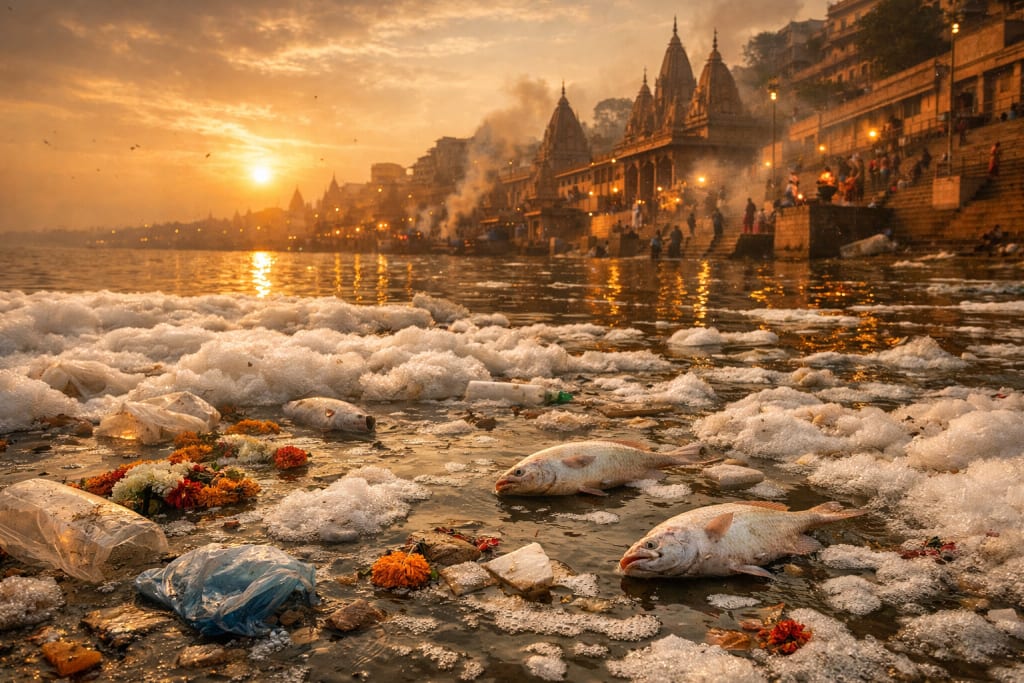
I stood on the banks of the Ganges once, years ago, and the air itself felt alive with something ancient. Pilgrims chanted, lamps floated on the water, and for a moment you could almost believe the stories that this river was born from the heavens and could wash away any sin. But even then, beneath the beauty, I noticed the strange sheen on the surface, the smell that didn’t quite belong to nature. Today, that memory hurts. Because the river I saw is still there… only now it’s dying in plain sight, and we’re all pretending it isn’t.
This isn’t just an Indian story. It’s happening wherever humans have built civilizations around water we call sacred. The Yellow River cradle of Chinese culture and myth for five thousand years has stretches so choked with sediment and industrial runoff that fish have vanished for decades at a time. Nepal’s Bagmati, holy to both Hindus and Buddhists, flows black through Kathmandu, thick with sewage. Indonesia’s Citarum, once a lifeline for millions, became so toxic from textile dyes and factory waste that it was nicknamed “the world’s dirtiest river” until massive cleanup efforts began showing fragile signs of recovery. These aren’t random waterways. They are the arteries that fed empires, inspired scriptures, and sustained billions of souls. When they turn into open sewers, something deeper than ecology breaks.
Let’s be honest about what’s actually in these waters. Recent assessments of the Ganges show fecal coliform counts at certain ghats during major gatherings reaching 1,400 times the safe bathing limit. That’s not a statistic you can shrug off it means cholera, dysentery, typhoid, and hepatitis are part of daily life for communities that have no choice but to drink, bathe, and irrigate with it. Over 500 million people depend on the Ganges basin. Untreated sewage billions of liters every single day pours in from cities, while more than 3,000 grossly polluting industries add heavy metals, microplastics, and chemicals. Only around 37 percent of the sewage is treated even now, after years of high-profile programs. The rest flows straight in. Farmers downstream watch crops fail or absorb toxins into the food chain. Fishermen pull up fewer and fewer catches, or fish that simply aren’t safe to eat. Children in these regions suffer waterborne illnesses at rates that should shame any modern society.
And the cultural wound? That’s the part that feels almost too painful to say out loud. For Hindus, the Ganges is Ma Ganga a mother, a living goddess. People still travel thousands of kilometers to immerse the ashes of loved ones or to bathe during Kumbh Mela, believing the water purifies. Yet the very rituals meant to honor her sometimes add to the burden: thousands of idols painted with toxic colors, floral offerings wrapped in plastic, human remains. The river that is supposed to cleanse us is being asked to carry sins it was never meant to hold. The same paradox plays out elsewhere sacred rivers turned into dumping grounds while the faithful keep coming, caught between devotion and desperation.
So why won’t the people in charge just say it? “The river is already dead in stretches. We have to treat it like a patient in critical care, not a photo opportunity.” You almost never hear those words. Instead, we get slogans, ribbon-cuttings for sewage plants that never run at full capacity, and funds that disappear into bureaucratic black holes. In India, the Namami Gange mission was launched with genuine promise and billions of rupees, yet stretches of the river remain biologically dead and politicians still claim victory or point fingers across state lines. Economic growth comes first tanneries, sugar mills, cities expanding without infrastructure. Religious sensitivities make it tricky; nobody wants to tell millions that their holiest river needs saving from the very faith that sustains it. Downstream states suffer what upstream ones ignore. And let’s be real: short election cycles reward visible projects, not the slow, expensive, unsexy work of maintaining treatment plants for decades. The same pattern repeats globally. Leaders everywhere prioritize GDP numbers over the quiet collapse of ecosystems their voters depend on.
What happens to a civilization when its sacred rivers die? History whispers the answer. Ancient societies that mismanaged water whether through drought, salinization, or pollution didn’t always fall in a single dramatic collapse. They frayed. People migrated. Economies shrank. Cultures lost the rituals and stories that once bound them. Health crises weakened generations. The same risks stare at us now, only on a planetary scale. When mothers can’t safely bathe their children, when farmers lose their soil’s fertility, when entire regions face water scarcity because the source is too toxic to use — trust in institutions erodes. Communities turn inward or against each other. The quiet contract that says “we will leave the world better for our children” starts to feel like a lie.
I’m not here to shame anyone. Most of us myself included have contributed in small ways: that plastic bottle tossed without thinking, the convenience of fast fashion whose dyes end up in rivers halfway across the world. The problem is massive, systemic, and emotionally complicated. But here’s what gives me cautious hope: change is not impossible. Indonesia’s Citarum has shown that with serious government will, community involvement, and sustained funding, even the most notorious “dead” river can begin to breathe again fish have returned in places, people are swimming where they couldn’t for decades. Small victories in the Ganges basin prove that when treatment plants actually work and industries are held accountable, oxygen levels rise and dolphins are spotted more often. The technology exists. The money, in theory, exists. What’s missing is the collective refusal to look away.
So this isn’t really about rivers anymore. It’s about whether we still believe our civilizations are worth saving. Because if we can’t protect the waters that gave us life the ones we once called holy then what exactly are we building for? The river isn’t just “dirty.” In too many places, it’s already dead. The question is whether we’re willing to admit it, mourn it, and then roll up our sleeves and bring it back to life before the next civilization writes our story the same way we write the ones that came before us.
The water is still flowing. For now. Let’s stop pretending that’s enough.
About the Creator
Arjun. S. Gaikwad
Truth Writing unveils reality beyond illusion, power, and propaganda words that awaken conscience and challenge comfort. Fearless, honest, and thought-provoking, it explores politics, humanity, and spirit to inspire awareness and change.
Keep reading
More stories from Arjun. S. Gaikwad and writers in Earth and other communities.
Why India's Water Is Vanishing
Imagine standing in a vast field that once bloomed with lush green crops, now reduced to a mosaic of deep cracks under a relentless sun. A farmer tilts his head back, sipping the last drops from a clay pot, his face etched with worry. This isn't a scene from a distant dystopia it's the reality for millions in rural India today. Groundwater, the invisible lifeline that sustains over 60% of India's irrigated agriculture and provides drinking water to countless households, is disappearing at an alarming rate. India is the world's largest user of groundwater, extracting more than the United States and China combined. Yet, this precious resource is being depleted faster than nature can replenish it, creating a silent crisis that threatens food security, livelihoods, and the environment.
By Arjun. S. Gaikwad11 days ago in Earth
When Behavior Walks Away:
I have spent decades watching how behavior changes when the environment stops making sense. That skill came from forensics, trauma science, and animal work in the field. Patterns never break cleanly. They stretch first. They warp. Then the organism abandons the behavior that once kept it stable. I see that pattern now across animals that have nothing in common except the world they live in.
By Dr. Mozelle Martinabout 20 hours ago in Earth
Goodbye, Mr. Duvall
It is turning out to be an interesting year. I was in the middle of teaching a class when a pop-up appeared on the screen announcing the death of Mr. Robert Seldon Duvall (yes, that was his full name). I was in the middle of a discussion on the obsession we have with winning when it comes to sports (the Winter Olympics was a theme), and I felt as though things were coming full circle. We had already lost Gene Hackman last year, and along with that titan, it feels though one particular golden age has closed off to be replaced by...?
By Kendall Defoe 4 days ago in Geeks



Comments
There are no comments for this story
Be the first to respond and start the conversation.