
Thermal Desorption Recovery Pathways for Oil-Based Drilling Mud
A technical pathway for hydrocarbon recovery and compliant drilling waste treatment

Oil-based mud (OBM) is indispensable in complex drilling environments, yet it generates waste streams with high hydrocarbon loading and regulatory sensitivity. Thermal desorption has emerged as a technically mature recovery route, enabling separation of hydrocarbons from solids while reducing environmental liability. Its value lies not only in waste minimization, but in material reclamation and compliance assurance.
Characteristics of Oil-Based Mud Waste
OBM consists of base oil, water, emulsifiers, weighting agents, and drilled solids. During drilling operations, the mud accumulates cuttings coated with oil and additives. This waste exhibits high total petroleum hydrocarbon content, low biodegradability, and strong adhesion between oil and mineral surfaces.
Conventional treatment methods such as solidification or landfilling merely relocate risk. Thermal desorption, by contrast, targets the fundamental phase separation challenge by exploiting volatility differentials between hydrocarbons and inorganic solids.
Principles of Thermal Desorption
Phase Separation via Controlled Heating
Thermal desorption unit operates by heating OBM-contaminated solids to temperatures sufficient to vaporize hydrocarbons without degrading the mineral matrix. Typical operating ranges span 300–550 °C, depending on oil composition and desired recovery efficiency.
As temperature rises, base oil and lighter fractions transition into the vapor phase. These vapors are subsequently condensed, collected, and either reused or further refined. The remaining solids exit the system with significantly reduced oil content.
Indirect Versus Direct Heating
Indirect heating systems isolate combustion gases from the waste stream, preventing oxidation and preserving oil quality. Direct heating systems introduce hot gases directly into the material bed, offering higher thermal efficiency at the expense of product purity.
Selection between these modes reflects recovery objectives. Projects prioritizing oil reuse favor indirect configurations, while volume reduction-focused systems may tolerate direct contact.
Process Configurations and Equipment Design
Rotary Kilns and Thermal Screws
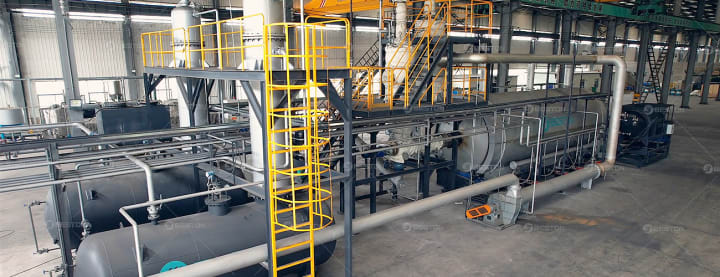
Rotary kilns remain the most common thermal desorption reactors for OBM due to their robustness and ability to handle variable feedstock. Their rotating motion ensures continuous mixing and uniform heat exposure. Thermal screw systems provide tighter residence time control and lower oxygen ingress. These attributes are advantageous for achieving low residual oil on solids while minimizing secondary reactions.
Vapor Handling and Condensation
Vapor management is a critical subsystem. Hydrocarbon vapors must be rapidly quenched to prevent cracking or polymerization. Multi-stage condensation enables fractionation, separating water, light hydrocarbons, and base oil. Non-condensable gases are often recycled as supplementary fuel, improving overall energy efficiency and reducing external fuel demand.
Recovery Efficiency and Material Quality
Oil Recovery Performance
Well-designed thermal desorption systems routinely achieve oil recovery efficiencies exceeding 95%. Recovered oil quality depends on peak temperature and residence time. Excessive severity leads to thermal degradation, reducing reuse potential.
When optimized, recovered base oil can be reintegrated into drilling fluid formulations or downgraded to industrial fuel. Either pathway represents value retention compared to disposal.
Treated Solid Characteristics
Post-treatment solids typically meet stringent discharge criteria, with residual oil content reduced to low single-digit percentages or less. Mineralogy remains largely intact, allowing for potential reuse in construction or safe disposal.
Particle agglomeration may occur at higher temperatures, necessitating downstream size reduction or conditioning depending on reuse intent.
Environmental and Regulatory Implications
Emission Control Requirements
Thermal desorption systems must address air emissions, including volatile organic compounds and combustion byproducts. Afterburners, cyclones, and scrubbers are commonly deployed to meet regulatory thresholds. Properly managed, these systems offer a lower environmental footprint than incineration, as they focus on recovery rather than destruction.
Compliance and Liability Reduction
By reducing oil content and toxicity, thermal desorption transforms hazardous waste into a manageable byproduct. This simplifies regulatory compliance and significantly reduces long-term liability for operators. In jurisdictions with zero-discharge policies, thermal desorption often represents the only viable onshore treatment option.
Economic Considerations
Cost Structure and Value Recovery
Capital costs for thermal desorption are non-trivial, driven by high-temperature materials, vapor handling systems, and emission controls. Operating costs are dominated by energy consumption and maintenance. However, recovered oil offsets treatment expenses. In regions with high disposal fees or limited landfill access, thermal desorption becomes economically compelling even without oil reuse.
Mobility and Deployment Models
Modular and mobile units enable on-site treatment, reducing transportation cost and risk. Offshore-adjacent deployments further enhance economic performance by minimizing logistics complexity. Scalability allows operators to match capacity with drilling activity, avoiding underutilized assets.
Operational Challenges and Mitigation
Feedstock variability remains a persistent challenge. Changes in oil composition, water content, or solid loading affect heat transfer and recovery efficiency. Advanced control systems mitigate these effects through real-time temperature and residence time adjustment. Fouling and abrasion impose maintenance demands. Material selection and preventive maintenance strategies are therefore integral to sustained performance.
Strategic Role in Drilling Waste Management
Thermal desorption occupies a strategic position between disposal and recycling. It converts OBM waste from an environmental burden into a partially recoverable resource stream. Its technical maturity, combined with regulatory acceptance, underpins its adoption across offshore and onshore drilling operations.
As environmental scrutiny intensifies, recovery-focused treatment technologies will increasingly define acceptable drilling practices. Thermal desorption, with its balance of efficiency and material recovery, remains central to this evolution.
About the Creator
Keep reading
More stories from Wayne Shen and writers in Earth and other communities.
Positive Policy Signals for Biochar Carbon Removal
As the world intensifies its efforts to combat climate change, biochar has emerged as a promising technology for carbon removal. The process of converting biomass into biochar involves heating organic material in the absence of oxygen, which traps carbon in a stable form and prevents it from re-entering the atmosphere. Biochar can be used as a soil amendment, improving soil fertility, water retention, and microbial activity. In addition to these agricultural benefits, biochar also plays a role in reducing greenhouse gas emissions. Recent policy signals from governments worldwide indicate a growing recognition of the importance of biochar in the global carbon removal landscape. These policies are creating an encouraging environment for the development and deployment of biochar carbon removal projects.
By Wayne Shen10 days ago in Earth
Protesters Bid to Save the ‘Heart’ of Margate
Residents and activists in Margate have launched a passionate campaign to save what they describe as the town’s “heart” — a historic public space facing redevelopment. The dispute has ignited local debate over preserving heritage, supporting small businesses, and maintaining the cultural identity of one of England’s most iconic seaside towns.
By Aarif Lashari4 days ago in Earth
Lately, I'm empty
Lately, I feel an emptiness inside of me that doesn’t make any sense. I was fine a week ago and now I’m numb to the pain that I’ve been carrying around. Numb to the idea of me existing. I wish I could go to a place where I can hear happy positive thoughts and surround myself with joy. The medication I’m on doesn’t seem to work anymore. I still feel pain from existing, why am I here anyways? Merely to exist. I don’t feel like I’m making any differences being here.
By Cerina Galvan3 days ago in Confessions




Comments
There are no comments for this story
Be the first to respond and start the conversation.