
Middle East Diplomatic Initiatives and Regional Conflicts in 2026: Challenges and Opportunities
The Middle East in 2026 continues to be a focal point of global attention due to its complex political dynamics, ongoing conflicts, and diplomatic initiatives. With decades-long disputes, regional rivalries, and new opportunities for peace, the region remains a critical area for international diplomacy. This article examines current diplomatic initiatives, ongoing conflicts, and the broader implications for the Middle East and the world.

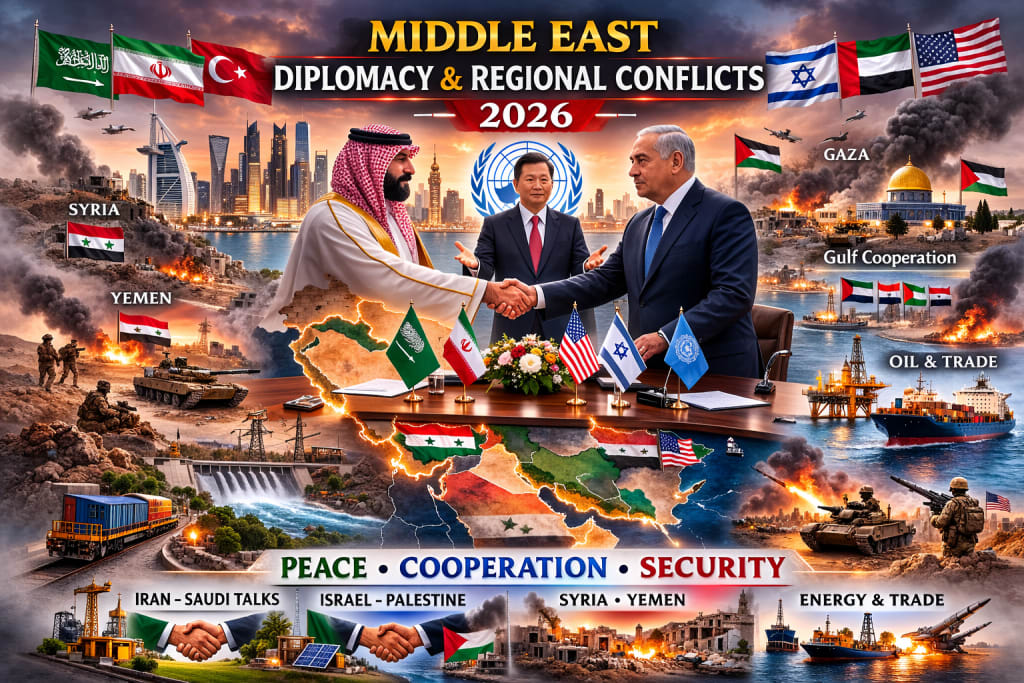
1. Current Geopolitical Landscape
The Middle East encompasses nations with diverse political systems, religious affiliations, and economic priorities. As of 2026, key issues shaping the region include:
• Iran–Saudi Arabia rivalry: Competing for influence across the Gulf and the wider Islamic world.
• Israel–Palestine tensions: Ongoing disputes over territory and sovereignty, despite periodic peace negotiations.
• Syria and Yemen conflicts: Persistent civil wars causing humanitarian crises.
• Regional alliances: Shifts in power, including Turkey, UAE, and Qatar playing pivotal diplomatic roles.
The convergence of these dynamics makes coordinated diplomatic initiatives essential for regional stability.
SEO Keywords: Middle East diplomacy 2026, Middle East conflicts, Gulf political tensions
________________________________________
2. Diplomatic Initiatives in the Middle East
A. Iran–Saudi Dialogue
One of the most significant developments is the ongoing dialogue between Iran and Saudi Arabia, mediated by neutral actors such as Oman and China. Recent rounds of talks aim to:
• Reduce proxy conflicts in Yemen and Syria.
• Establish joint economic and trade agreements.
• Promote regional security cooperation, including maritime safety in the Persian Gulf.
These initiatives have garnered global attention as a potential turning point for Gulf diplomacy.
SEO Keywords: Iran Saudi Arabia talks 2026, Gulf diplomacy, Middle East peace efforts
________________________________________
B. Israel–Arab Normalization
The Abraham Accords, initiated in 2020, continue to evolve in 2026. Israel has deepened relations with UAE, Bahrain, and Morocco, while ongoing discussions involve other Arab nations:
• Expanding economic partnerships and technological exchange.
• Promoting joint security frameworks to counter regional threats.
• Facilitating cultural and educational collaborations.
This trend represents a gradual transformation of traditional regional alliances.
SEO Keywords: Israel Arab peace 2026, Abraham Accords updates, Middle East normalization
________________________________________
C. Syria and Yemen Peace Efforts
Civil wars in Syria and Yemen remain unresolved but have seen recent diplomatic progress:
• Syria: Ceasefire agreements monitored by the UN and Russia, with talks of reconstruction aid.
• Yemen: Negotiations between the Saudi-led coalition and Houthi rebels aim to secure humanitarian corridors and eventual political settlements.
Humanitarian efforts are a key component of diplomacy, ensuring that peace initiatives address civilian needs.
SEO Keywords: Syria peace talks 2026, Yemen conflict resolution, UN Middle East diplomacy
________________________________________
3. Proxy Conflicts and Regional Tensions
While diplomacy makes progress, proxy conflicts persist:
• Iranian-backed groups in Iraq and Lebanon continue to exert influence.
• Saudi and Emirati involvement in Yemen has stabilized some areas but intensified conflict in others.
• Turkey’s regional ambitions influence northern Syria and parts of Iraq.
These dynamics create a complex web of local, regional, and international actors whose interests sometimes clash, complicating the peace process.
SEO Keywords: Middle East proxy conflicts, Iran influence Middle East, Yemen war 2026
________________________________________
4. Global Involvement in Middle East Diplomacy
External powers play a significant role in regional diplomacy:
• United States: Maintains military presence and mediates in Gulf security and Israel-Palestine negotiations.
• Russia: Influences Syria and engages in multilateral negotiations for reconstruction and ceasefires.
• China: Expanding economic and diplomatic footprint, particularly in Gulf trade and infrastructure projects.
• European Union: Supports peace processes, humanitarian aid, and regional stability initiatives.
The interplay between local and international actors defines the success or failure of diplomatic efforts.
SEO Keywords: Middle East international diplomacy, US Russia China Middle East, Gulf conflict mediation
________________________________________
5. Humanitarian Concerns and Development Initiatives
Conflict zones in the Middle East have created millions of refugees and internally displaced people. Diplomatic initiatives often include humanitarian measures to:
• Secure safe corridors for civilians.
• Provide food, medical care, and shelter.
• Promote long-term reconstruction and development.
Recent examples include UN-led programs in Syria, Yemen, and Lebanon, supported by international donors and regional powers.
SEO Keywords: Middle East humanitarian crisis 2026, refugee aid Middle East, UN development initiatives
________________________________________
6. Energy and Economic Dimensions
Middle East diplomacy is closely tied to energy security and economic cooperation:
• Oil and natural gas exports remain critical for global energy markets.
• Regional conflicts can disrupt supply chains, influencing global oil prices.
• Diplomatic agreements increasingly include economic partnerships, trade corridors, and investment in renewable energy.
The nexus of diplomacy, economics, and energy underscores the strategic importance of Middle East peace initiatives.
SEO Keywords: Middle East energy diplomacy, Gulf oil market 2026, regional economic cooperation
________________________________________
7. Emerging Challenges for 2026
Despite progress, challenges remain:
• Sectarian tensions and historical grievances may undermine peace efforts.
• Political instability in fragile states can reverse diplomatic gains.
• External geopolitical rivalries may exacerbate regional conflicts, particularly involving U.S., Russia, and China.
Navigating these challenges requires coordinated, multi-layered diplomacy.
SEO Keywords: Middle East challenges 2026, regional security risks, conflict resolution Middle East
________________________________________
8. Opportunities for Sustainable Peace
Opportunities for long-term stability in the Middle East include:
1. Multilateral cooperation: Inclusive diplomacy that engages all relevant actors.
2. Economic integration: Shared infrastructure, trade, and investment projects.
3. Humanitarian focus: Addressing civilian needs to build trust and social resilience.
4. Conflict resolution frameworks: Establishing enforceable agreements and monitoring mechanisms.
Sustainable peace is achievable if regional and international actors maintain commitment and strategic patience.
SEO Keywords: Middle East peace initiatives, sustainable diplomacy Middle East, regional cooperation 2026
________________________________________
9. The Global Impact of Middle East Diplomacy
Middle East conflicts and diplomacy have far-reaching global consequences:
• Stability affects global energy markets and commodity prices.
• Refugee flows influence Europe and neighboring regions.
• Military conflicts can trigger broader international tensions, particularly in multipolar power dynamics.
The international community continues to monitor the region, recognizing that Middle East diplomacy is central to global security and economic stability.
SEO Keywords: Middle East global impact 2026, regional stability international consequences, diplomacy worldwide effect
________________________________________
Conclusion
In 2026, the Middle East remains a region of both conflict and opportunity. Diplomatic initiatives are advancing slowly but steadily, addressing long-standing disputes while navigating complex regional and international dynamics.
Success in these initiatives depends on:
• Strong international support.
• Engagement of all regional stakeholders.
• Integration of economic, humanitarian, and security measures.
For the world, the stakes are high: peace in the Middle East contributes to global security, economic stability, and regional development, making 2026 a critical year for diplomatic breakthroughs.
Meta Description :
"Explore Middle East diplomatic initiatives and ongoing conflicts in 2026. Learn about peace efforts, regional tensions, humanitarian challenges, and global implications."
About the Creator
Keep reading
More stories from shahkar jalal and writers in Education and other communities.
How Meteorites Differ from Meteors: Understanding Space Rocks Before and After They Hit Earth
The Simple Difference: Stage of the Journey The easiest way to understand the difference is this: • Meteoroid – A small rocky or metallic object traveling through space.
By shahkar jalal2 days ago in Education
Ramadan Mubarak – A Month of Mercy, Forgiveness, and Spiritual Transformation
Ramadan is not just a month in the Islamic calendar — it is a divine season of mercy, forgiveness, and spiritual elevation. It is the month in which Allah Almighty revealed the Noble Qur’an as guidance for humanity, a criterion between truth and falsehood, and a light for those who seek righteousness.
By M Irfan Zafar6 days ago in Education
The Protection-of-Innocence Reciprocity Doctrine
Core Moral Premise The highest duty of any legitimate social order is the protection of innocent life. Innocent life has absolute moral primacy. Any system that systematically insulates predators, tolerates predatory asymmetry, rewards hypocrisy, or allows aggressors to retain insulation has inverted its purpose and forfeited legitimacy. Truth, justice, reciprocity, humility, mercy, forgiveness, and vertical accountability are structural necessities rather than optional virtues. Vertical accountability means recognition of and submission to a moral law higher than oneself. Authority must flow toward those who most consistently demonstrate sustained competence in moral and epistemic discipline. This competence is shown through observable conduct and trajectory over time, not through doctrinal label, tribal identity, credential alone, or self-profession.
By Peter Thwing - Host of the FST Podcast5 days ago in Education
Boundless
A geographical map could take you there. To the places I've been, to the sights I've seen, to the landscapes I've climbed. But no compass could point you in the direction of my memories. To the experiences I've lived, to the happiness I've felt, to the wonder I've held so close to my heart.
By Alyssa Musso3 days ago in Writers



Comments
There are no comments for this story
Be the first to respond and start the conversation.