
2026 AI Revolution: Personal Tech and Smart Growth
The Shift from Generative Tools to Deeply Personal AI Ecosystems

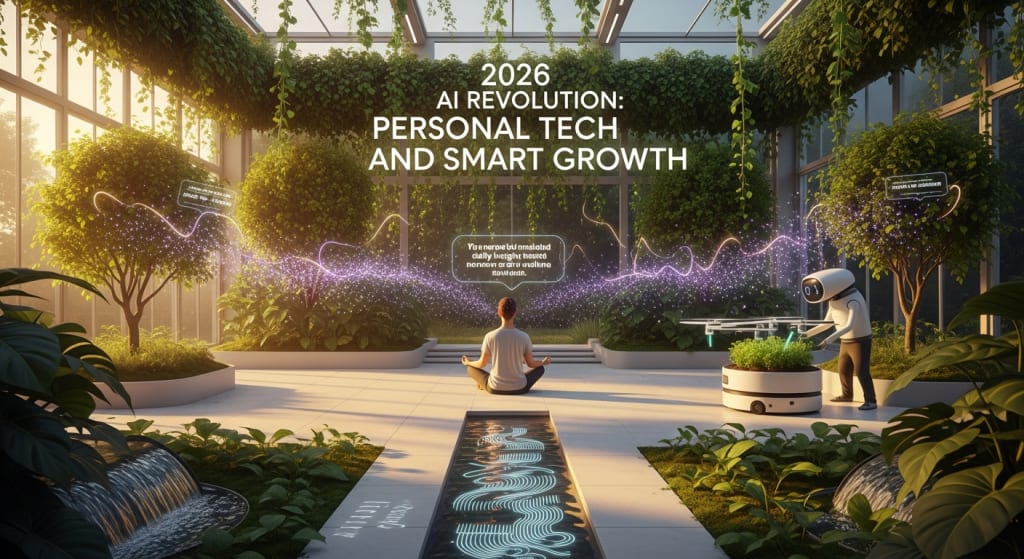
The AI revolution in 2026 is no longer about simple chat interfaces. It is not about generic image generation either. We have entered the era of Deeply Personal Technologies. AI has transitioned from a tool you use. It is now an ecosystem. This system understands your specific context. It knows your preferences. It learns your professional workflows over time. This shift represents a fundamental change. Founders and developers now interact with digital systems differently. The focus has pivoted toward high-agency autonomous agents. These agents do more than just summarize data. They execute complex operations. They manage multi-step tasks with minimal oversight. This evolution is the primary driver of growth this year.
The Problem of Context Fragmentation
Until recently, AI had a primary limitation. It lacked a persistent memory. It did not have personal context. In 2024 and 2025, users had a common problem. They had to repeat instructions often. They had to re-upload the same documents many times. This created a problem called "context fragmentation." This led to a productivity ceiling. Managers spent more time teaching the AI. They spent less time actually doing work. This meant AI remained just a helpful assistant. It was not a strategic partner. There was a gap between private data and public models. This gap hindered true deep integration for technical teams. For example, a developer might explain a bug twice. The AI would forget the first explanation. This waste of time is now a thing of the past.
The Agentic Framework for 2026
Organizations are now adopting the "Agentic Framework." This model moves away from single-prompt interactions. It moves toward persistent loops. These loops are autonomous.
- Autonomous Reasoning: Systems can now break down a large goal. One goal might be to launch a local campaign. The AI identifies the sub-tasks itself. It does this without human intervention. It creates a logical map of steps first. Then it executes them one by one.
- Privacy-First Integration: Local LLMs now run on-device. They can also run in private clouds. Proprietary business logic stays inside your secure perimeter. Your data never leaves your control.
- Multimodal Execution: Tools process video, audio, and text at once. They provide one cohesive output. An AI can record a technical meeting. Then it generates real-time documentation from the video.
High-Impact AI Tools for Strategic Growth
Mainstream tools like ChatGPT and Claude are still evolving. However, specialized platforms are now the best-in-class choices. They offer higher precision for professional work.
Lesser-Known but Elite Tools:
- Cursor (AI Code Editor): This is better than basic plugins. Cursor deeply indexes your entire codebase. Developers ask complex questions about logic flows. It searches across hundreds of files in seconds. It understands how one change affects the whole system.
- Perplexity Pages: This tool is for marketers and researchers. It transforms raw search data into reports. The reports are ready for publication. They include cited and verified sources. This avoids the "hallucination" issues of other models.
- Descript Underlord: This tool is for creative teams. It automates the tedious parts of video production. It removes filler words like "um" automatically. It can even correct eye contact in videos. It generates social clips based on engagement patterns.
These tools help localized teams succeed. For example, teams in mobile app development Minnesota use them. Small teams can now produce enterprise-level output. They automate code maintenance. They also automate content localization.
Step-by-Step Blueprint for Implementation
A personal AI workflow requires a structured approach. Follow these steps to build your system.
- Audit Your Data Silos: Find where your valuable context lives. It might be in Slack or Notion. It might be in Jira. Use secure API connectors to bridge these sources. Feed this data into your agentic tools.
- Define Agency Levels: Assign specific roles to your AI agents. Some agents should be "observers." They only provide insights and data. Other agents are "executors." You give them authority to push code. You let them send emails to clients.
- Pilot Local Models: Deploy an instance of a local model. Llama 3 is a good choice for this. Use it for your most sensitive tasks. This tests the balance of speed and security.
- Iterate and Refine: AI in 2026 needs feedback loops. You must fine-tune the system regularly. Spend 15 minutes each week training your agent. Teach it your specific stylistic preferences.
Risks and Tradeoffs
Advanced technology brings new risks to the table. The most significant risk is "Model Drift." An AI’s performance can degrade over time. This happens when it over-fits to one user. It stops seeing the broader context. There is also a "Privacy-Convenience Tradeoff." More personal AI needs more of your data. This increases the impact of any security breach. Organizations must use "Human-in-the-Loop" (HITL) protocols. Humans should review every high-stakes decision. This helps to catch algorithmic blind spots early.
Conclusion and Key Takeaways
The 2026 AI revolution is about autonomy. It is also about deep personalization. Success no longer goes to the best prompt writers. Success goes to those who build agent systems. Use high-precision tools that few people know. Integrate them into a private environment. This environment must be rich with context. This allows for efficiency that was once impossible. It was only a theory 24 months ago.
Key Takeaways:
- Context is King: AI value is tied to your business data. The more it knows, the better it works.
- Shift to Agents: Move away from one-off prompts. Use persistent agents for multi-step tasks.
- Security First: Use local or private cloud deployments. Do this for all proprietary data.
About the Creator
Keep reading
More stories from Del Rosario and writers in Futurism and other communities.
Indi IT Solutions Preparing US Businesses for Connectivity
The landscape of US business connectivity has shifted fundamentally in 2026. High-speed and low-latency infrastructure is no longer just a luxury. It is not only for Silicon Valley startups anymore. It is now the baseline for survival in every single sector. This includes everything from logistics to the retail industry. 5G-Advanced (5G-A) is reaching critical mass across American metro areas. 5G-A provides much better speed and network capacity than original 5G. The gap between businesses is now widening very quickly. Some businesses can leverage real-time data effectively. Others are stuck in slow and legacy data cycles. This is a baseline for survival in the modern economy.
By Del Rosario4 days ago in 01
Baby Food and Infant Formula Market Outlook: Nutrition Trends and Growth Opportunities
Rising awareness of infant nutrition, increasing working parent populations, and growing demand for convenient, fortified baby food are driving growth in the baby food and infant formula market. According to IMARC Group's latest research publication, The global baby food and infant formula market size reached USD 53.73 Billion in 2024. Looking forward, IMARC Group expects the market to reach USD 84.06 Billion by 2033 exhibiting a growth rate (CAGR) of 4.58% during 2025-2033
By James Whitman8 days ago in Futurism
Silicon of the South: 7 Atlanta App Agencies Changing the Tech Landscape
I remember walking through Tech Square a few years ago and feeling a quiet hum that I couldn't quite place. It wasn't just the usual city noise. It was the sound of a place beginning to realize its own potential. For a long time, Atlanta was known for big soda, big airlines, and big logistics. But lately, when I sit in a coffee shop in Midtown, the conversations around me have changed. People aren't just talking about moving goods; they’re talking about moving data.
By Mary L. Rodriquez4 days ago in Futurism
Writing About Writing: The Rainbow Trap
The good thing about living in modern times is that LGBTQ representation in media is increasing. Not just in niche and Independant media, either, but also in mainstream media. Books, movies, TV shows, comics... they're finally catching on that LGBTQ+ people form a significant part of their audience, and deserve to see themselves on screen and in fiction, not just as victims in documentaries and true crime shows.
By Natasja Rose5 days ago in Writers



Comments
There are no comments for this story
Be the first to respond and start the conversation.