
Amazfit T-Rex 3 Pro Review: A Rugged Outdoor Smartwatch With Offline Navigation
Bright AMOLED, strong endurance, and serious navigation tools make it compelling for hikers and athletes — but missing ECG/BP and a paywalled feature layer may be deal-breakers.

What Happened (Facts)
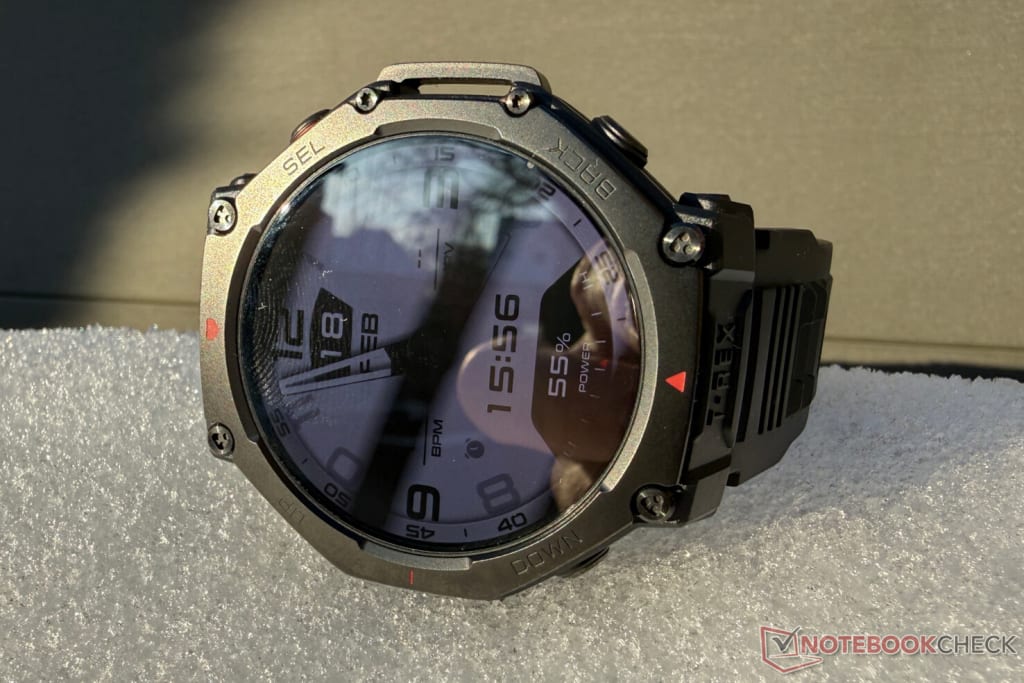
The Amazfit T-Rex 3 Pro is positioned as a rugged smartwatch for outdoor and fitness-heavy users, and in testing it stood out for durability, display brightness, navigation features, and battery life.
Build, sizes, and durability
The watch comes in two sizes: 48mm and 44mm. The tested unit was the 48mm model, which is described as bulky at roughly 15mm thickness.
The case uses fiber-reinforced plastic, while the bezel and buttons are grade 5 titanium. Bands are silicone with quick-release (22mm strap for 48mm, 20mm for 44mm).
It is rated 10 ATM water resistance and claimed suitable for diving depths up to 45 meters.
Temperature tolerance is claimed down to -40°C, with a low-temperature mode intended to keep key software features working at -30°C.
Screen and visibility
The 48mm model has a 1.5-inch AMOLED at 480×480 (322 ppi), protected by sapphire glass.
The manufacturer claims 3,000 nits peak brightness; testing measured around 2,650 nits in the center, still strong for outdoor visibility.
A notable downside: PWM flicker at 60Hz was detected, which can cause eye strain for sensitive users over long sessions.
Controls and software
The watch runs Zepp OS 5 and uses a combination of touchscreen plus four physical buttons (including customizable shortcut behavior).
Setup uses the Zepp app (Android/iOS), pairing via QR code. The app allows configuration of health tracking, notifications, watch faces, and installs extra apps via an app store.
The review notes a small selection in the app store and that some functions are behind a paid subscription (for example, certain AI sleep-related features via the Aura subscription).
Health and fitness tracking
The watch offers broad activity coverage with 160+ sports modes, plus common health monitoring: heart rate, blood oxygen (SpO2), stress, sleep, and skin temperature.
It does not include ECG or blood pressure measurement.
Heart rate accuracy was compared with a Polar chest strap reference. Resting values matched closely; mid-range heart rate showed some deviation (up to ~10 bpm lower at times), with an overall deviation reported around 2.6%.
SpO2 readings were compared with a pulse oximeter and tended to read slightly higher, with deviation around 2.8%, described as acceptable given the difficulty of wrist-based measurements.
Sleep tracking includes stages, sleep score, breathing rate, and heart rate variability during sleep, with more detailed analysis in the app.
Navigation, GPS, and offline maps
A key highlight is offline navigation. Positioning uses six satellite systems, and GPS lock times were reported as quick with generally strong accuracy.
Offline maps support features such as POI search, contour lines, and ski resort maps, plus route display on-wrist.
Flashlight and extras
The T-Rex 3 Pro includes a built-in LED flashlight with multiple brightness levels, red light, and an SOS signal—useful for close-range visibility at night.
Battery and charging
The 48mm model includes a 700mAh battery, with a manufacturer claim of up to 25 days. The 44mm uses 500mAh, with a claim of up to 17 days.
In test conditions (regular health tracking and modest usage), the 48mm lasted around two weeks with only occasional sports tracking without GPS; with heavier outdoor/GPS activity, battery life was expected to drop but still remain around a week in typical use.
Charging is via a magnetic adapter, reaching nearly 50% in ~30 minutes, and 0–100% in under 90 minutes.
Price and value
MSRP is listed as $399.99 for either size, available in multiple color options.
The review’s conclusion: it’s a strong rugged pick for outdoor users, but lacks premium medical features (ECG/BP) offered by higher-priced competitors.
What Is Analysis (Interpretation)
1) The “outdoor watch” identity is real — not just styling
Many rugged smartwatches look tough but don’t meaningfully improve outdoor utility. Here, the combination of offline maps + multi-satellite GNSS + contour maps + a flashlight pushes the T-Rex 3 Pro into a category closer to “adventure tool” than “fitness band with a bulky case.” If you hike, trail run, ski, or spend time off-grid, offline navigation is a genuine differentiator, especially when paired with a bright screen you can read in harsh light.
2) Battery life is the silent competitive advantage
Mainstream smartwatches often trade endurance for features and ecosystem depth. The T-Rex 3 Pro’s ability to run roughly two weeks under typical settings (in the 48mm model) is a lifestyle shift: fewer charging interruptions and more confidence on multi-day trips. For outdoor users, this matters as much as raw sports modes. The tradeoff is size — the most impressive endurance is tied to the larger case.
3) The health feature ceiling may limit mainstream appeal
For many buyers, “premium smartwatch” now implies ECG and sometimes blood pressure. Amazfit’s omission of both means this watch is less suited for users whose priority is advanced cardiac metrics or medical-adjacent monitoring. In other words: it competes on outdoor practicality and endurance, not on “clinical-style” features.
4) Two caution flags: PWM flicker and subscriptions
The 60Hz PWM finding is a meaningful caveat. A display can be bright and sharp yet still cause discomfort for some users. Anyone sensitive to flicker should take this seriously.
Separately, paywalled features can create a “hidden cost” feeling: the hardware is priced like a premium device, but some attractive extras live behind subscription tiers, and the app ecosystem is described as limited.
5) Best-fit buyer profile
The T-Rex 3 Pro looks strongest for:
Outdoor and endurance athletes who want offline navigation and long runtime
Users who prefer physical buttons for sweaty/gloved conditions
People who want rugged hardware without paying ultra-premium flagship watch prices
It’s weaker for:
Buyers who want a deep third-party app ecosystem
Anyone prioritizing ECG/BP or the most advanced health diagnostics
Users highly sensitive to screen flicker
About the Creator
Keep reading
More stories from Behind the Tech and writers in Futurism and other communities.
Galaxy S26 Ultra: Samsung’s Next Flagship Aims to Shift the Smartphone Conversation
What Happened (Facts) Samsung is expected to unveil the Galaxy S26 Ultra alongside the Galaxy S26 and S26+ at a Galaxy Unpacked event scheduled for next week, according to reporting circulating ahead of the launch. The framing around the S26 Ultra is less about chasing the biggest numbers (megapixels, brightness, raw clock speeds) and more about repositioning the phone as a stable, long-life “professional tool” that anchors Samsung’s ecosystem against rivals like Apple’s iPhone 17 Pro and Google’s Pixel 10 Pro.
By Behind the Techabout 3 hours ago in Futurism
Saudi Arabia Yogurt Market: Health Trends, Functional Dairy & Growth Outlook
Growing health awareness, a rising young population, and a clear shift toward functional dairy are reshaping what Saudi consumers put in their fridges. Yogurt has moved from a traditional staple to a mainstream wellness product, driven by Vision 2030’s nutrition agenda, booming e-commerce, and a steady stream of new brands entering the market. According to IMARC Group’s latest data, the Saudi Arabia yogurt market size reached USD 1.3 Billion in 2025. Looking forward, IMARC Group expects the market to reach USD 2.0 Billion by 2034, exhibiting a growth rate (CAGR) of 5.24% during 2026-2034.
By Faisal Al-Harbi5 days ago in Futurism
Saudi Arabia Two-Wheeler Market: EV Adoption, Urban Mobility & Last-Mile Delivery Boom
Saudi Arabia's two-wheeler market is gaining serious momentum, driven by worsening traffic congestion, the explosion of e-commerce deliveries, and government pushes to improve urban mobility. From scooters weaving through Riyadh's gridlock to motorcycles powering last-mile logistics, two-wheelers are becoming essential infrastructure across the Kingdom. According to IMARC Group's latest data, the Saudi Arabia two-wheeler market size was valued at USD 1.4 Billion in 2025. Looking forward, IMARC Group estimates the market to reach USD 2.3 Billion by 2034, exhibiting a CAGR of 5.94% from 2026-2034.
By Kishan Kumar3 days ago in Futurism



Comments
There are no comments for this story
Be the first to respond and start the conversation.