
Australia Power Market: Renewable Integration, Grid Modernization & Demand Growth
How increasing renewable energy adoption, investments in grid modernization and rising electricity demand are shaping Australia’s power market
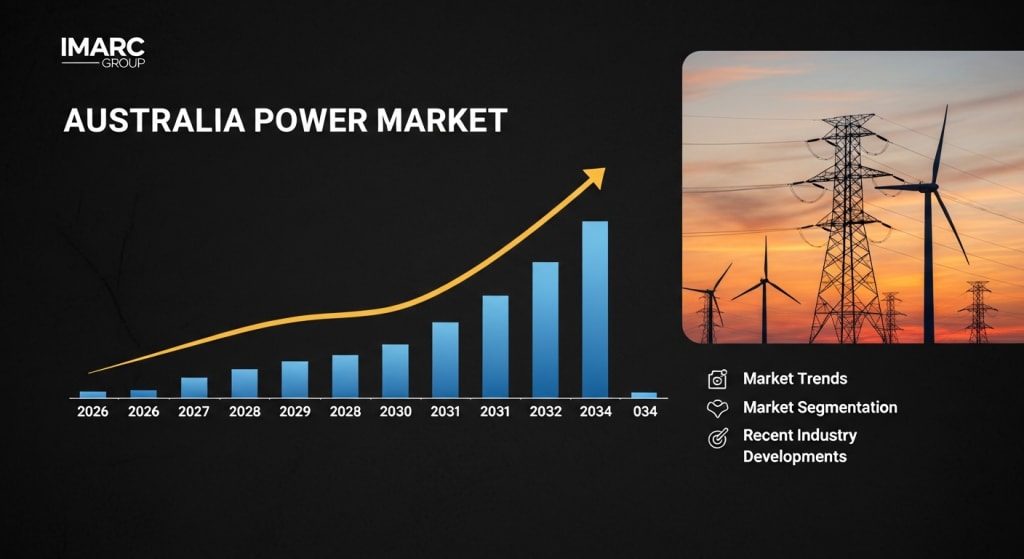
According to IMARC Group, the Australia power market reached 285.7 TWh in 2025 and is projected to expand to 377.0 TWh by 2034, exhibiting a compound annual growth rate (CAGR) of 3.04% during 2026–2034. This steady expansion reflects structural changes in electricity generation, transmission and consumption patterns across Australia. The power sector is undergoing a historic transformation as renewable energy capacity accelerates, coal-fired plants phase out and grid infrastructure modernizes. Rising electrification across transport, residential and industrial sectors is further reinforcing long-term electricity demand growth.
Why Should Smart Buyers and Investors Know About the Australia Power Market?
Stable Long-Term Demand Growth
With a projected CAGR of 3.04%, electricity demand expansion remains consistent.
Structural Energy Transition
Renewable integration ensures long-term infrastructure investment opportunities.
Policy-Backed Market Stability
Government incentives and regulatory frameworks support clean energy development.
Storage and Technology Upside
Battery and hydrogen technologies create additional growth segments.
ESG Investment Alignment
Decarbonization efforts align closely with environmental investment criteria.
Recent Trends & Developments in the Australia Power Market
July 2025:
Large-scale battery installations expanded to support renewable energy balancing.
April 2025:
Grid modernization projects accelerated in renewable energy zones.
October 2024:
Corporate power purchase agreements increased renewable generation commitments.
The Australia power market stands at the forefront of a global energy transition. Supported by IMARC’s steady growth projections, the sector is evolving through renewable integration, grid modernization and rising electrification. As coal capacity declines and clean energy technologies expand, infrastructure investment and digital innovation are redefining the national electricity landscape. From battery storage deployment to hydrogen development and virtual power plant integration, Australia’s power ecosystem is becoming increasingly flexible and technology-driven. For investors, energy providers and infrastructure stakeholders, the market offers a forward-looking opportunity grounded in decarbonization, resilience and sustained electricity demand growth within a rapidly modernizing energy system.
Australia Power Market Vision 2050
1. Renewable-Dominant Energy Mix
By 2050, renewables could account for the majority of electricity generation.
2. Fully Digitalized Grid Infrastructure
AI-powered grid optimization systems may manage distributed energy resources in real time.
3. Hydrogen Integration
Green hydrogen could complement electricity supply for heavy industry and export markets.
4. Decentralized Energy Systems
Microgrids and community-based generation models may gain prominence.
5. Carbon-Neutral Power Sector
Net-zero electricity generation could become a national benchmark.
What Are the Key Growth Drivers in the Australia Power Market?
Rapid Renewable Energy Adoption
Solar and wind energy continue to expand across Australia, supported by federal and state-level incentives. Rooftop solar penetration remains among the highest globally, while large-scale wind and solar farms are reshaping the national generation mix.
Grid Modernization Investments
Aging grid infrastructure is being upgraded to accommodate variable renewable energy sources. Advanced transmission systems, smart meters and digital monitoring technologies enhance grid reliability and efficiency.
Battery Storage Expansion
Energy storage systems are becoming central to balancing supply and demand. Utility-scale batteries and residential storage solutions improve grid stability and enable renewable integration.
Phase-Out of Coal Plants
Australia is progressively retiring coal-fired power stations, accelerating the transition toward cleaner energy sources. Replacement capacity increasingly relies on renewables, gas and storage technologies.
Rising Electricity Demand
Electric vehicle adoption, electrified industrial processes and population growth contribute to rising electricity consumption. Data centers and advanced manufacturing facilities also increase load requirements.
Corporate Sustainability Goals
Businesses are committing to net-zero emissions targets and entering long-term renewable power purchase agreements (PPAs), boosting clean energy generation.
Integration of Emerging Technologies
Virtual power plants (VPPs), hydrogen projects and AI-driven energy management systems are strengthening flexibility and innovation within the market.
About the Creator
Keep reading
More stories from Shrestha Roy and writers in Futurism and other communities.
Australia Organic Food Market: Consumer Health Focus, Sustainable Agriculture & Retail Penetration
According to IMARC Group, the Australia organic food market reached USD 1.2 Billion in 2025 and is projected to expand to USD 2.3 Billion by 2034, exhibiting a compound annual growth rate (CAGR) of 6.90% during 2026–2034. This steady growth reflects a structural shift in food consumption patterns across Australia, where consumers increasingly prioritize clean-label products, sustainable farming and transparency in sourcing. Organic food—produced without synthetic pesticides, fertilizers or genetically modified organisms—has transitioned from niche health stores into mainstream supermarket shelves. As retail access broadens and agricultural practices evolve, Australia’s organic sector is emerging as a significant component of the national food industry.
By Shrestha Royabout 8 hours ago in Futurism
GCC Data Center Market Outlook: Growth Drivers, Investment Trends & Future Opportunities
According to IMARC Group's latest research publication, GCC data center market size reached USD 1.9 Billion in 2024. The market is projected to reach USD 17.1 Billion by 2033, exhibiting a growth rate of 27.9% during 2025-2033.
By Abhay Rajputabout 8 hours ago in Futurism
Self-Care Medical Devices Market: Remote Monitoring Tools, Digital Health Integration & Market Forecast
According to IMARC Group's latest research publication, the global self-care medical devices market size reached USD 27.5 Billion in 2025. Looking forward, IMARC Group expects the market to reach USD 45.0 Billion by 2034, exhibiting a growth rate (CAGR) of 5.65% during 2026-2034.
By sujeet. imarcgroup4 days ago in Futurism
At My Wits’ End
Life is about taking out the trash and calling it trash because you have every reason to. It wasn't meant to be linear, they say. But the times you tried to make it straight led to problems, and you didn’t have the tools to put any of it to use. You don't put your right shoes on the right feet; you put the left shoes on the left feet. The grey hardened slab will trip you up anyway.
By Caitlin Charlton4 days ago in Humans




Comments
There are no comments for this story
Be the first to respond and start the conversation.