
Australia Organic Food Market: Consumer Health Focus, Sustainable Agriculture & Retail Penetration
How rising consumer health consciousness, expanding sustainable agricultural practices and growing retail penetration are shaping Australia’s organic food market
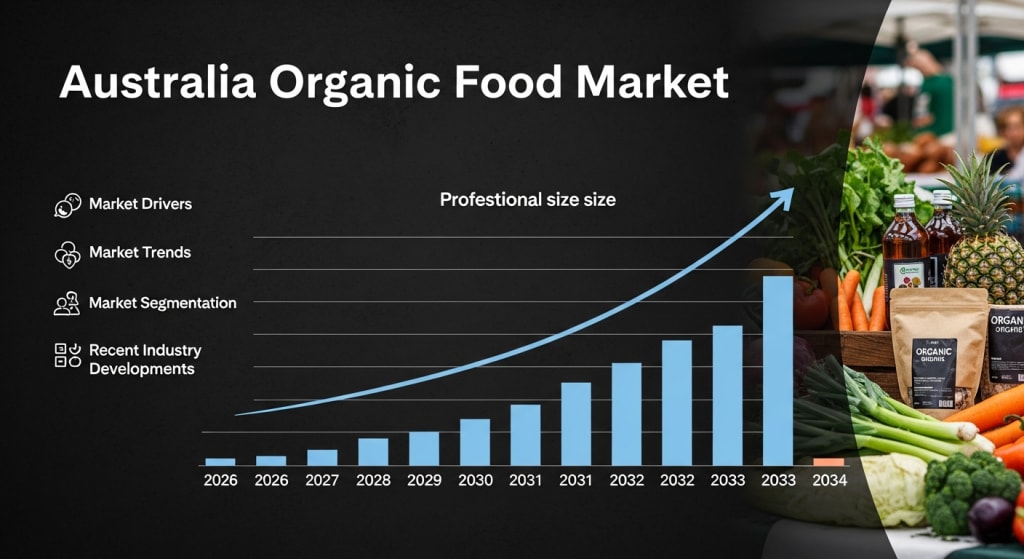
According to IMARC Group, the Australia organic food market reached USD 1.2 Billion in 2025 and is projected to expand to USD 2.3 Billion by 2034, exhibiting a compound annual growth rate (CAGR) of 6.90% during 2026–2034. This steady growth reflects a structural shift in food consumption patterns across Australia, where consumers increasingly prioritize clean-label products, sustainable farming and transparency in sourcing. Organic food—produced without synthetic pesticides, fertilizers or genetically modified organisms—has transitioned from niche health stores into mainstream supermarket shelves. As retail access broadens and agricultural practices evolve, Australia’s organic sector is emerging as a significant component of the national food industry.
Why Should Smart Buyers and Investors Know About the Australia Organic Food Market?
Steady Growth Outlook
With a projected CAGR of 6.90%, the market demonstrates consistent expansion aligned with lifestyle trends.
Strong Retail Infrastructure
Established supermarket networks ensure broad product distribution.
ESG and Sustainability Alignment
Organic production aligns with environmental and social governance priorities.
Premium Pricing Potential
Certified organic products often command higher margins.
Export Market Opportunities
Growing demand in Asia-Pacific markets enhances international trade prospects.
Recent Trends & Developments in the Australia Organic Food Market
July 2025:
Retailers expanded private-label organic product lines to improve affordability.
April 2025:
Farmers increased adoption of regenerative practices to enhance soil health and certification compliance.
October 2024:
Online grocery platforms introduced subscription-based organic produce delivery services.
The Australia organic food market represents a convergence of health awareness, environmental responsibility and retail innovation. Backed by IMARC’s solid growth projections, the sector continues to gain momentum as consumers prioritize clean-label nutrition and sustainable sourcing. Expanding retail penetration through major supermarket chains, coupled with evolving agricultural practices, is strengthening market resilience. As digital traceability tools, regenerative farming methods and export strategies mature, Australia’s organic food industry is positioned for sustained expansion. For producers, retailers and investors, the market offers a forward-looking opportunity grounded in consumer trust, environmental stewardship and long-term food system sustainability within a progressively health-conscious society.
Australia Organic Food Market Vision 2050
1. Regenerative Agriculture Integration
By 2050, regenerative farming practices may become standard within organic certification frameworks.
2. Blockchain-Enabled Traceability
Advanced supply chain tracking systems could provide real-time verification of organic sourcing.
3. Carbon-Neutral Food Production
Organic producers may adopt carbon-offset strategies to strengthen sustainability credentials.
4. Urban and Vertical Farming Expansion
Innovative urban agriculture models could enhance local organic food supply.
5. Global Export Expansion
Australia may strengthen its position as a premium organic exporter in Asia-Pacific markets.
What Are the Key Growth Drivers in the Australia Organic Food Market?
Rising Consumer Health Consciousness
Australian consumers are becoming more aware of the connection between diet and long-term health outcomes. Growing concerns about chemical residues, food additives and artificial preservatives are pushing demand for certified organic products. Families with young children and health-focused demographics are particularly driving this trend.
Expansion of Sustainable Agricultural Practices
Farmers are increasingly adopting sustainable and regenerative agricultural methods to meet organic certification standards. These practices emphasize soil health, biodiversity and reduced environmental impact. Government initiatives and industry-led programs support farmers transitioning from conventional to organic production.
Strong Retail Penetration
Organic products are now widely available in major supermarket chains such as Woolworths Group and Coles Group, making them accessible to mainstream consumers. Private-label organic brands and expanded shelf space have enhanced affordability and visibility.
Growing Product Diversification
The organic category now includes fresh produce, dairy, meat, beverages, packaged foods and baby nutrition products. Innovation in ready-to-eat organic meals and snacks further broadens appeal.
E-Commerce and Direct-to-Consumer Growth
Online grocery platforms and farm-to-consumer subscription services are facilitating direct access to organic products. Digital retail channels enhance convenience and product transparency.
Environmental Awareness and Ethical Consumption
Consumers increasingly align purchasing decisions with sustainability values. Organic farming’s lower chemical footprint and biodiversity focus resonate with environmentally conscious buyers.
About the Creator
Keep reading
More stories from Shrestha Roy and writers in Futurism and other communities.
Australia Solar Panel Recycling Market: PV Waste Growth, Regulatory Focus & Technology Innovation
According to IMARC Group, the Australia solar panel recycling market reached USD 4,013.4 Million in 2025 and is projected to expand significantly to USD 11,604.1 Million by 2034, exhibiting a compound annual growth rate (CAGR) of 12.15% during 2026–2034. This rapid growth reflects the maturing of Australia’s early photovoltaic (PV) installations and the rising urgency to manage solar waste responsibly across Australia. As large volumes of solar panels installed in the early 2000s approach the end of their 20–25 year lifespan, the country faces a new sustainability challenge: handling thousands of tonnes of end-of-life PV modules annually. Recycling solutions are emerging as a critical component of Australia’s clean energy transition.
By Shrestha Royabout 9 hours ago in Futurism
GCC Forage Market Outlook: Growth Drivers, Supply Dynamics & Demand Trends
According to IMARC Group's latest research publication, the GCC forage market size reached USD 1.9 Billion in 2025. The market is projected to reach USD 2.8 Billion by 2034, exhibiting a growth rate of 4.50% during 2026-2034.
By Abhay Rajputabout 5 hours ago in Futurism
Germany Cybersecurity Market Outlook 2025–2033: Rising Digital Threats Drive Strong Growth
The Germany cybersecurity market reached USD 13.60 Billion in 2024 and is expected to expand to USD 37.90 Billion by 2033, growing at a compound annual growth rate (CAGR) of 10.80% during 2025–2033, according to IMARC Group.
By Akshay Kumarabout 6 hours ago in Futurism



Comments
There are no comments for this story
Be the first to respond and start the conversation.