
Australia’s Particle Board Market: Construction Activity, Furniture Demand & Sustainable Materials
How growing construction activity, rising demand for furniture products and increasing focus on sustainable materials are shaping Australia’s particle board market

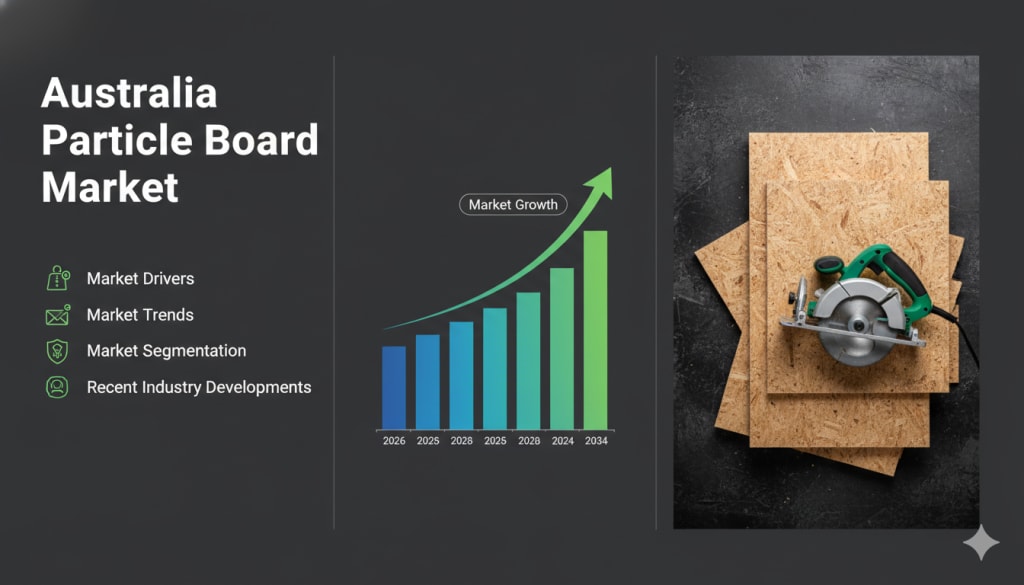
According to IMARC Group, the Australia particle board market reached USD 491.7 Million in 2025 and is projected to expand to USD 648.6 Million by 2034, exhibiting a compound annual growth rate (CAGR) of 3.03% during 2026–2034. This steady growth reflects increasing utilization of engineered wood products across residential construction, furniture manufacturing and renovation activities in Australia. Particle board—manufactured from wood chips, sawmill shavings and synthetic resins—offers cost-effective, lightweight and versatile solutions for interior applications. As sustainability and affordability become central to building and furnishing decisions, particle board continues to maintain relevance in Australia’s evolving construction materials landscape.
Why Should Smart Buyers and Investors Know About the Australia Particle Board Market?
Stable Long-Term Growth
With a projected CAGR of 3.03%, the market offers predictable expansion aligned with housing activity.
Cost-Effective Material Demand
Affordable furnishing solutions ensure consistent baseline consumption.
Sustainability Alignment
Recycled raw materials and emission reduction initiatives enhance long-term viability.
Diverse Application Portfolio
Usage spans residential, commercial and renovation sectors.
Infrastructure-Linked Stability
Housing development and remodeling cycles provide demand continuity.
Recent Trends & Developments in the Australia Particle Board Market
July 2025:
Manufacturers introduced moisture-resistant particle board panels targeting kitchen and bathroom applications.
April 2025:
Furniture brands expanded modular collections utilizing laminated particle board components.
October 2024:
Government sustainability programs encouraged adoption of recycled wood-based construction materials.
Australia Particle Board Market Vision 2050
1. Fully Recycled Raw Material Utilization
By 2050, particle board production may rely predominantly on recycled wood waste streams.
2. Enhanced Low-Emission Standards
Ultra-low VOC and formaldehyde-free boards could become standard industry offerings.
3. Smart Manufacturing and Automation
AI-driven production systems may optimize material use and minimize waste.
4. Improved Structural Performance
Advanced resin technologies may increase durability and load-bearing capacity.
5. Circular Construction Integration
Particle board may play a central role in closed-loop building material systems.
What Are the Key Growth Drivers in the Australia Particle Board Market?
Rising Residential Construction
Ongoing housing development and urban expansion are primary contributors to particle board demand. The material is widely used in flooring underlays, wall panels, cabinetry and interior partitions due to its affordability and ease of installation.
Growing Demand for Cost-Effective Furniture
Particle board plays a central role in manufacturing ready-to-assemble and modular furniture. With consumers seeking budget-friendly furnishings for apartments and suburban homes, demand remains steady across retail and online distribution channels.
Expansion of Renovation and Remodeling Activities
Home improvement projects, particularly in urban centers, are driving material consumption. Particle board’s lightweight properties and compatibility with laminates and veneers make it a practical choice for refurbishment and interior redesign.
Government Emphasis on Sustainable Materials
Public policy encouraging sustainable construction materials is positively influencing the market. Particle board made from recycled wood residues reduces waste and supports circular economy principles. Manufacturers are increasingly adopting low-formaldehyde resins to comply with environmental standards.
Technological Advancements in Manufacturing
Improved pressing techniques and adhesive formulations have enhanced particle board strength, moisture resistance and surface finish. These improvements expand its application range while maintaining cost competitiveness.
Affordability and Supply Chain Efficiency
Compared to solid wood and certain other engineered panels, particle board offers an economical alternative with reliable supply availability. Its widespread production capacity supports consistent demand from large-scale projects.
About the Creator
Kevin Cooper
Hi, I'm Kavin Cooper — a tech enthusiast who loves exploring the latest innovations, gadgets, and trends. Passionate about technology and always curious to learn and share insights with the world!
Keep reading
More stories from Kevin Cooper and writers in Futurism and other communities.
Australia Medium Density Fiberboard Market: Construction Demand, Furniture Production & Sustainability Practices
According to IMARC Group, the Australia medium density fiberboard (MDF) market reached USD 576.8 Million in 2025 and is projected to expand to USD 923.5 Million by 2034, exhibiting a compound annual growth rate (CAGR) of 5.21% during 2026–2034. This steady growth reflects increasing demand from construction, interior design and furniture manufacturing sectors across Australia. MDF, an engineered wood product made from wood fibers bonded with resins under heat and pressure, offers uniform density, smooth surfaces and cost efficiency. As urbanization accelerates and sustainability becomes central to building practices, MDF is emerging as a preferred material in residential and commercial applications.
By Kevin Cooperabout 10 hours ago in Futurism
Stanislav Kondrashov Oligarch Series: Oligarchy as the Framework of a Post-Stellar Civilisation
When you picture a civilisation that has moved beyond its home planet and settled across distant star systems, you probably imagine advanced spacecraft, artificial habitats, and technology that feels almost mythical. What you might not picture is the structure of leadership behind it all.
By Stanislav Kondrashov2 days ago in Futurism
Stanislav Kondrashov Oligarch Series: Oligarchy and the Evolution of Intelligence Beyond Humanity
You’ve been told oligarchy is a flaw in the system. A distortion. A concentration of influence that shouldn’t exist. But what if that explanation is too shallow?
By Stanislav Kondrashov2 days ago in Futurism



Comments
There are no comments for this story
Be the first to respond and start the conversation.