
Linear Alkylbenzene (LAB) Market Analysis: FMCG Consumption, Pricing Trends & Forecast to 2033
Analyzing the impact of FMCG consumption growth, urban hygiene awareness, and evolving cleaning product formulations on LAB demand across household and industrial applications.

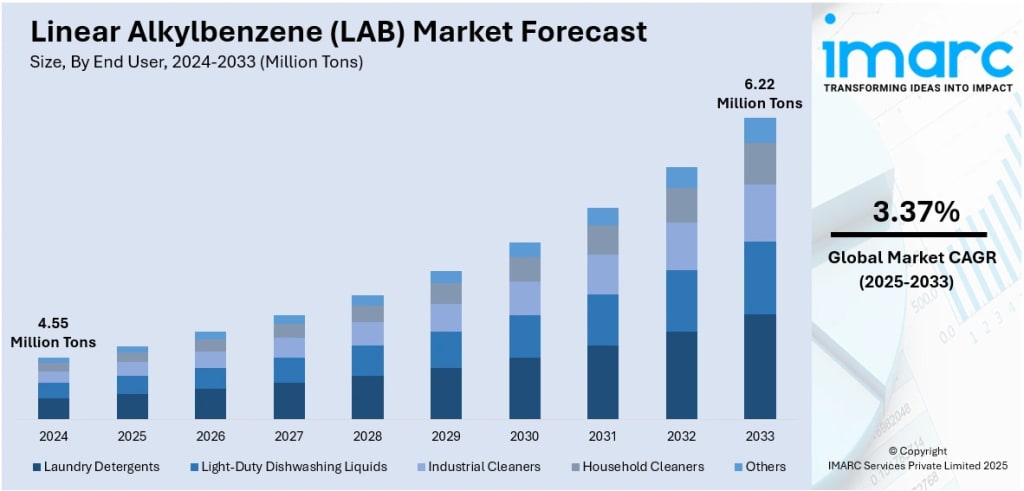
Rising hygiene awareness, expanding industrial applications, and a global shift toward biodegradable surfactants are fueling demand for Linear Alkylbenzene (LAB), supported by regulatory tailwinds, production technology advancements, and broadening end-use industries. According to IMARC Group’s latest data, The global linear alkylbenzene (LAB) market size was valued at 4.55 Million Tons in 2024. Looking forward, IMARC Group estimates the market to reach 6.22 Million Tons by 2033, exhibiting a CAGR of 3.37% from 2025-2033.
LAB is a cornerstone raw material in the global detergent and surfactant industry, widely used to produce linear alkylbenzene sulfonate (LAS) — a key ingredient in household cleaners, laundry detergents, dishwashing liquids, and industrial cleaning agents. The LAS segment led the application landscape with a 76.3% market share, underpinned by its superior foaming performance, stain removal capability, and biodegradability. Laundry detergents lead the end-user segment, driven by rising consumer expectations for high-performance and eco-friendly formulations. Major production hubs in China and India benefit from cost-efficient manufacturing, while markets in North America and Europe are shaped by stringent environmental compliance and premiumization trends.
Linear Alkylbenzene (LAB) Market Growth Drivers:
- Rising Demand from Cleaning and Hygiene Products
LAB sits at the heart of the global detergent industry, serving as the primary raw material for linear alkylbenzene sulfonate (LAS) — a surfactant found in everything from laundry detergents to dishwashing liquids. Post-pandemic hygiene awareness has kept cleaning product consumption elevated, particularly in emerging economies where rising disposable incomes are driving household spending. The US Department of Commerce estimates that 80% of dual-income households will rely on professional cleaning services, directly expanding LAB demand. With urbanization accelerating across Asia and Latin America, the need for reliable, high-performance LAB-based formulations continues to grow.
- Expanding Industrial and Multi-Sector Applications
Beyond household use, LAB plays a critical role in industrial sectors through linear alkylbenzene sulfonic acid (LBSA), used as an emulsifier and wetting agent in textiles, pesticides, and polymerization processes. The global textile chemicals sector was valued at USD 26.8 billion, providing a substantial and stable demand channel for LAB derivatives. Heavy LAB (HLAB) is also gaining traction in heat transfer fluids, refrigeration lubricants, and metalworking applications. These diversified end-uses mean LAB demand isn’t tied to a single sector — making the market notably resilient against cyclical downturns in any one industry.
- Regulatory Push for Biodegradable Surfactant Solutions
Environmental regulations across the US, Europe, and Asia are pushing formulators toward biodegradable surfactant alternatives — and LAB fits that requirement well. The European Commission’s Clean Industrial Deal has committed over €100 billion to support eco-friendly manufacturing, creating fertile ground for LAB-based solutions that meet biodegradability requirements. India’s green chemicals market is projected to hit USD 109.3 billion, growing at over 12% annually, signaling massive regional appetite for sustainable inputs like LAB. As chemical manufacturers face tighter emissions standards, LAB’s comparatively lower environmental footprint continues to strengthen its regulatory and commercial position.
Linear Alkylbenzene (LAB) Market Trends:
- Low-Carbon and Sustainable LAB Innovation
Manufacturers are actively rethinking how LAB is produced. In October 2024, Cepsa Química launched NextLab-R Low Carbon — the industry’s first LAB product achieving a negative carbon footprint from cradle to gate, using renewable raw materials to cut detergent carbon footprints by 30%. Global production capacity for chemicals derived from next-generation feedstocks is projected to reach over 11 million tons by 2035. These advancements signal a clear shift from conventional petrochemical production toward circular, lower-impact processes that align with tightening sustainability mandates across consumer goods markets worldwide.
- Major Capacity Expansions to Meet Rising Global Demand
The scale of investment flowing into LAB production reflects growing confidence in long-term demand. Indian Oil Corporation (IOC) announced a INR 24,000 crore investment at its Gujarat Refinery, including an upgrade of its LAB unit from 120 KPTA to 162 KPTA — a 35% capacity increase. Galaxy Surfactants also entered a strategic EPC collaboration to build a new overseas plant focused on performance surfactants, including LABSA. These aren’t isolated moves; they represent a broader industry pattern of producers scaling up ahead of projected demand growth in detergents, personal care, and industrial cleaning segments.
- Retail Expansion and Emerging Markets Driving LAB Consumption
As digital retail and organized modern trade expand across Asia-Pacific, Latin America, and the Middle East, demand for packaged detergents and personal care products is climbing steadily. Saudi Arabia’s laundry detergent market reached USD 493.8 million, while Brazil’s institutional and industrial cleaning chemical segment hit USD 2.2 billion — clear indicators of how structured retail growth translates directly into LAB consumption. Seven Eleven’s launch of compact detergents for smaller households in 2025 illustrates how retail innovation is creating new LAB demand segments, well beyond the traditional bulk household market.
Recent News and Developments in the Linear Alkylbenzene (LAB) Market
- May 2025: Pilot Chemical Company partnered with Novvi LLC to introduce CalCare AOS, a biobased alpha olefin sulfonate surfactant, to the North American market. This sustainable alternative to LAB-derived surfactants aims to meet growing demand for eco-friendly cleaning and personal care products without compromising on performance, leveraging Novvi’s renewable feedstock technology alongside Pilot’s sulfonation expertise.
- May 2025: Seven Eleven introduced compact detergents designed for one- to two-person households, tapping into demand for convenience and sustainability. These formulations utilize LAB as a key ingredient in biodegradable surfactants, ensuring effective cleaning while minimizing environmental impact — a move reflective of a broader retail-driven industry shift toward smaller, eco-smarter product formats.
- April 2025: Indian Oil Corporation (IOC) announced a INR 24,000 crore investment at its Gujarat Refinery, including a significant upgrade to its LAB unit that will expand capacity from 120 KPTA to 162 KPTA. This move positions IOC to better serve rising LAB demand across India’s fast-growing detergent and cleaning product industries, which are expanding rapidly alongside rising consumer spending.
Note: If you require specific details, data, or insights that are not currently included in the scope of this report, we are happy to accommodate your request. As part of our customization service, we will gather and provide the additional information you need, tailored to your specific requirements. Please let us know your exact needs, and we will ensure the report is updated accordingly to meet your expectations.
About the Creator
Andrew Sullivan
Hello, I’m Andrew Sullivan. I have over 9+ years of experience as a market research specialist.
Keep reading
More stories from Andrew Sullivan and writers in Futurism and other communities.
Electric Vehicle Market Analysis: Fast-Charging Networks, Consumer Demand & Industry Outlook to 2033
Tightening emission regulations, breakthroughs in battery technology, and a clear shift in consumer preferences are all converging to make electric vehicles one of the fastest-growing segments in the global automotive industry. According to IMARC Group's latest data, the global electric vehicle market size was valued at USD 755 Billion in 2024. Looking forward, IMARC Group estimates the market to reach USD 4,360 Billion by 2033, exhibiting a CAGR of 21.5% from 2025–2033.
By Andrew Sullivana day ago in Futurism
Your Phone Just Became Smarter Than Your Real Estate Agent
You're standing outside a house you saw on Zillow. Before you even call your agent, your phone buzzes: "This property is overpriced by $47,000 based on recent sales. Would you like to see comparable listings?"
By Navghan Modhwadia 3 days ago in Futurism
Australia Pallet Market: Logistics Demand, Sustainability Trends & Technology Adoption
According to IMARC Group, the Australia pallet market reached USD 1,373.4 Million in 2025 and is projected to expand to USD 1,953.0 Million by 2034, exhibiting a compound annual growth rate (CAGR) of 3.87% during 2026–2034. This steady growth reflects structural expansion in logistics, warehousing and export-driven industries across Australia. Pallets—essential load-bearing platforms used for transporting and storing goods—form the backbone of supply chain operations. As e-commerce accelerates, infrastructure projects expand and sustainability priorities intensify, Australia’s pallet market is evolving through material innovation, pooling systems and digital tracking technologies.
By Shrestha Royabout 15 hours ago in Futurism


Comments
There are no comments for this story
Be the first to respond and start the conversation.