science
Topics and developments in science and medicine, presented by Futurism.
How Solar Winds Are Reshaping the Surface of Mercury
Mercury, the innermost planet of our Solar System, is often described as a silent, lifeless world — a scorched sphere of rock orbiting perilously close to the Sun. For a long time, scientists assumed that its surface was largely static, shaped mainly by ancient volcanic activity and impacts billions of years ago. Recent space missions, however, have revealed a far more dynamic reality. Mercury’s surface is constantly changing, sculpted by one of the most powerful and relentless forces in the Solar System: the solar wind.
By Holianyk Ihor14 days ago in Futurism
Exploring New Frontiers: Innovative Methods to Find Exoplanets Around Red Dwarfs
In the quest to understand our place in the universe, one of the most exciting frontiers is the search for planets beyond our solar system. Among the most promising targets are red dwarf stars, also known as M-dwarfs.
By Holianyk Ihor15 days ago in Futurism
The Mystery of Fast Radio Bursts (FRBs): What We Know Now
Since the first discovery of Fast Radio Bursts (FRBs) in 2007, these brief, intense flashes of radio waves have become one of the most captivating mysteries in modern astrophysics. With their incredible brightness, extremely short duration, and unknown origins, FRBs have fascinated both professional astronomers and the general public. Despite significant progress in observations and theory, many questions about their nature remain unanswered.
By Holianyk Ihor15 days ago in Futurism
The "Robot in the Room": Will AI Actually Take Our Jobs?
We’ve all seen the headlines. One day it’s a report from a global bank predicting that 300 million jobs are "exposed" to automation. The next, it’s a viral video of a humanoid robot making a latte or a chatbot writing a legal brief in six seconds.
By George Evan17 days ago in Futurism
The Linearity Crisis
When David Deutsch proposed his self-consistency condition for particles traversing closed timelike curves, he created more than a solution to temporal paradoxes. He exposed a fundamental crisis at the intersection of quantum mechanics and general relativity. The problem is simple to state but shocking in its implications: his model requires quantum evolution to become non-linear, violating one of the most sacred principles in physics.
By Abigail Goldwater17 days ago in Futurism
Satellites show that ice loss at Earth's poles is gradually getting worse.
Polar ice sheets do not suddenly break or collapse, according to satellite data. They slip most of the time, slowly and unrelentingly. Massive rivers of ice flow towards the sea every day from the centres of Antarctica and Greenland. The amount of ice that ends up in the ocean and the rate at which sea levels rise are determined by this motion.
By Francis Dami21 days ago in Futurism
Contrary to popular perception, far-side observations show that Earth's moon is not "dead."
For a long time, the moon appeared to be a world that had completed its major transformations before becoming silent. Although there are still scars on its surface from heavy impacts and past lava floods, many experts have viewed such features as remnants of a far older era.
By Francis Dami21 days ago in Futurism
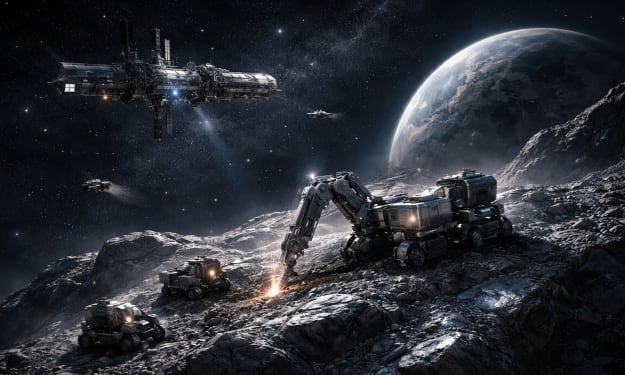
New Plans for Resource Extraction Beyond Earth
For most of human history, the idea of mining resources beyond Earth belonged firmly to the realm of science fiction. Asteroids rich in precious metals, lunar factories producing rocket fuel, and self-sufficient colonies extracting materials from alien soil were staples of futuristic novels rather than serious policy discussions. Today, however, this vision is rapidly transforming into a concrete strategy supported by governments, private companies, and long-term economic planning. Humanity is approaching the dawn of an off-world resource economy—one that could fundamentally reshape our relationship with space and with Earth itself.
By Holianyk Ihor22 days ago in Futurism
Why New Telescope Data Is Once Again Questioning the Age of the Universe
For decades, the age of the Universe seemed like a settled question. According to the standard cosmological model, known as Lambda-CDM, the Universe is approximately 13.8 billion years old. This number appears in textbooks, documentaries, and scientific papers as a near-cosmic constant — stable, precise, and well supported by observations.
By Holianyk Ihor22 days ago in Futurism
The Era of Agentic AI
For the past three years, we’ve been smitten with "prompt engineering." We’ve interacted with AI as we would an oracle in an "answer cave": we came before its text box, articulated a question thoughtfully, and then waited for an answer. However, as we find ourselves in 2026, so is the passing of the era of "static prompts." We are now in the "Age of Agentic AI."
By Artical Media22 days ago in Futurism