science
Topics and developments in science and medicine, presented by Futurism.
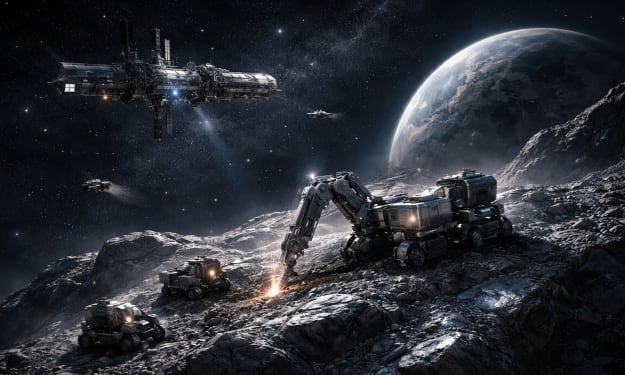
New Plans for Resource Extraction Beyond Earth
For most of human history, the idea of mining resources beyond Earth belonged firmly to the realm of science fiction. Asteroids rich in precious metals, lunar factories producing rocket fuel, and self-sufficient colonies extracting materials from alien soil were staples of futuristic novels rather than serious policy discussions. Today, however, this vision is rapidly transforming into a concrete strategy supported by governments, private companies, and long-term economic planning. Humanity is approaching the dawn of an off-world resource economy—one that could fundamentally reshape our relationship with space and with Earth itself.
By Holianyk Ihor23 days ago in Futurism
Why New Telescope Data Is Once Again Questioning the Age of the Universe
For decades, the age of the Universe seemed like a settled question. According to the standard cosmological model, known as Lambda-CDM, the Universe is approximately 13.8 billion years old. This number appears in textbooks, documentaries, and scientific papers as a near-cosmic constant — stable, precise, and well supported by observations.
By Holianyk Ihor23 days ago in Futurism
The Era of Agentic AI
For the past three years, we’ve been smitten with "prompt engineering." We’ve interacted with AI as we would an oracle in an "answer cave": we came before its text box, articulated a question thoughtfully, and then waited for an answer. However, as we find ourselves in 2026, so is the passing of the era of "static prompts." We are now in the "Age of Agentic AI."
By Artical Media24 days ago in Futurism
Hubble Captures Stunning New Images, Including the Largest Known Planet-Forming Disk
More than three decades after its launch, the Hubble Space Telescope continues to deliver discoveries that reshape our understanding of the Universe. Despite the arrival of newer observatories, Hubble remains a cornerstone of modern astronomy, offering a unique view of cosmic phenomena in visible and ultraviolet light. Its latest series of observations has once again demonstrated its scientific power, revealing breathtaking images of one of the largest known protoplanetary disks ever observed, along with dramatic evidence of collisions in young planetary systems.
By Holianyk Ihor28 days ago in Futurism
Will Earth Remain the Center of Civilization?
For all of recorded history, Earth has been more than just a planet. It has been the unquestioned center of human civilization — the birthplace of culture, science, politics, and technology. Every empire, every revolution, every scientific breakthrough has unfolded on this single world. Yet for the first time, this central role is no longer guaranteed. As humanity takes its first serious steps into space, a profound question emerges: will Earth remain the center of civilization, or is it destined to become just one node in a much larger human network?
By Holianyk Ihor28 days ago in Futurism
Who Controls Earth’s Orbit?
At first glance, Earth’s orbit seems like a lawless void — a vast, silent expanse where no one truly holds power. Space is often imagined as infinite and free, untouched by politics or borders. Yet in reality, the space surrounding our planet has become one of the most crowded, strategic, and contested environments of the modern world. The question “Who controls Earth’s orbit?” is no longer philosophical. It is political, technological, economic, and increasingly existential.
By Holianyk Ihor29 days ago in Futurism
Starship: A Breakthrough or an Overhyped Project?
Few space projects in modern history have sparked as much debate as Starship, the ambitious launch system being developed by SpaceX. To its supporters, Starship represents nothing less than a revolution — a machine that could make humanity a multi-planetary species and dramatically lower the cost of spaceflight. To critics, it is an overpromised, underproven concept whose technical challenges may outweigh its potential benefits. So which is it: a genuine breakthrough or an overhyped gamble?
By Holianyk Ihor29 days ago in Futurism
Water on the Moon: Is There Enough for Permanent Human Bases?
For most of the twentieth century, the Moon was seen as a dry, lifeless world — a silent, dusty companion to Earth with no meaningful resources of its own. Early astronauts brought back rocks and soil that seemed to confirm this view. Water, the most essential ingredient for life and long-term habitation, appeared to be completely absent.
By Holianyk Ihor30 days ago in Futurism
Is There a Limit to Our Knowledge of the Universe?
From the moment early humans looked up at the night sky, the Universe has provoked questions that seem both simple and impossibly deep. What are those lights above us? How big is everything? And perhaps the most profound question of all: can we ever fully understand the Universe, or is there a fundamental limit to human knowledge?
By Holianyk Ihor30 days ago in Futurism
Mars: Once Habitable, or Just Deceptively Earth-Like?
For centuries, Mars has fascinated humanity more than any other planet in the Solar System. Its reddish surface, polar ice caps, changing seasons, and surface features reminiscent of dried riverbeds once inspired dreams of canals, civilizations, and alien life. Today, science has replaced speculation with data, yet the central question remains just as compelling: was Mars ever truly habitable—and did life actually arise there—or was it merely a planet that looked like Earth without ever crossing the threshold into life?
By Holianyk Ihorabout a month ago in Futurism
Do Unknown Types of Stars and Compact Objects Really Exist?
For more than a century, astronomers have been steadily cataloging the inhabitants of the Universe. We have mapped stellar lifecycles, classified stars by their mass and temperature, and identified the ultimate fates of stellar evolution: white dwarfs, neutron stars, and black holes. At first glance, it may seem that the cosmic inventory is complete. Yet modern astrophysics increasingly suggests that this picture might be far from finished. As observational technology improves, scientists are encountering phenomena that do not fit neatly into established categories, raising an intriguing question: could there be unknown types of stars and compact objects still waiting to be discovered?
By Holianyk Ihorabout a month ago in Futurism
Astrobiology: The Search for Life Beyond Earth
Since the time we have been on Earth, we have looked up at the stars and wondered whether we are alone in the universe. The night sky filled with stars has always left us asking ourselves if there might be life elsewhere. Ancient myths of extraterrestrial beings grew into science fiction depicting alien civilizations that challenge us to go out and learn more. Astrobiology, the science of searching for life in the universe, is taking interest to serious inquiry today by combining astronomy, biology, chemistry, and planetary science in a quest for an answer to one of humanity's most basic questions: Are we alone?
By The Chaos Cabinetabout a month ago in Futurism