space
Space: The Final Frontier. Exploring space developments and theorizing about how humans fit into the universe.
Most Exciting NASA Space Missions
NASA has kept the world on its toes. From Apollo to Chandra to Viking, and all of the space exploration in between, NASA's entire history has been step after giant step for mankind. The organization was established in 1958 by President Dwight D. Eisenhower to encourage peaceful applications in space science. Since then, NASA has led the vast majority of US space missions. Throughout these decades, NASA has launched many an exciting and revolutionary mission, from winning the space race to launching numerous unmanned missions for observational purposes. As man looks from the most exciting NASA space missions and exploration towards colonization, more and more privately held space companies are popping up to complement NASA's work. With Elon Musk's SpaceX releasing the first privately funded, liquid-propellant rocket to reach orbit and working towards enabling people to live on other planets, it seems that the future of space travel may be more privately run than governmental. However, as we move forward, it is important to look back and see how far NASA has brought us with the most exciting NASA space missions.
By Futurism Staff10 years ago in Futurism
Mystery of Quasars
Quasar! The very name evokes visions of vast power, primordial matter, the brightness of a trillion suns, mystery. In the decades since these curious objects were first identified, the mystery of quasars has broadened and deepened. Many astrophysicists think that quasars were only one type in a wide range of energetic extragalactic phenomena. A decade after their discovery, Britain's Dr. Martin J. Rees even called for a whole new classification scheme to replace the helter-skelter assortment of terms that was in use for high-powered radio sources with terms that recognize their basic similarity.
By Mark R. Chartrand III10 years ago in Futurism
Betty Hill Abduction
Among the most influential and widely known UFO incidents is the story of Barney and Betty Hill, a middle-aged New Hampshire couple who in 1961 were returning from vacation. Driving late at night through the White Mountains, the Hills encountered a UFO whose alien occupants reportedly took them on board and subjected them to a thorough medical examination. Several factors seemed to argue strongly in favor of the authenticity of the case. First, the narrative of the abduction was not consciously remembered by the Hills but was extracted by a psychiatrist using hypnosis. This fact seemed to rule out any chance of a deliberate hoax. Second, one particular piece of information (similarly retrieved from Betty Hill’s subconscious) was a "star map," which was subsequently deciphered by experts to indicate the alien ship's home solar system. Over the years, the "Barney and Betty Hill Abduction" has become accepted as a "classic" close encounter of the third kind. Since then, dozens of similar cases have been reported. A bestselling book (Interrupted Journey by John Fuller) and a made-for-TV movie (NBC's UFO Incident) have boosted the case's fame. Betty Hill (Barney died in 1969) has become a popular feature at UFO conventions nationwide.
By Futurism Staff10 years ago in Futurism
What Was the Star of Bethlehem?
It’s a scientific detective case, really, not unlike some modern UFO reports: cold clues, conflicting observers, many possible explanations, lack of data from people who should have seen what others reported, plus a need to come up with an answer. The nature of the Star of Bethlehem, or the Star of the Magi, used to come up every year around December and was the subject of planetarium shows all over the Western world. It was the case of trying to identify a historical event using available records, modern knowledge of the sky, ancient astrology, and was subjected to the errors of interpreting extinct tongues.
By Mark R. Chartrand III10 years ago in Futurism
How Can Venus Be a UFO?
A celebrated UFO report, widely publicized in the 1970s, is Jimmy Carter's sighting in Georgia, before he was governor. Hundreds of UFO writers and lecturers refer glowingly to the "Jimmy Carter UFO," though not a single one of them appears to have actually investigated the report. In light of statistics showing that 90 to 98 percent of all such instances can readily be identified as scientific phenomena (at least a quarter of these cases turn out to be bright planets), one suspects that UFO buffs are afraid that just such a solution would explain away the Carter sighting and thus deprive them of a good publicity gimmick.
By James Oberg10 years ago in Futurism
299,000 Kilometers a Second
Bill had 24 hours before his flight. He had spent the last month jettisoning his possessions to his friends and family in a process that felt a lot like a living funeral. All his books, most of his clothes, and many of the objects he had collected for years began to feel heavy on him.
By Brett Ryan Bonowicz10 years ago in Futurism
Astronaut Humor
Space, the final frontier. Mankind has explored, colonized, and dominated just about every corner of the earth. But it is not our destiny keep our feet planted merely on the dirt. In our bones we know our destiny is to float amongst the stars. While nations might bicker and squabble the best of the best struggle to make their own headway towards conquering the final frontier. Astronauts, the best and brightest men and women, are the ones who have taken it upon themselves to shoulder this cosmic burden. But just because the future of the human race and our destiny in the stars lays upon them doesn’t mean they can’t have a little fun. After some extensive research, we have found some of the funniest anecdotes from some of our favorite space missions. So as you go out gazing out at the stars and wondering in awe at the infinite possibility of the cosmos take a second and chuckle at these funny little mishaps on the road towards cosmic enlightenment.
By Isaac Shapiro10 years ago in Futurism
Space Exploration Developments by 2050, A Fictional Vision
By 2050, the concept of exploring Mars will have been the impetus that drove the world to tackle space exploration. Here, society is filled with goals of establishing permanent habitats on the Moon and Mars, and developing the resources of these and other planetary bodies. The concerted efforts to meet the challenges of space exploration might well bring about a multitude of exploratory developments. By 2050, how will our outer-world function?
By S.H. Jucha10 years ago in Futurism
Examining the Fermi Paradox
The Fermi Paradox is the apparent contradiction between the high probability of other lifeforms in the universe and humanity's lack of contact with extraterrestrial civilizations. For every grain of sand on Earth there are 10,000 stars, a vastness so immense it escapes comprehension. Humanity should not be the only intelligent life in the universe, but so far no evidence indicates otherwise. Robin Hanson is amongst pragmatic intellects who answer the paradox by amplifying the differentiation between finding life, and finding intelligent life.
By John Foley10 years ago in Futurism
Can We Live on Venus?
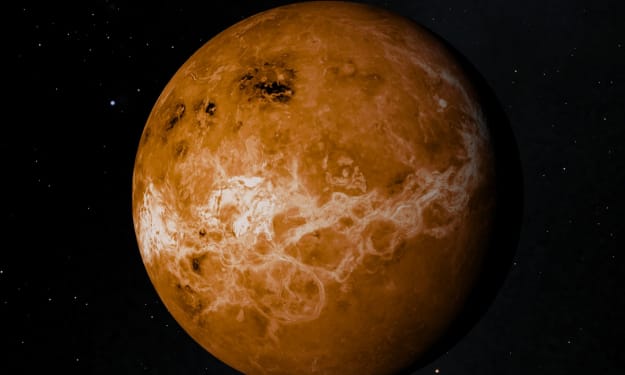
Floating cities on Venus; it sounds like something Hugo Gernsback would have published in the pulp era of science fiction, but colonizing the second planet from the sun may not be as impossible as is widely believed. Despite Dantean-like surface conditions with temperatures that can melt lead, and atmospheric pressure equal to being under 3,000 feet of water, there remains a plausible place humanity might be able to exist—not on the surface but in the atmosphere above.
By Chris Lites10 years ago in Futurism
Meteorites and Asteroids Facts
With all the unknown objects and happenings beyond our control going on in outer space, as human beings we can’t help but wonder what the chances are of extraterrestrial disasters having a significant impact on Earth. Every day, people die from the strangest things, but for some reason we’re inclined to believe that there’s a looming possibility of life ending because of space rocks. So for those curious about astronomical catastrophes affecting our beloved planet, here are a few things to note:
By Futurism Staff10 years ago in Futurism
Darkening Day
Remember when The Curtain went up? The only viable solution, extreme as it was, to save humanity from Earth's rapidly hyper-toxifying, invisibly over-saturating air. A superstructure, ten miles up, of floating chemical filters, each a sort of box-shaped balloon, converting noxious chemicals into safer ones. Billions of them, linked together into an edgeless shell spanning the entire globe.
By Breyen Katz10 years ago in Futurism