
Why Future Human Colonies May Be Built Underground
Space

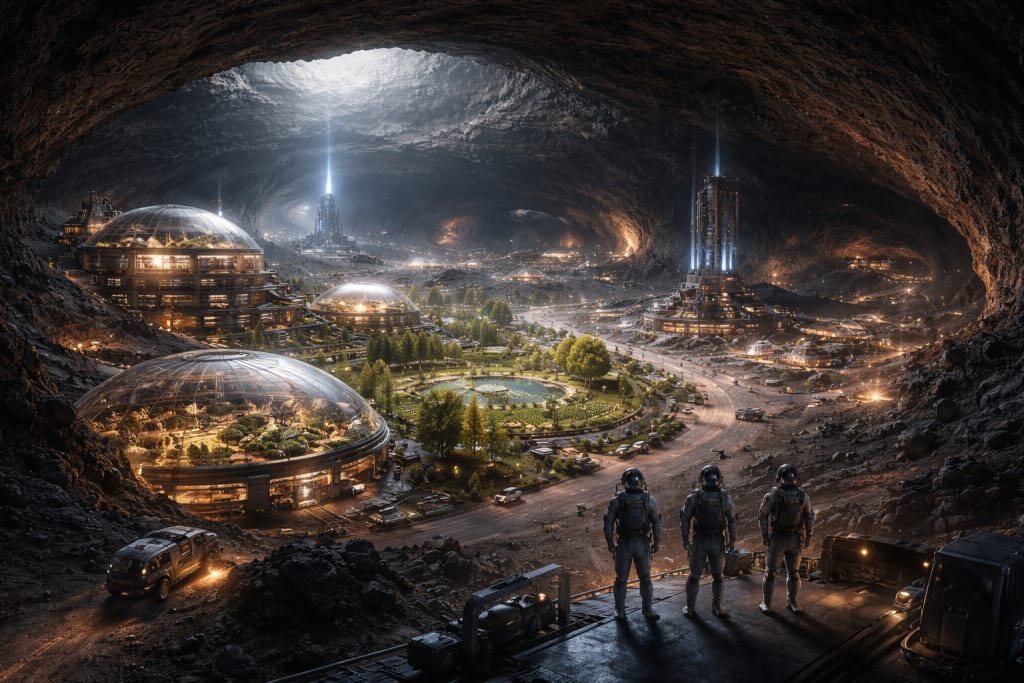
When people imagine humanity’s future beyond Earth, they often picture shining cities beneath transparent domes, towering structures on Mars, or lunar bases with panoramic views of alien landscapes. These images are inspiring—but they are also deeply optimistic. In reality, the first long-term human colonies on other worlds are far more likely to be hidden beneath the surface. Paradoxically, the safest and most practical path to becoming a spacefaring civilization may lead us underground.
This idea is not driven by pessimism, but by physics, biology, and engineering. Space is an extremely hostile environment, and underground habitats offer natural solutions to many of its most dangerous challenges.
The Hostility of Alien Surfaces
On Earth, life thrives thanks to a combination of atmosphere, magnetic field, and stable climate. Most other planetary bodies offer none of these protections. The surfaces of the Moon and Mars, for example, are exposed directly to space.
One of the greatest threats is cosmic radiation. High-energy particles from the Sun and distant galaxies constantly bombard planetary surfaces. Earth’s magnetic field and thick atmosphere block most of this radiation, but Mars lost its global magnetic field billions of years ago. As a result, radiation levels on the Martian surface are many times higher than what humans experience on Earth. Long-term exposure increases the risk of cancer, damages DNA, and affects the nervous system.
Another danger comes from micrometeorites. Tiny fragments of rock and metal travel through space at extreme speeds. Even particles no larger than grains of sand can punch through metal when moving at tens of kilometers per second. On Earth, our atmosphere burns most of them up. On airless worlds, there is no such protection.
Temperature extremes add yet another layer of difficulty. On the Moon, surface temperatures can swing from about –170°C at night to over +120°C during the day. Designing surface structures that can survive such cycles for decades is a massive technical challenge.
The Underground Advantage
Beneath the surface, conditions change dramatically. Just a few meters of soil or rock can block a large portion of harmful radiation. This makes underground habitats a form of passive shielding—no power, no moving parts, and no complex systems required.
Subsurface environments also provide excellent protection from micrometeorites and space debris. Rock does not crack under tiny impacts the way exposed structures do. In addition, underground temperatures are far more stable. While the surface may experience extreme fluctuations, the subsurface remains relatively constant, simplifying thermal control systems and reducing energy demands.
Instead of fighting the environment, underground colonies allow humans to use the planet itself as a protective shell.
Lava Tubes: Nature’s Ready-Made Shelters
One of the most promising underground options comes from geology. Lava tubes—vast tunnels formed by ancient volcanic activity—exist on both the Moon and Mars. Satellite imagery suggests that some of these structures are enormous, hundreds of meters wide and stretching for kilometers.
For future colonists, lava tubes could be a gift. They already provide thick overhead shielding, structural stability, and massive interior volumes. A single lava tube could house living quarters, research labs, hydroponic farms, storage areas, and even industrial facilities.
Instead of excavating everything from scratch, humans could seal and reinforce these natural caverns, dramatically reducing construction time and cost. In essence, entire underground cities may already exist, waiting to be adapted for life.
Psychological Life Below the Surface
At first glance, living underground may seem psychologically challenging. Humans evolved under open skies, and the absence of windows or natural horizons could feel claustrophobic.
However, research from Antarctic research stations, submarines, and long-duration isolation experiments suggests a different conclusion. Mental well-being depends less on physical views and more on a sense of safety, routine, and environmental control.
Underground colonies can be carefully designed to support mental health. Artificial lighting can mimic Earth’s day-night cycle. Interior spaces can include gardens, water features, and open communal areas. Large digital displays can simulate windows with views of Earth, stars, or imagined landscapes.
Ironically, an underground habitat may feel more comfortable and “Earth-like” than a fragile surface base constantly threatened by radiation storms and environmental hazards.
Resources, Energy, and Long-Term Survival
From a practical standpoint, underground colonies also make resource utilization easier. On Mars and the Moon, water is often found below the surface in the form of ice. Being closer to these reserves reduces the effort required for extraction.
Minerals needed for construction, manufacturing, and repairs are also located in the ground. This supports the idea of in-situ resource utilization—using local materials instead of relying on constant resupply from Earth. Such independence is essential for any colony that aims to survive long-term.
Energy systems benefit as well. Nuclear reactors, which are likely to play a major role in early colonies, require heavy shielding. Underground placement naturally provides this protection while also isolating the reactors from surface hazards like solar storms.
A Familiar Strategy in Human History
Although underground space colonies sound futuristic, the strategy itself is ancient. Throughout history, humans have built underground cities and shelters to survive harsh environments, invasions, and climate extremes. From the rock-carved cities of Cappadocia to modern bunkers and subway systems, going underground has repeatedly proven to be a reliable survival strategy.
Space is simply the most extreme environment humanity has ever faced—and it demands equally extreme solutions.
Not the End Goal, but the First Step
Underground colonies do not represent a rejection of humanity’s dreams of open cities beneath alien skies. Instead, they are a transitional phase. A way to survive, adapt, and learn.
In the distant future, advanced technologies—artificial magnetic fields, thick atmospheres, or planetary-scale engineering—may allow humans to live safely on planetary surfaces. But until then, the smartest place to begin is below ground.
The future of space civilization may not start under the stars, but beneath layers of rock and dust. And in that quiet, protected darkness, humanity may take its first truly sustainable steps into the cosmos.
About the Creator
Keep reading
More stories from Holianyk Ihor and writers in Futurism and other communities.
What Happens If a Black Hole Enters Our Solar System
The universe is full of cosmic horrors that make even the most imaginative science fiction seem tame, and black holes rank among the most terrifying. These gravitational monsters, regions of spacetime where gravity is so intense that not even light can escape, have captured human imagination for decades. But what would actually happen if one of these cosmic predators wandered into our neighborhood?
By Holianyk Ihor3 days ago in Futurism
Potting Compound Market Outlook: Material Trends and Growth Opportunities
Rising demand for protection of electronic components against moisture, vibration, heat, and chemicals is driving growth in the potting compound market. Expansion of electronics, automotive, renewable energy, and industrial equipment sectors supports adoption. According to IMARC Group's latest research publication, The global potting compound market size reached USD 3.4 Billion in 2024. Looking forward, the market is expected to reach USD 4.8 Billion by 2033, exhibiting a growth rate (CAGR) of 3.6% during 2025-2033.
By Michael Richard2 days ago in Futurism
Role of Wood Pellet Industry in Achieving Net-Zero Emission Targets
1) The Net-Zero Imperative and the Heat Problem Net-zero plans often spotlight solar panels and wind turbines, yet heat for buildings and industry remains one of the hardest sectors to decarbonize. High-temperature process heat, winter space heating, and district heating networks still rely heavily on coal, oil, and gas. Electrification will grow, but it is slow, capital-intensive, and grid-dependent. This is where solid biomass - especially densified wood pellet market offers an immediately deployable, lower-carbon pathway.
By Sonpal Singhabout an hour ago in Futurism
The Devil's Triangle
The sails ruffled in the breeze as we cruised along. The Sea Breeze was a mid-size catamaran that sailed out of Royal Naval Dockyard in Bermuda. We had booked this trip weeks in advance and were now looking at our Captain, Spike and two boat hands. Paddy and Wilson seemed like nice guys, joking around with the passengers and telling us some stories about Bermuda that only locals would know. Their island accents sounded almost British but they were pleasant to listen to.
By Barbara Gode Wilesabout 14 hours ago in Fiction


Comments
There are no comments for this story
Be the first to respond and start the conversation.