
Beyond the Phone: Portland Mobile App Development for VR and AI (2027 Look)
How the Definition of “Mobile” Is Expanding Beyond Smartphones and Reshaping App Strategy

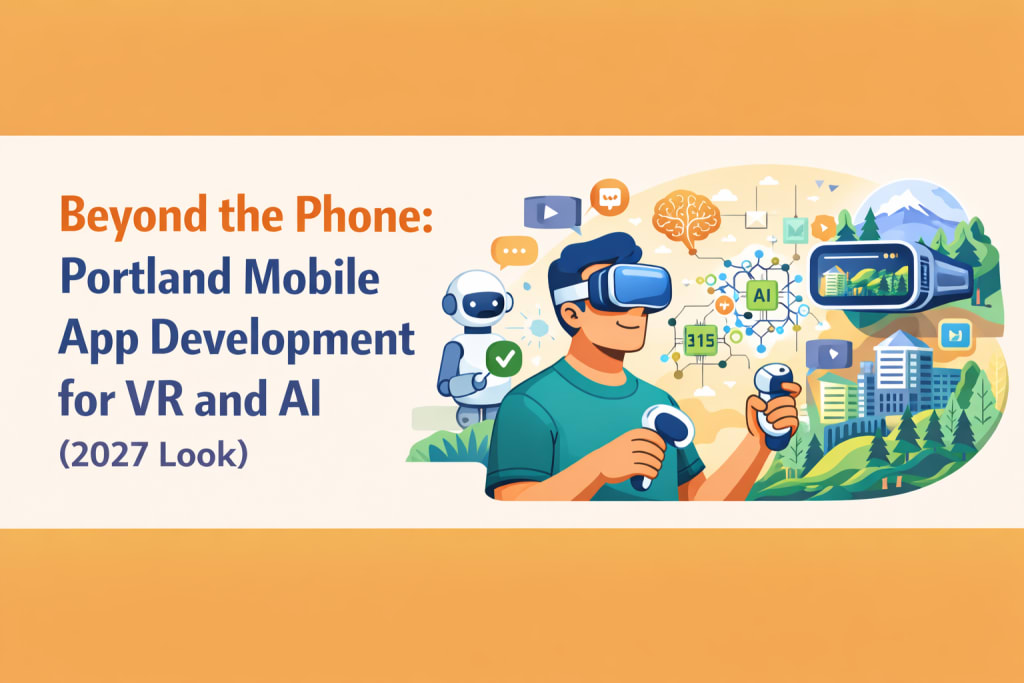
For much of the last decade, mobile development was synonymous with smartphones. Success meant optimizing for smaller screens, improving battery efficiency, and delivering seamless touch-based experiences. But by 2027, the concept of “mobile” is undergoing a transformation that challenges long-standing assumptions about platforms and user interaction.
Emerging technologies such as virtual reality (VR), augmented reality (AR), artificial intelligence (AI), and wearable computing are expanding the boundaries of what mobile experiences can be. Instead of building solely for handheld devices, developers are designing interconnected ecosystems that span headsets, voice interfaces, spatial environments, and AI-powered agents.
Industry analysts estimate that immersive technology adoption is accelerating rapidly, with global VR and AR markets projected to grow at annual rates exceeding 25–30% through the late 2020s. Meanwhile, AI integration into consumer applications has surged dramatically; surveys suggest that over 70% of new apps released in recent years incorporate some form of machine learning functionality.
These shifts signal a redefinition of mobile itself — from a device category to an experience layer that follows users across contexts.
Why VR Is Moving from Experimental Technology to Practical Development Focus
For years, VR remained on the fringe of mainstream application development, often limited to gaming or specialized enterprise training environments. Recent hardware improvements and ecosystem investments, however, are changing its trajectory.
Lighter headsets, improved visual fidelity, and more intuitive input systems have reduced barriers to adoption. Enterprise demand is also accelerating growth, particularly in industries such as healthcare simulation, remote collaboration, and architectural visualization.
Studies indicate that immersive training environments can improve knowledge retention rates by as much as 75% compared to traditional methods. Such outcomes are attracting businesses seeking measurable productivity improvements rather than novelty experiences.
Developers are now considering VR not as a standalone category but as an extension of existing mobile platforms. Spatial interfaces require different design thinking — focusing on depth, movement, and contextual awareness — but they often share backend infrastructure with traditional applications.
As one industry strategist observed, “The question is no longer whether VR will become part of everyday computing, but how quickly developers adapt their design language to three-dimensional environments.”
Artificial Intelligence as the Invisible Layer Powering Next-Generation Apps
While VR transforms user interfaces, artificial intelligence is reshaping how applications behave behind the scenes. AI is increasingly embedded as a foundational component rather than a feature add-on.
Machine learning models now drive:
- Personalized content delivery.
- Predictive user interfaces that anticipate behavior.
- Natural language interaction through voice or text.
- Automated workflows that reduce manual input.
Research suggests that AI-driven personalization can increase user engagement metrics by 20–40%, depending on implementation quality. For developers, this creates both opportunity and complexity. Designing adaptive systems requires careful consideration of data pipelines, ethical implications, and long-term scalability.
Experts often emphasize that AI’s most significant impact lies in subtle improvements rather than dramatic transformations. As one developer noted during a recent conference discussion, “The best AI experiences feel invisible — users simply notice that everything works better.”
The Convergence of VR and AI: Toward Spatial Intelligence
The intersection of immersive technology and artificial intelligence represents one of the most significant frontiers for app development. AI enables environments that respond dynamically to user behavior, while VR provides the spatial canvas for interaction.
Examples include:
- Intelligent virtual assistants embedded in immersive spaces.
- Adaptive training simulations that adjust difficulty in real time.
- AI-generated environments customized to individual preferences.
Analysts predict that spatial computing combined with AI could redefine productivity workflows by the end of the decade. Early studies indicate that collaborative virtual environments supported by AI-driven translation and context analysis can improve remote team efficiency by over 30%.
This convergence moves development beyond traditional screen-based paradigms toward experiences that blend physical and digital realities.
The Changing Skill Set Required for Developers Entering 2027
As platforms evolve, the skill profile for developers is also shifting. Building for immersive and intelligent environments requires cross-disciplinary expertise.
Key areas gaining importance include:
- Spatial UX design principles.
- Real-time rendering optimization.
- Data science and machine learning fundamentals.
- Ethical AI considerations.
- Cross-device architecture strategies.
According to industry surveys, more than 60% of development teams are investing in upskilling initiatives related to AI integration. Similarly, demand for designers familiar with three-dimensional interaction patterns is rising as immersive platforms mature.
Rather than replacing traditional skills, these emerging competencies expand the toolkit required for future-ready development.
Infrastructure Challenges: Performance, Energy, and Scalability
The evolution toward VR and AI introduces new technical challenges. Immersive environments require significant processing power, while AI workloads demand efficient data handling.
Developers must balance:
- Low latency requirements for real-time interaction.
- Battery consumption on portable devices.
- Cloud infrastructure costs.
- Data privacy considerations.
Optimization strategies increasingly focus on edge computing — processing data closer to the user to reduce latency and bandwidth usage. Some estimates suggest that edge computing adoption could reduce response times by up to 50%, enabling more responsive immersive experiences.
These infrastructure decisions shape not only performance but also sustainability and long-term operational costs.
Why Alternative Tech Ecosystems Are Influencing Innovation Directions
Innovation is no longer confined to traditional technology hubs. Emerging ecosystems are contributing unique perspectives shaped by local culture, design philosophy, and community values.
In this context, mobile app development Portland reflects a broader trend toward interdisciplinary experimentation. Developers are exploring how sustainability, creativity, and human-centered design intersect with advanced technologies like AI and VR.
Such environments encourage experimentation with new forms of interaction and ethical frameworks, potentially influencing how next-generation applications are built.
Business Implications: Rethinking Product Strategy for Immersive and Intelligent Platforms
The shift toward immersive and AI-driven experiences forces companies to reconsider product strategy. Instead of focusing solely on app downloads or screen engagement metrics, success increasingly depends on:
- Context-aware interactions.
- Continuous learning systems powered by AI.
- Multi-platform experiences that transition seamlessly between devices.
Market forecasts suggest that spatial computing could become a major revenue driver by the late 2020s, particularly in enterprise sectors. Early adoption offers opportunities for differentiation but also requires careful experimentation to avoid overinvestment in immature technologies.
Strategists often recommend incremental integration — layering AI capabilities or immersive features onto existing products rather than attempting complete reinvention.
The Ethical and Social Dimensions of Next-Generation Mobile Experiences
As technology becomes more immersive and intelligent, ethical considerations gain importance. AI systems raise questions about bias and data privacy, while VR environments introduce concerns about accessibility and psychological effects.
Responsible development involves:
- Transparent data practices.
- Inclusive design principles.
- Clear user consent mechanisms.
- Ongoing evaluation of unintended consequences.
These considerations are not merely philosophical; they influence user trust and long-term adoption rates.
Looking Ahead: The Future of Mobile as an Experience Rather Than a Device
By 2027, the term “mobile” may describe a philosophy rather than a platform. Applications will move fluidly between physical and digital contexts, guided by AI and enhanced through immersive interfaces.
The most successful developers will likely be those who view emerging technologies not as replacements for smartphones but as extensions of a broader ecosystem. VR, AI, and spatial computing represent new layers of interaction that complement existing tools rather than eliminating them.
As innovation accelerates, the boundaries between devices, environments, and intelligence continue to blur. The future of development lies not beyond the phone alone, but beyond the idea that mobile experiences must be confined to a single screen.
About the Creator
Keep reading
More stories from Mary L. Rodriquez and writers in Geeks and other communities.
How Orlando Hospitality Apps Handle Seasonal User Surges Now?
The surge didn’t catch us off guard. That was the problem. It arrived exactly when the calendar said it would—same week, same days, same hours we’d planned for. Our forecasts were conservative. Our infrastructure had headroom. On paper, we were ready.
By Mary L. Rodriquez12 days ago in Geeks
No Other Choice (2025)
It is only February, so other films may well surpass “No Other Choice”, but I think this is the best film I’ve seen so far this year. And that surprises me, because, it is a subtitled film and while I am pretentious enough to choose to watch foreign-language films, I was also very tired and that was an extra commitment from me. But more importantly, let me warn you, this film is gruesome and violent. There were times I had to turn away from the screen to avoid the worst of it (including some self-inflicted dentistry).
By Rachel Robbins3 days ago in Geeks
Wootton High School
Wootton High School stands as one of the most well-known public high schools in Montgomery County, Maryland, recognized for its strong academic culture, diverse student body, and commitment to preparing students for college and civic life. Over the years, Wootton High School has built a reputation that goes beyond test scores, reflecting the broader challenges, conversations, and responsibilities that modern schools face in the United States. Located in Rockville, Thomas S. Wootton High School serves students from a wide range of backgrounds. The school is consistently noted for offering rigorous coursework, including Advanced Placement classes, STEM-focused programs, and a wide selection of arts and humanities subjects. This balance allows students to explore personal interests while meeting high academic expectations. Faculty members are often praised for maintaining high standards while supporting students through mentorship, counseling, and extracurricular engagement. Like many large public schools, Wootton High School is not only a place for learning but also a reflection of wider social realities. Conversations around student well-being, mental health, and campus safety have become increasingly important in recent years. Across the country, schools have been prompted to reevaluate emergency preparedness and communication systems, and Wootton is no exception. Administrators and educators have worked to ensure that students and parents are informed, supported, and reassured during moments of uncertainty. Online searches sometimes surface the phrase Wootton High School shooting, which can understandably raise concern among parents, students, and community members. It is important to approach such terms carefully and responsibly. In many cases, heightened attention around school safety comes from drills, false reports, or broader national discussions about violence in schools rather than a confirmed, large-scale tragedy specific to the campus. As with any sensitive topic, relying on official statements and verified local reporting is essential to avoid spreading misinformation or unnecessary fear. The presence of such search terms also highlights a larger issue affecting schools nationwide: the emotional impact of constant exposure to news about violence. Even when incidents occur elsewhere, students can feel anxious or distracted, prompting schools to take proactive steps. Wootton High School has emphasized communication with families, counseling resources, and structured safety procedures designed to protect students while maintaining a healthy learning environment. Beyond safety discussions, Wootton High School continues to be recognized for student achievement. Graduates frequently go on to attend competitive universities, pursue careers in technology, medicine, public service, and the arts, or contribute directly to their local communities. Student clubs and organizations play a major role in shaping school culture, from debate teams and science clubs to volunteer groups and cultural associations. These activities encourage leadership, collaboration, and social awareness. Athletics are another cornerstone of life at Wootton. School teams compete at a high level within Maryland’s public school system, fostering school spirit and teamwork. Participation in sports also supports student wellness, teaching discipline and resilience that extend beyond the classroom. Coaches and administrators stress balance, reminding students that academic success and personal growth remain the top priorities. Community involvement is deeply tied to the identity of Wootton High School. Parent-teacher organizations, alumni networks, and local partnerships contribute time and resources to support programs and campus improvements. This strong connection between the school and the surrounding community helps create a shared sense of responsibility for student success and safety. When concerns arise—whether academic, social, or security-related—the community response often centers on dialogue and cooperation. In the digital age, the way information spreads can shape public perception quickly. Misspellings such as wooton high school appear frequently online, demonstrating how easily confusion can arise when searching for information. For readers seeking clarity, it is always best to refer to the school’s official communications, district announcements, or trusted local news outlets. Doing so ensures that discussions remain grounded in fact rather than speculation. Ultimately, Wootton High School represents both the strengths and challenges of contemporary public education. It is a place where academic excellence, student diversity, and community values intersect. While discussions around safety and alarming keywords can capture attention, they should not overshadow the daily reality of teaching, learning, and growth that defines the school experience. As conversations about education continue to evolve, Wootton High School remains a case study in balance—between rigor and support, awareness and reassurance, vigilance and optimism. By focusing on accurate information, open communication, and student well-being, the school and its community continue working toward an environment where students can learn confidently and thrive
By Saboor Brohi 5 days ago in Geeks




Comments
There are no comments for this story
Be the first to respond and start the conversation.