literature
Geek literature from the New York Times or the recesses of online. Our favorite stories showcase geeks.
"Castle Rackrent" by Maria Edgeworth
Within this text, a number of striking personalities can be seen. First and foremost we have the personality of the first generation guided by Sir Patrick, a man of little means and of normally few words apart from a more godly and patriarchal view in a William Faulkner fashion. Sir Patrick is declared a ‘spend-thrift’ and is often the most concerned about the view of others upon himself as a moral human being towards them. A Machiavellian trait, this is thought to have continued in the lineage of the family. Sir Murtagh is the second generation and he is described as a ‘fiend’ and often a ‘litigating fiend’. Here we see the morality of the family descend ever so slightly and so, the reader is given insight into the decline and fall of this rather extensively proud and historical family of old, Irish faith. Within the third generation the reader meets Sir Kit - a deplorable human being, a gambler, a spender and an abusive husband to his wife. Here the reader can clearly see a massive decline from what was the historical past of Sir Patrick in which the spend-thrift culture was clearly visible to all. Sir Kit seems to be overtly concerned about himself and does not care what others think of him. This is most likely a delusion of grandeur since he has come from a family that is both respected and historical and, as he is the third generation, must feel as if he is entitled to respect and is automatically virtuous for his purity of family. Finally we have the furthest generation away from the firast which is the fourth generation of Sir Condy. Sir Condy is a man that is often considered the morally better of the four, the more likeable of them all and yet, the most susceptible to suggestion out of them all. He is constantly manipulated and duped, turned and twisted. His naivety is his downfall and therefore, he too has similar faults to his predecessors - that he cannot see something approaching right in front of him and that he has very little self-control. But in the way that the older generations have no self-control because of various needs such as: saving money, fiendishness and machiavellianism, gambling addiction and spending money relentlessly - Sir Condy has no self-control because of the way in which other characters tend to want to control or overpower him.
By Annie Kapur6 years ago in Geeks
"Oedipus Rex" by Sophocles
The first time I read this book I was in sixth form, so I was about maybe sixteen or seventeen. The way in which I discovered this book was actually only because my teacher was talking about it for a brief time in a class about Shakespeare’s “Hamlet” and the Freudian Complexes of the play. I’m not going to lie, at first I was actually only interested in the Sophocles play because of the fact I hadn’t read it - but when I started reading it I was then thoroughly disgusted. I stayed up for most of the night reading and annotating my tattered second hand copy and then, when all was done, I put it down and didn’t really pick it up again purely because it was a bit too gross. The next time I’d pick it up, my opinion of Ancient Greek Plays was already fully formed and I understood that they were all absolutely disgusting.
By Annie Kapur6 years ago in Geeks
10 Books: Adventure Novels
Adventure novels are good for any occasion, normally written as children’s texts, they are perfect for going on a ride when you don’t want to leave your home. Since I was a child, I’ve always loved various adventure books no matter where they are from or what they are about - they can be as magical as ever, or they can be realist as hell. Adventure novels were most famous during the late 19th and early 20th century when children had little less to do than play with wooden toys and outside in their gardens. In order to present children with great reading material and stories that they could act out with their friends, read at bedtime and enjoy throughout the cold winters when they couldn’t go outdoors - authors penned children’s novels. Throughout the 20th century, the children’s literature grew and grew until it got a resurgence with the release of “Harry Potter and the Philosopher’s Stone” in 1996. Then, children’s literature got the kick it needed and became one of the biggest selling genres of the next twenty years. What I want to have a look at today is which novels you should be reading in order to learn more about children’s literature and where it came from. So let us go through ten big books of children’s literature. The more we know about what we read as children, the more we can know about why we read as adults.
By Annie Kapur6 years ago in Geeks
"Therese Raquin" by Emile Zola
It’s been about eight years since I’ve read this - I first read it when I was around sixteen and since then, I’ve read the book, read a graphic novel based on the book, listened to the audiobook, watched a production of it and read a ton of journals all about the way in which the book portrays Shakespearean themes. The way in which I first discovered it was because I heard about it on the radio. Yes, the radio. I don’t actually remember exactly where but I liked the pronunciation of the word and looked for it for half an hour because I couldn’t spell it. It took a while but I finally found it and read the book. It was crazy and amazing. It was almost overwhelmingly emotional and it makes you fearful and tearful at the same time. It completely changed the way I thought about gothic romances and what they could achieve. I admit, I never thought literature could be so dark and romantic since I read Anne Rice’s Vampire Chronicles Series.
By Annie Kapur6 years ago in Geeks
"The Book and the Brotherhood" by Iris Murdoch
Within this text there is a clear account of each character being tortured by three things: their identity, change and the past. The book represents the way in which the characters evolve through their understandings of themselves and the growth of each of their relationships. From the death of Gerard’s father to Tamar’s strange and aloof attitude - this book constructs character identities from their past experiences and gives the reader reason to believe that now that all is said and done, their lives are falling apart at the seams. Each and every one of them has an individual identity and yet, their identity is entirely different to what the reader believes of them after reading the book.
By Annie Kapur6 years ago in Geeks
10 Books: Existential Men
Men have constantly been the source for great soliloquies of existentialism in literature. Just thinking about some such as the speeches of Hamlet in William Shakespeare’s eponymous play, Victor Frankenstein in Mary Shelley’s magnum opus and in the works of Dostoevsky, Gogol, Victor Hugo, and many more. These books always have men who are mentally disturbed by either their own existence, are disturbed by someone else’s existence, feel either hunted, alienated from reality, treated like outsiders for some reason or have been rejected, resented or hated for reasons that are not entirely fair, but you can definitely see where the other characters are coming from.
By Annie Kapur6 years ago in Geeks
20 Books of 2020 (Pt.35)
We have finally hit 700 and I can honestly say thank you to everyone who has been joining me on this journey. Recommendations have been welcome from every corner of the globe whilst I have also been expanding my knowledge of the modern classics. I also want to thank you for joining me in my 'first impression' articles where I spend around 2'000 words on a book I've been analysing and write about what my very first impression of themes and plot were. It has been incredibly interesting this year since I've had a lot more time to read during lockdown and yet, I feel like I'm not exhausted or burnt out at all. I find that I've become more social in my reading - giving and receiving recommendations, people actually caring about what I think about books and I've made a ton of new friends.
By Annie Kapur6 years ago in Geeks
"The Red and the Black" by Stendhal
It’s been a long, long while since I read “The Red and the Black” by Stendhal. I first read it when I was sixteen and the reason I read it was because I accidentally mistook it for “The Charterhouse of Parma” by the same author. I was actually looking for “The Charterhouse of Parma” and picked up “The Red and the Black” from the shelf instead. It’s recorded in my diary as me making a strange mistake and not really looking at what I was picking up. But it proved to be an amazing book anyways and ironically, I enjoyed it far more than I enjoyed “The Charterhouse of Parma” when I got around to reading that one. My first reading experience of “The Red and the Black” was admittedly a little difficult. There was a lot of political language I needed to look up and so, I kept my dictionary at hand again. When I finished the book, I had a sense of real pride and yet, I found the book to be very satirical and actually somewhat humorous about the way political position and social hierarchy were seen in France during the time of the author himself. The book changed my opinion on French Literature forever because until then, I had only been exposed to either horrors or books like “Les Miserables” and “Notre Dame de Paris”. I had never really read anything that directly made fun of itself. It was a cool and refreshing idea of France and I thoroughly enjoyed my experience of it.
By Annie Kapur6 years ago in Geeks
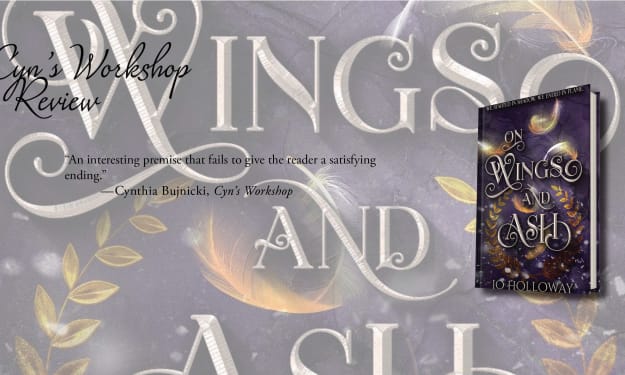
Review of 'On Wings and Ash'
Synopsis Alessa awoke the morning of the festival for Hades expecting nothing more than a night at the bonfires with her charming best friend. She never expected the rest... Not meeting the man she would end up promised to in marriage. Not the Spartan warrior or the desperate fight to save a lost princess. And certainly not the monsters who swooped down in the dark. When Alessa’s ability to communicate with them results in her taking the blame for the bloodshed, she’ll have to fight for her life. But she never imagined her future would depend on the trust of a stranger – the stranger she’s set to marry – or the strength of a long unspoken love. Before the night is over, more than just the bonfires might burn...
By Cyn's Workshop6 years ago in Geeks
The Best Works: William Faulkner
William Faulkner is one of my favourite writers in the world. From a young age, I was interested in Faulkner’s divine writing style, his southern gothic atmosphere, his Shakespearean and Biblical-scaled tragedies. Most importantly, I think I was interested in his characters the most. Faulkner’s works are known for being filled with intense darkness, destruction and the danger of humans when they are taken out of their natural environments. A satire on the heavy industrialisation of the USA during and after the times of the Civil War, Faulkner’s writing was often heaped in darkness, tragedy, well-written and almost poetically style prose along with characters that you could’ve seen coming from either a Shakespeare Play, the Bible or a 18th Century Opera. These almost Byronic heroes tend to take the Hamlet-like form and often end up worse than they began. Death overtakes in many cases and the natural world around the character is harmful, turned against them, as they move through the world and get out of their habitats, they long for release from this new, self-destructive lifestyle that brings them nothing but greed and misery.
By Annie Kapur6 years ago in Geeks
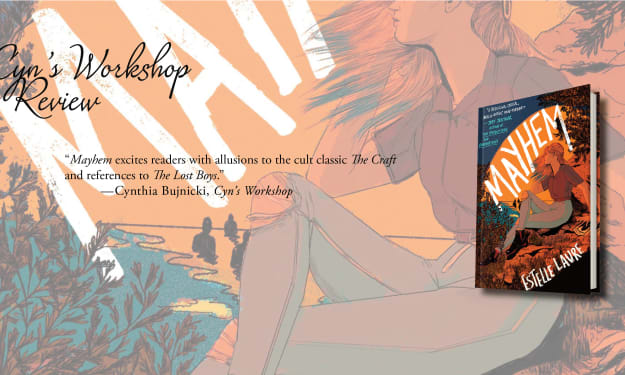
Review of 'Mayhem'
Synopsis The Lost Boys meets Wilder Girls in this supernatural feminist YA novel. It's 1987 and unfortunately it's not all Madonna and cherry lip balm. Mayhem Brayburn has always known there was something off about her and her mother, Roxy. Maybe it has to do with Roxy's constant physical pain, or maybe with Mayhem's own irresistible pull to water. Either way, she knows they aren't like everyone else. But when May's stepfather finally goes too far, Roxy and Mayhem flee to Santa Maria, California, the coastal beach town that holds the answers to all of Mayhem's questions about who her mother is, her estranged family, and the mysteries of her own self. There she meets the kids who live with her aunt, and it opens the door to the magic that runs through the female lineage in her family, the very magic Mayhem is next in line to inherit and which will change her life for good. But when she gets wrapped up in the search for the man who has been kidnapping girls from the beach, her life takes another dangerous turn and she is forced to face the price of vigilante justice and to ask herself whether revenge is worth the cost. From the acclaimed author of This Raging Light and But Then I Came Back, Estelle Laure offers a riveting and complex story with magical elements about a family of women contending with what appears to be an irreversible destiny, taking control and saying when enough is enough.
By Cyn's Workshop6 years ago in Geeks