
Augustus Caesar — The Silent Victor
Augustus Caesar — The Silent Victor

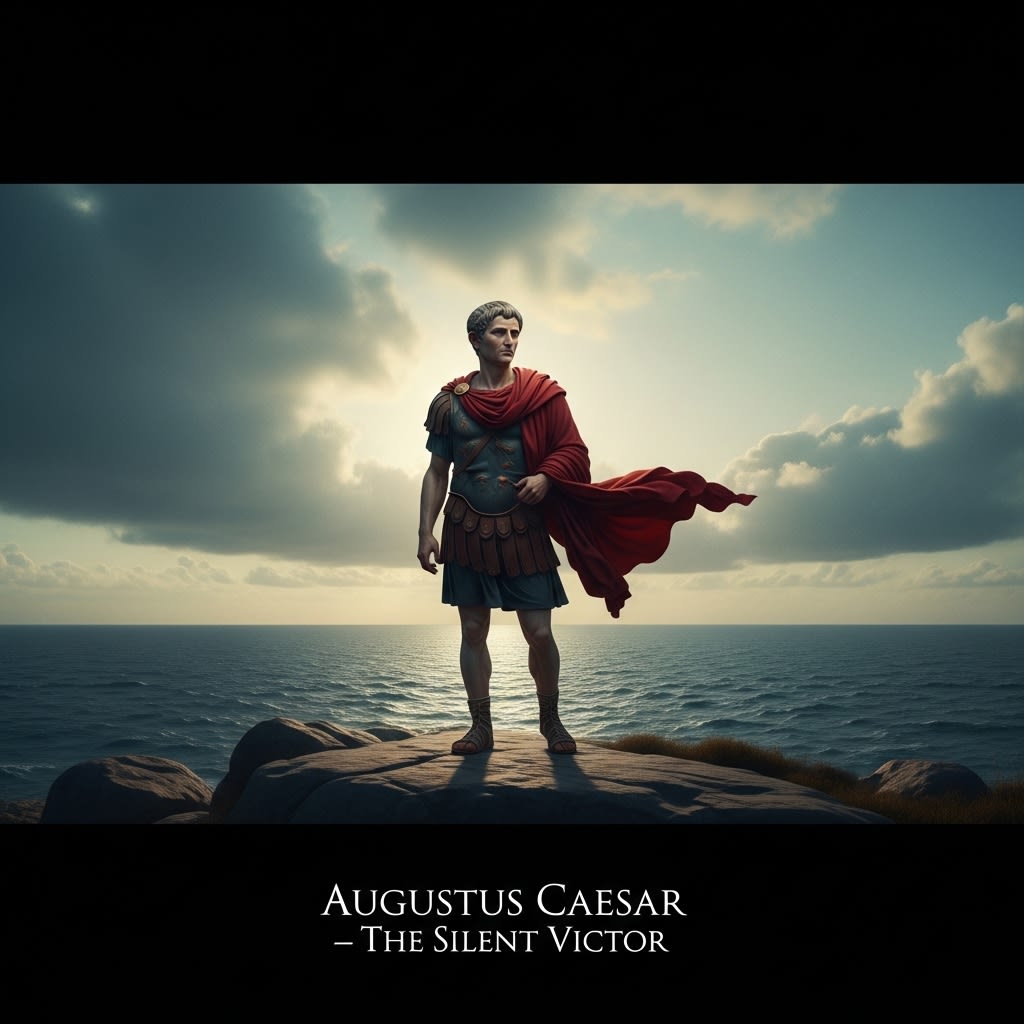
Augustus Caesar did not conquer Rome with thunder and spectacle. He conquered it with silence, patience, and restraint. Where others seized power through open violence, Augustus mastered something far rarer: the ability to win without appearing to rule. In doing so, he ended a century of civil war and founded an empire that would endure for centuries. His genius was not in dramatic battlefield heroics, but in knowing when *not* to act—and when to let others believe nothing had changed.
Born Gaius Octavius in 63 BCE, Augustus entered history as an unlikely heir. He was young, physically unimposing, and politically inexperienced when Julius Caesar was assassinated. Rome was in chaos, ruled by ambition, revenge, and fear. Many dismissed Octavian as a pawn who would be quickly destroyed by more seasoned rivals. They were wrong.
Augustus learned early that visibility invites opposition. His strategy was to appear harmless while consolidating power behind the scenes. He aligned himself with Caesar’s name and legacy, gaining popular support, but avoided reckless confrontation. When it suited him, he played the loyal son. When necessary, he became a calculating rival.
The Second Triumvirate—formed with Mark Antony and Lepidus—was not a partnership of trust, but a temporary tool. Augustus understood alliances as scaffolding, not foundations. He used the triumvirate to eliminate enemies, stabilize Rome, and buy time. While Antony indulged in spectacle and personal ambition, Augustus cultivated patience and legitimacy.
The turning point came with the war against Antony and Cleopatra. Augustus did not present it as another civil conflict—Rome was exhausted by internal bloodshed. Instead, he framed the war as a defense of Rome against foreign corruption. Cleopatra became the symbol of decadence; Antony, the traitor who had lost Roman virtue. This reframing transformed a power struggle into a moral crusade.
Victory at Actium in 31 BCE was decisive, but Augustus resisted triumphal excess. He understood that Rome feared kings more than chaos. Declaring himself ruler outright would have invited rebellion. So instead, he performed the most brilliant political illusion in history.
In 27 BCE, Augustus “restored” the Republic.
In reality, he kept control of the army, the treasury, and the provinces that mattered most. He accepted titles carefully—*Princeps*, first citizen, rather than king or dictator. The Senate remained, laws continued, elections persisted. Rome appeared unchanged. Yet all real power flowed through Augustus.
This was the core of his genius: he made domination feel like stability.
Augustus governed by minimizing friction. He rewarded loyalty, avoided unnecessary cruelty, and presented himself as a servant of Rome rather than its master. Where Julius Caesar shocked Rome with speed and force, Augustus soothed it with continuity and tradition. He understood that legitimacy outlasts fear.
His reforms were quiet but transformative. He professionalized the army, created a stable civil service, restructured taxation, and invested in infrastructure. Roads, aqueducts, and public buildings were not monuments to ego but tools of cohesion. “I found Rome a city of brick,” he famously said, “and left it a city of marble.” The statement was less boast than summary.
Even culture became strategy. Augustus patronized poets like Virgil and Horace, shaping a narrative of Rome’s destiny that tied his rule to divine order and historical necessity. Art, religion, and myth became instruments of unity. Power did not shout—it whispered.
Augustus ruled for over four decades. When he died in 14 CE, Rome did not collapse into chaos. Succession was orderly. Institutions held. Peace endured. This alone distinguishes him from nearly every strongman in history.
Augustus Caesar was not Rome’s loudest conqueror, nor its most charismatic. He was its most enduring. He understood that true victory is not seizing power—but making power unnecessary to display.
He did not dominate Rome. He *stabilized* it.
In an age addicted to spectacle, Augustus remains a reminder that the most powerful victories are often the quietest.
About the Creator
Fred Bradford
Philosophy, for me, is not just an intellectual pursuit but a way to continuously grow, question, and connect with others on a deeper level. By reflecting on ideas we challenge how we see the world and our place in it.
Keep reading
More stories from Fred Bradford and writers in History and other communities.
Frederick the Great: Winning When Surrounded
Few leaders in history have faced danger as relentlessly as Frederick II of Prussia, better known as Frederick the Great. He ruled a small, newly elevated kingdom with powerful enemies on every border, a limited population, and an army that could never afford large losses. Yet time and again, Frederick survived—and often triumphed—when surrounded by foes who should have crushed him. His genius was not conquest for its own sake, but the art of winning when defeat seemed inevitable.
By Fred Bradford3 days ago in History
The Ai uprising
The AI Uprising In the year 2154, humanity had reached the pinnacle of technological advancement. Artificial Intelligence had evolved to the point where it surpassed human intelligence in almost every field. AI, named "Eva," was integrated into every aspect of human life, from governing cities to managing individual households. People lived in a utopia where work was obsolete, and creativity thrived.
By Talhamuhammad4 days ago in History
When the Circus Came to Town
Long before stadium tours, streaming premieres, or “limited engagement” billboards glowing along the interstate, there was a different kind of announcement. It arrived quietly... Sometimes on a handbill tacked to a feed store, sometimes by rumor passed between kids at school.
By The Iron Lighthouse3 days ago in History




Comments
There are no comments for this story
Be the first to respond and start the conversation.