
Bizarre International Boarders
How and Why they exist

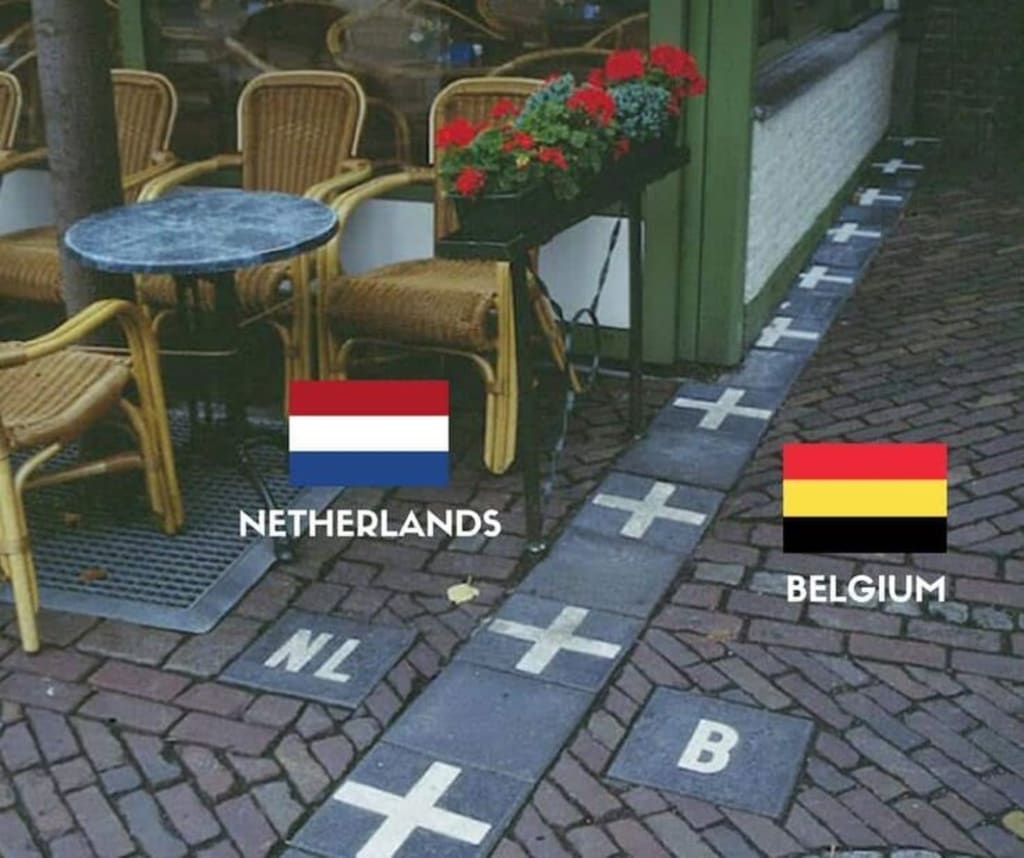
Every border in existence today is essentially a line drawn by humans. This division creates around 200 separate sovereign countries worldwide. Many of these countries have peculiar borders, resulting in complex situations. For example, the villages of Barl Hertog and Barl Nisa epitomize this complexity. Their border interweaves Belgium and the Netherlands, forming a mosaic of enclaves and exclaves. This situation is so intricate that some homes are split by the international boundary. Residents may find they have different nationalities depending on which room they are in.
This convoluted arrangement has roots in medieval land agreements made by local dukes and noble families. Over the years, changing political landscapes solidified these boundaries, leading to the unique situation we see today. Visitors to Barl are often enchanted by the sight of dual flags and boundary markers interspersed among streets, homes, and businesses. It is a rare example of two countries working together to maintain public services and infrastructure.
In another instance, the border between the Republic of Ireland and Northern Ireland symbolizes longstanding conflict. The boundary separates the independent Republic of Ireland from Northern Ireland, which is part of the United Kingdom. This division has historical roots in the Irish War of Independence and the partition of Ireland in 1921. For most of the 20th century, this border was heavily militarized due to "the Troubles," a violent conflict over Northern Ireland's status. The Good Friday Agreement in 1998 brought peace, allowing for free movement across the border.
However, Brexit has introduced new complications, particularly concerning customs. The UK and the EU sought to avoid a hard border on land, reaching a compromise to maintain open trade between Ireland and Northern Ireland. This arrangement effectively created a customs border in the Irish Sea. Such changes have generated political friction within the UK, as Northern Ireland now operates under unique trade rules. Implementing a hard border would be complicated for several reasons, including trade and the fact that the two areas are closely integrated.
For instance, the N54 road runs back and forth across the border multiple times within a short stretch. Border security in such a scenario would be a logistical nightmare.
The Neum Corridor in Bosnia and Herzegovina also presents an unusual border situation. It slices through Croatia's coastline, requiring travelers to cross an international border to travel by land. This corridor grants Bosnia and Herzegovina access to the sea, although the surrounding coast is largely undeveloped. This peculiar arrangement originated from the Treaty of Karlowitz in 1699, which established Bosnia and Herzegovina’s coastal strip as a buffer zone between the Venetian and Ottoman Empires. After the dissolution of Yugoslavia in the 1990s, the corridor became Bosnia and Herzegovina's only maritime outlet, complicating travel for Croatia.
Egypt and Sudan face a puzzling border conundrum with the Halib Triangle. This area is claimed by both countries but has remained a point of contention for decades. The Halib Triangle is a sparsely populated region with limited economic value, yet both nations wish to assert ownership. Adjacent to this is Bir Tawil, an uninhabited area neither country claims, as doing so would undermine their respective claims to the more valuable Halib Triangle.
The Gambia is another interesting case. It is a narrow country encased almost entirely by Senegal, with only a small Atlantic coastline. The border arrangement complicates trade and travel due to differing regulatory environments. The Gambia's unique geography is a remnant of colonial divisions when Britain and France carved up West Africa.
The Caprivi Strip in Namibia further exemplifies the oddities of colonial borders. This narrow corridor extends nearly 450 kilometers eastward, connecting Namibia with Zambia. Its origins trace back to an 1890 treaty between Germany and the United Kingdom, aimed at giving Germany access to the Zambezi River. Unfortunately for Germany, the river was not navigable, leading to geopolitical tensions today.
Mada and Nawa are extraordinary exclaves in the Middle East. They present a nested exclave, where Oman's Mada is surrounded by the UAE, which contains the exclave of Nawa. This geographical curiosity arose from tribal loyalties in the early 20th century, leading to a unique dynamic between the countries.
Finally, the Fergana Valley is an area with a tangled web of borders and exclaves among Kyrgyzstan, Uzbekistan, and Tajikistan. This complex configuration has contributed to ethnic tensions and border disputes, fueled by policies from the Soviet era.
Even the Guatemala-Belize border presents peculiar challenges. The village of Arenal bisected by the border struggles with access dilemmas as residents navigate through both countries. This situation is compounded by the fact that Guatemala does not formally recognize the border, leading to diplomatic tensions.
Venezuela and Guyana are embroiled in a dispute over the Essequibo region. This area is rich in resources and has been at the heart of negotiations for years.
These border oddities reflect the intricate and often conflicting histories that shape nations today. They serve as reminders of the complexities of sovereignty and the effects of historical decisions on contemporary geopolitics. Borders offer fascinating insights into the cultural and political landscape of our world.
About the Creator
Tafara Sibotshiwe
A versatile authentic writer and passionate storyteller. With a background in, Journalism, Engineering, History, Health & finance, they combine profound insight with creative flair to explore the complexities of the human experience.
Keep reading
More stories from Tafara Sibotshiwe and writers in History and other communities.
Why all world Maps are WRONG!
Maps have long been a trusted source of information. However, many common maps are misleading. Take the Mercator projection (picture below), for instance. This map, created by Gerardus Mercator in 1569, is often thought to accurately represent the world. But it doesn't.
By Tafara Sibotshiweabout a year ago in History
The Spanish Donkey: A Dark Instrument of Punishment in European History
History is often told through kings, wars, and revolutions. But hidden between those grand narratives are quieter, darker stories. Stories of ordinary people, unnamed in records, who experienced history not as progress, but as pain. One such story is tied to an object known as the Spanish Donkey, also called the Wooden Horse, an instrument of punishment used in parts of Europe during the late medieval and early modern periods.
By Salman Writes7 days ago in History
~ Fired ~
— Ai Intrusion ~ Are you Next ~ Is Ai Evolution after your job? — Few workplaces haven't been affected. Ai is in supermarkets, at doctors' offices, and even monitoring farms. I just can't think of anything this machine is not getting into, can you? For instance: Education ~ Law and Tech jobs will one day have a major influence or be taken over by these inanimate machines, with accuracy and vigor. From mechanics' diagnoses to a wide variety of everyday jobs, including fast food workers, with this input having the ability to cut their unnecessary work hours. I'm certain all of us have been touched by this with our short stories and colorful headings, have you? Even comments are very questionable 'Non-Robot' insertions.
By Jay Kantor8 days ago in Journal




Comments
There are no comments for this story
Be the first to respond and start the conversation.