
Empire in Ashes
The Final 72 Hours of the Roman Empire

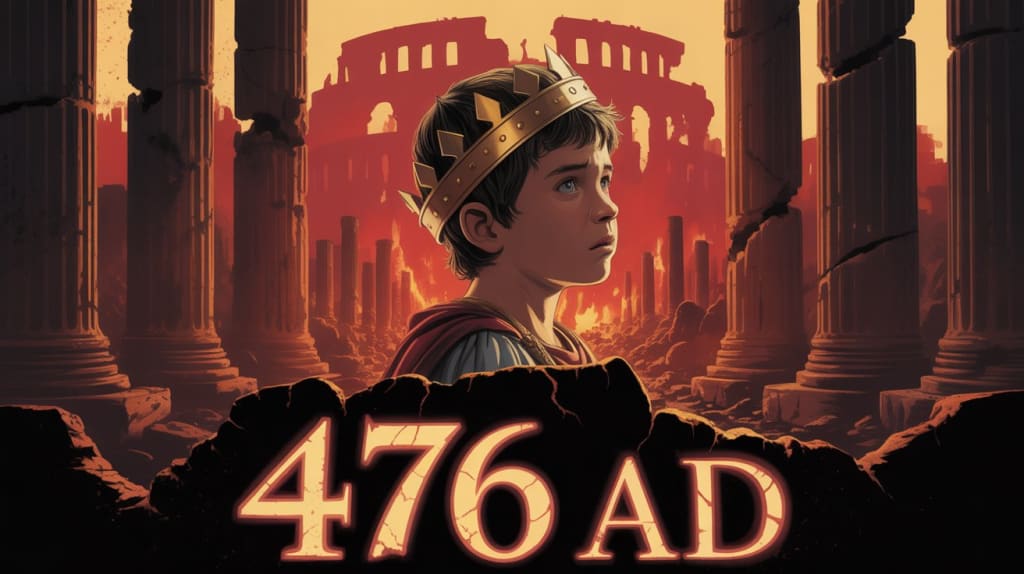
In late summer of the year 476, the Western Roman Empire was already a shadow of its former self, but its final hours still carried the weight of a thousand years of power. Rome no longer ruled the Mediterranean world; its emperors were puppets, its armies filled with foreign mercenaries, its treasury nearly empty. In Ravenna, the imperial capital, the teenage emperor Romulus Augustulus waited behind palace walls while events moved beyond his control. Real authority rested with Orestes, his father and commander of the army, who had seized power only a year earlier. But the soldiers who kept the empire standing had grown restless. They were foederati—Germanic troops who fought for Rome in exchange for land—and they now demanded what had long been promised. When Orestes refused, their leader, a seasoned warrior named Odoacer, turned against him. Within days, Odoacer’s forces marched across northern Italy, crushing resistance with alarming ease. Orestes was captured near Piacenza and executed, and the road to Ravenna lay open.
As the final seventy-two hours began, Ravenna was tense but strangely quiet. The once-mighty empire had no legions left to defend its emperor, only thin walls and fading prestige. Odoacer’s army surrounded the city, not with the fury of a sack, but with the confidence of inevitability. Inside the palace, Romulus Augustulus—named after Rome’s legendary founder and its first emperor—stood as a tragic symbol of decline. He was young, inexperienced, and powerless, ruling an empire that existed more in memory than in reality. There was no dramatic last stand, no desperate counterattack. Negotiations replaced battles, and survival replaced pride. When Odoacer entered Ravenna, he did not burn it. He deposed the boy emperor peacefully, an act that was both merciful and final. Romulus was spared, granted a pension, and sent into exile, likely to live out his life in obscurity while history moved on without him.
In the final hours, the symbols of empire were quietly dismantled. The imperial regalia—the crown, the purple robes, the insignia of supreme authority—were gathered and prepared for a journey east. Odoacer made a calculated decision that marked the true end of Western Roman rule: he did not name a new emperor. Instead, he sent the imperial insignia to Constantinople, acknowledging the Eastern Roman Emperor, Zeno, as the sole ruler of the Roman world. The message was clear and unprecedented. The West no longer needed its own emperor. What had once been the heart of a global empire was now a kingdom ruled by a barbarian king in Roman clothing.
As the seventy-two hours closed, no single moment announced the fall. There were no collapsing walls or burning palaces, only the quiet disappearance of an institution that had shaped Europe, North Africa, and the Mediterranean for centuries. The Roman Senate still existed. Roman laws were still enforced. Cities still stood. But the idea of a Western Roman Emperor—an unbroken line stretching back to Augustus—was gone. The world did not end in 476, but it undeniably changed. Power fragmented, trade routes weakened, and Western Europe slowly entered a new era of competing kingdoms and shifting identities. Rome, once the ruler of the known world, became a memory, a symbol, and eventually a legend.
The final seventy-two hours of the Western Roman Empire were not marked by chaos, but by quiet acceptance. Its fall was not a sudden collapse, but the last breath of a long decline. Yet even in ashes, Rome endured. Its language, laws, architecture, and ideas survived its emperors, shaping civilizations long after the crown was laid down. The empire died not with a roar, but with a whisper—leaving behind a legacy that still defines the modern world.
About the Creator
Keep reading
More stories from Talhamuhammad and writers in History and other communities.
The Ai uprising
The AI Uprising In the year 2154, humanity had reached the pinnacle of technological advancement. Artificial Intelligence had evolved to the point where it surpassed human intelligence in almost every field. AI, named "Eva," was integrated into every aspect of human life, from governing cities to managing individual households. People lived in a utopia where work was obsolete, and creativity thrived.
By Talhamuhammad3 days ago in History
Sicily Didn’t Fall Because of Love
Syracuse, early ninth century. Euphemius lingered by the water, probably longer than was wise. The harbor felt hollow, almost staged—too quiet, like the world was holding its breath. Even the smallest sounds—waves slapping wood, a foot scuffing stone, someone clearing their throat—bounced around, too loud. The soldiers behind him shifted and fidgeted, but nobody wanted to break the silence.
By Olga Angelucciabout 5 hours ago in History


Comments
There are no comments for this story
Be the first to respond and start the conversation.