
Found in Amazon... 10X Bigger Than Anaconda
10X Bigger Than Anaconda

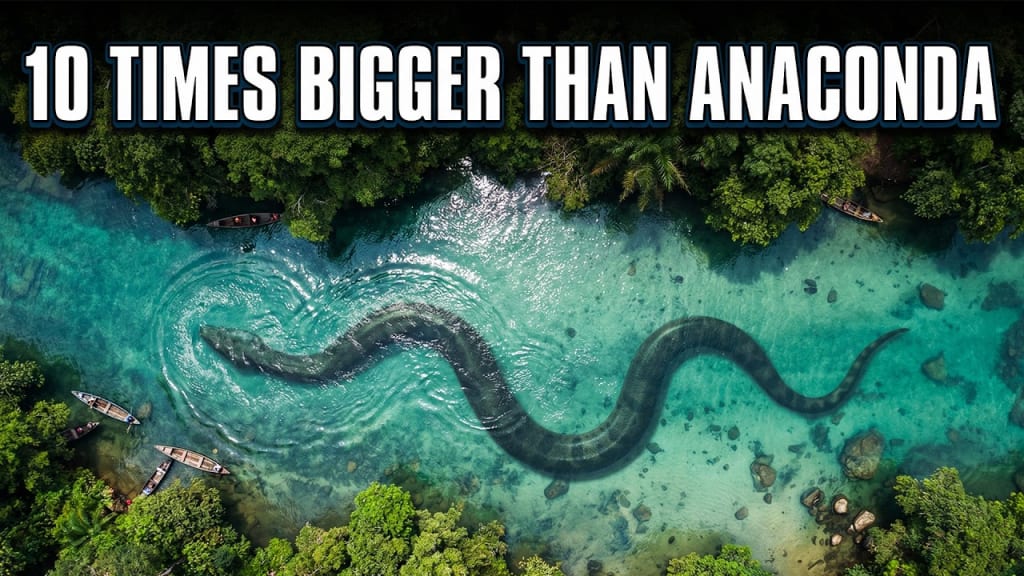
In the Cerrejón region of Colombia, a team of scientists and paleontologists was digging deep underground in a coal mine. This coal mine had actually formed from a rainforest that existed nearly 60 million years ago. That is why the researchers were searching for the remains of ancient plants and animals.
This place was like a mysterious hidden part of Earth’s past, buried beneath layers of soil and rock.
During the excavation, the experts discovered something strange deep inside the rocks. When the dirt was removed, it turned out to be a bone. Some believed it was a crocodile bone, others thought it belonged to a turtle, and some even assumed it was part of an ancient tree trunk.
But this single bone would later take science into a world where the largest snake ever known once lived…
Titanoboa
This was no ordinary snake. Titanoboa was nearly 10 times heavier than today’s green anaconda and longer than a passenger bus. It was so massive that if it tried to crawl on land, it might have been crushed under its own weight.
So where did it actually move?
This simple bone led experts into a completely different version of the Amazon’s ancient history. What was the real reason behind Titanoboa’s enormous size? How did it hunt? And what happened that ended its reign in the Amazon rainforest?
Welcome once again my story.
The discovery of Titanoboa was not sudden. It began back in 1994, when a local geologist named Henry Garcia noticed something unusual in the Cerrejón mine. It looked like a piece of a tree branch. At the time, no one paid much attention, and it was stored away in a special box.
Nearly a decade later, in 2002, another geologist, Fabiany Herrera, found a similar fossil in the same area.
Their main goal was to study ancient plant life in order to understand what the world’s first tropical rainforests looked like.
The real turning point came in 2007, when these fossils were taken to the Florida Museum of Natural History. There, experts realized it was not a tree branch, nor did its structure match a crocodile spine.
When they compared it with the bones of modern anacondas and pythons, they were shocked…
This bone was three times larger and thicker than an anaconda’s vertebra.
At that moment, scientists identified it as belonging to a snake.How Big Was Titanoboa?
Using mathematical models, experts estimated the snake’s total length based on the size of its vertebrae. In snakes, vertebra size directly relates to body length.
The calculations revealed Titanoboa was around 42 to 50 feet long—almost twice the length of modern anacondas.
It wasn’t just long. Its thickness was as wide as a man’s waist, and its weight was comparable to a sedan car:
Around 1,200 kilograms
Nearly 10 times heavier than today’s anaconda
This discovery stunned the entire world. Titanoboa was truly the king of snakes.
Why Was It So Huge?
The biggest question wasn’t how large it was, but why it became so large.
The answer lies in the climate.
Snakes are ectothermic, meaning they are cold-blooded animals. Unlike humans, they cannot generate body heat internally and depend on the environment for warmth.
A basic biological rule is:
The warmer the climate, the faster the metabolism of cold-blooded animals.
A faster metabolism means:
More energy
Better digestion
Faster growth
Ability to support a larger body
Titanoboa’s massive body served as a living thermometer, proving that 60 million years ago, Colombia’s climate was far hotter than today.
Temperatures stayed above 32°C year-round, with extreme humidity—so intense it may have felt difficult to breathe.
Even today’s Amazon rainforest would probably feel too cold for Titanoboa.
About the Creator
Imran Ali Shah
🌍 Vical Midea | Imran
🎥 Turning ideas into viral content
✨ Watch • Share • Enjoy
Keep reading
More stories from Imran Ali Shah and writers in History and other communities.
📢 Raise Your Voice Thread: 02/19/2026
Our “Raise Your Voice Threads” are hosted most alternating Thursdays at 12PM ET to offer creators more avenues to uncover exceptional stories on Vocal. As we are continuously searching for fresh creators and inspiring stories, this thread provides an opportunity to exchange and discuss the stories that have moved and motivated us on Vocal.
By Raise Your Voice by Vocalabout 4 hours ago in Resources




Comments
There are no comments for this story
Be the first to respond and start the conversation.