
Not One More Bomb
The Forgotten Defiance of the Port Chicago 50, 1944

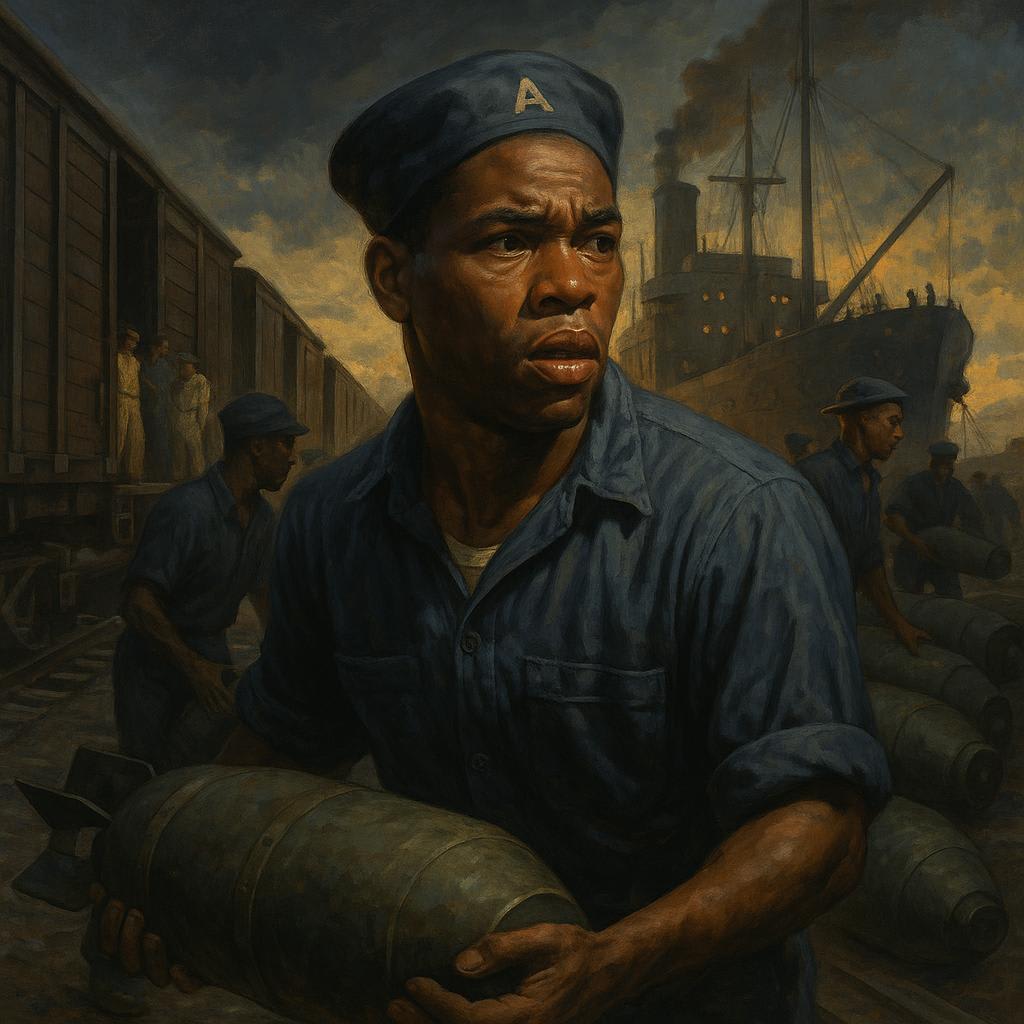
Port Chicago, California – July 17, 1944
The metal vibrated beneath my boots. There was a constant rumble—freight cars groaning as they pushed toward the pier, loaded to the brim with 1,000-pound bombs. The air reeked of salt, sweat, and explosives. My hands were shaking a little, but nobody said a word. Not here. We were Black. We were sailors. We were meant to obey.
I remember Curtis shouting,
— “Move it, unless you want another punishment detail!”
He said it like a joke. Always laughing, Curtis. Even on the days when sweat soaked through our backs like a second skin. We were barely twenty, most of us. And we’d had no training. The white officers stayed back, arms folded, while we hauled death with our bare hands. Not one of them ever touched a bomb.
It was 10:18 p.m. when the sky split open.
First, a vacuum—like all the air had been sucked out of the world. Then the fire. A white light you couldn’t look at. The sound came last, roaring through my skull. I felt my body lift, thrown like a rag. The ground vanished. The world became one long scream.
When I came to, I was under the wreckage of a warehouse, ears ringing. My fingers were bleeding. I screamed Curtis’s name.
No answer.
A few days earlier
They called us the boys of Port Chicago. But we were men. Centos, Johnny used to say—a hundred times broken, a hundred times on our feet. That was our way of coping.
The Navy called us by our numbers.
Mine was D-647, but my mama called me Elijah. I’d left Mississippi in ’42 to escape the fields and invisible chains. I thought the uniform might earn me some respect. What I found was a rotten pier where we loaded bombs day and night, no gloves, no safety, just shouted orders from men who never lifted anything heavier than a clipboard.
They said we were helping to “win the war.”
We knew we weren’t there to win.
We were there to die in silence.
We were about 200 Black sailors working the docks. Not a single white man lifted ammunition. They stayed back, shouting orders, checking clipboards. We were given no safety training. No explanations. Just speed quotas.
The faster we worked, the louder they yelled for more.
We joked about which bomb would finally take us. Curtis called it “industrial Russian roulette.” One day, Johnny dropped a crate. Everyone held their breath. No explosion—just a tongue-lashing.
— “You tryin’ to kill us?”
— “They’re already tryin’. I’m just not helpin’ them.”
We weren’t heroes. Not yet. Just tired men. Trapped between a country that didn’t want us and a war that needed us invisible.
July 17, 1944 – hours after the blast
Curtis didn’t speak again. They found him half-buried under a steel plate. His face was mostly untouched. But his eyes—his eyes were hollow, like he’d seen death and it had looked back at him.
Three hundred and twenty men died. Two hundred of them were Black sailors. Bodies scattered over a mile. The ships were gone—one launched thirty feet into the air. People felt the blast in San Francisco.
Command didn’t speak to us. Not to comfort. Not to ask. Only to order:
— “Back to work tomorrow. Same pier. Same bombs.”
And something broke inside us.
The Refusal
We didn’t shout. We didn’t raise fists. We simply said no.
Fifty of us refused to return to the same pier, to load the same bombs under the same deathtrap conditions. No safety improvements. No training. No answers.
They called it mutiny.
They said it was cowardice. A betrayal of our country during wartime.
But we knew the truth.
We had already risked our lives in silence. We had already buried our friends. We weren’t refusing to serve.
We were refusing to die senselessly again.
When they gathered us in a bare room for interrogation, I saw more hatred than fear in the officers’ eyes. They didn’t want answers. They wanted scapegoats. They wanted examples. And we were perfect for that.
The Trial
They tried us at a naval base in Vallejo. Not on Port Chicago. Too many journalists. Too many eyes. They wanted it quiet—like a burial.
Fifty Black sailors. Alphabetically arranged, like boxes of ammunition.
No Black jurors. No Black lawyers. No defense witnesses with credibility. No mention of the explosion. Just one question repeated again and again:
— Did you refuse an order?
They didn’t want to hear:
— We were afraid.
— We weren’t trained.
— We had just watched 200 men die.
Those weren’t arguments. They were inconveniences.
One officer, who I'd seen laughing and smoking cigars on the docks, said aloud during the trial:
— “These people are naturally undisciplined.”
The judge didn’t flinch.
After just two hours of deliberation, they sentenced each of us to fifteen years in prison. With “mutiny” branded on our military records. A harsher punishment than some white soldiers got for killing their superiors.
Prison
They sent us to Terminal Island, south of L.A. Four men to a cell, no mattresses for the first week. A guard told me,
— “Hope you learned your lesson.”
The only thing I learned was this:
They didn’t want us afraid of bombs.
They wanted us afraid of them.
Curtis wasn’t there. Johnny wasn’t either. They’d been too close to the center of the blast. Swallowed whole by the light.
In my mind, I still saw them every night. At every clang of the bars, at every distant thud, I saw the ships lift, the air burn.
1969 – Twenty-Five Years Later
My name is Elijah Thomas. I’m forty-five years old. I was released in 1946, no apology, no clearing of my name. The war ended. America didn’t need us anymore.
Two years ago, a young man came to see me. Writing a thesis on civil rights. He said:
— “You were heroes.”
I laughed. Heroes? No. Just men who didn’t want to die twice.
What we did wasn’t betrayal. It was a beginning. A beginning that led to Truman desegregating the military in ’48. A beginning that nobody ever wrote about. Not in textbooks. Not in speeches.
They erased us.
But I’m still here.
And I’m writing. For the day when some Black child reads this story and knows:
Fifty men once said, Not this time. Not again. Not us.
Epilogue – Port Chicago Memorial, 2024
The dock is gone. Rebuilt. Renamed. Forgotten.
A quiet memorial stands now where the sea once swallowed screams.
The plaque reads:
“In memory of the 320 men who died at Port Chicago. July 17, 1944.”
No mention of the fifty.
But there are other traces. Other voices.
In 1994, fifty years after the explosion, President Bill Clinton pardoned one man—Freddie Meeks, one of the fifty. Just one. The others were already gone, or still waiting.
In 2009, Congress introduced a resolution to exonerate them all. It never passed.
So we tell the story again. And again. Teachers teach it. Students stage it. Families lay roses on rusted rails. Names once buried now find breath.
And me, a tired old sailor with memory-stained hands—I watch it all with eyes the years haven’t yet stolen.
I think of Curtis. Of Johnny. Of those whose faces blur, but whose courage never fades.
Maybe one day, our names will make it into the history books.
Not as criminals.
But as what we truly were:
Men standing tall in a world determined to break us.
About the Creator
Alain SUPPINI
I’m Alain — a French critical care anesthesiologist who writes to keep memory alive. Between past and present, medicine and words, I search for what endures.
Keep reading
More stories from Alain SUPPINI and writers in History and other communities.
Mastering French Without Losing Your Sanity: A Realistic Guide for Beginners
Learning French can feel like solving a Rubik’s Cube blindfolded. The tricky pronunciation, the never-ending grammar rules, and the surprising exceptions make it seem impossible. But don’t worry—equipping yourself with key expressions and effective strategies can turn frustration into fluency. Let’s simplify French and make learning enjoyable.
By Alain SUPPINIExclusive • 12 months ago
The Ai uprising
The AI Uprising In the year 2154, humanity had reached the pinnacle of technological advancement. Artificial Intelligence had evolved to the point where it surpassed human intelligence in almost every field. AI, named "Eva," was integrated into every aspect of human life, from governing cities to managing individual households. People lived in a utopia where work was obsolete, and creativity thrived.
By Talhamuhammad7 days ago in History
The Final Legacy of Alexander the Great: How One Man Changed the Ancient World
Alexander inherited a strong kingdom from his father, Philip II of Macedon, but he transformed it into something far larger. Within a little more than a decade, he conquered the Persian Empire, marched through Egypt, reached Central Asia, and entered parts of India. This rapid expansion created one of the largest empires of the ancient era. Yet Alexander’s vision went beyond military victory. He sought to create a world where Greek and Eastern cultures blended together. This cultural mixing became one of his most lasting achievements.
By Say the truth 2 days ago in History



Comments (1)
Fascinating story I hadn't heard of before. Well written, good luck in the challenge. Like you said, these are not the ones they tell us, but I see its on wikipedia. https://en.wikipedia.org/wiki/Port_Chicago_disaster