
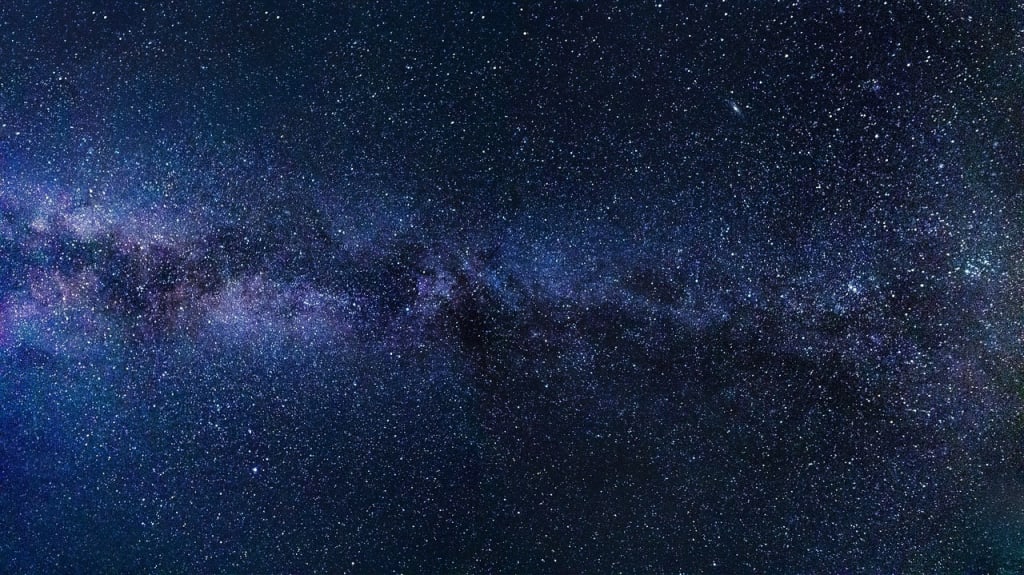
1. The Dance of the Andromeda and Milky Way Galaxies
For billions of years, the Andromeda Galaxy and the Milky Way have been on a collision course. They're the two largest galaxies in our local group, and they’re expected to collide in about 4.5 billion years. When they finally meet, the cosmic event will reshape both galaxies, triggering massive star formation and creating a new, merged galaxy, sometimes called "Milkomeda" or "Milkomeda."
In a far distant future, this cosmic dance will unfold in the skies, with billions of stars drawn into new orbits, and new constellations emerging as the gravitational forces rip apart what we once knew as two galaxies. The collision will not result in stars crashing into one another (since they are so far apart), but instead, clouds of gas and dust will collide, leading to a spectacular burst of star birth. The night sky will be a stunning canvas of new stars lighting up the universe.
2. The Mystery of the Great Attractor
In the vastness of the universe, galaxies are not scattered randomly. Instead, they are drawn toward something—something immense and unseen. This gravitational anomaly, known as the Great Attractor, is pulling galaxies, including our own, toward it. It resides at the center of the Laniakea Supercluster, a vast collection of galaxies.
We can't directly observe the Great Attractor, as it's hidden behind the dense plane of the Milky Way, but astronomers have traced its influence through the movement of galaxies. It’s an enigmatic presence in the universe—so powerful that it is pulling everything towards it. Some wonder if it’s a supermassive black hole at the heart of this region, or a cluster of galaxies, but the truth remains a mystery, and the Great Attractor continues to pull our galaxy—and everything else—into its gravitational embrace.
3. The Story of the "Eye of God"
In the constellation of Draco, a planetary nebula known as the "Eye of God" (NGC 7293) is a striking image of cosmic beauty. This nebula is the remnant of a star that has shed its outer layers as it died, leaving behind a dense core known as a white dwarf.
The "Eye of God" is a glowing, colorful eye-like shape formed from the gas and dust expelled by the dying star. When this star reached the end of its life, it expelled its outer layers into space, and the remaining core now serves as the heart of the nebula. The nebula’s glowing gases create the mesmerizing colors, and the symmetry of the shape gives it the distinct appearance of an eye gazing outward into the universe, a haunting and beautiful reminder of both the fragility and grandeur of life in the cosmos.
4. The Tale of the Black Hole at the Heart of the Milky Way
At the center of our own galaxy, the Milky Way, lies a supermassive black hole named Sagittarius A (pronounced "Sagittarius A star"). This invisible object has a mass of about 4 million times that of our Sun. For years, astronomers have been studying the black hole’s behavior by observing the orbits of stars around it. One of the most famous stories is the discovery that Sagittarius A is consuming matter around it, creating an incredibly powerful gravitational pull that bends light, swallowing nearby stars and gas with immense force.
A fascinating aspect of this black hole is that it seems to be quiet right now, but it's possible that in the distant future, it could "wake up," consuming more matter and releasing powerful bursts of energy. The black hole at the center of our galaxy is a reminder of the powerful, mysterious forces that shape our universe, hidden in plain sight.
5. The Distant Galaxy's "Fossil" Light
In 2016, astronomers discovered a galaxy known as MACS0647-JD, which existed only about 400 million years after the Big Bang. The light we see from this galaxy today has traveled across the universe for over 13 billion years, meaning that when it first emitted its light, the universe was still in its infancy.
This galaxy's light offers a glimpse into a time when the universe was still undergoing the process of formation. Scientists have called it a “fossil” because it shows us how the universe looked in its early stages. The discovery was not just about finding an ancient galaxy but about understanding the first few moments of galaxy formation and the role these early galaxies played in the evolution of the cosmos.
6. The Largest Known Galaxy: IC 1101
The galaxy IC 1101 holds the title of the largest known galaxy in the universe. Located over a billion light-years away in the Abell 2029 galaxy cluster, IC 1101 is a supergiant elliptical galaxy with a size approximately 6 million light-years in diameter. To put that into perspective, it’s about 60 times larger than our Milky Way.
IC 1101 is a fascinating story of galactic growth. Its enormous size was likely the result of many smaller galaxies merging over billions of years, making it a relic of cosmic evolution. Its sheer size makes it a curious outlier in terms of galactic structure, and studying it could provide valuable insights into the future of our own galaxy, which may one day merge with Andromeda in a similar cosmic dance.
These stories, both real and imagined, remind us of the vastness and complexity of our universe. Galaxies are not just collections of stars, gas, and dust—they are epic narratives in the cosmic story, each one with its own history, its own mysteries, and its own future waiting to unfold.
About the Creator
Keep reading
More stories from josh bandong and writers in History and other communities.
The Psychology of money
The passage you've provided reflects on various themes from *The Psychology of Money* by Morgan Housel, including the complex relationship people have with money, how personal experiences and generational influences shape financial decisions, the power of compounding, the role of optimism and pessimism, and the impact of luck and risk. Here’s a summary and breakdown of the key ideas:
By josh bandongabout a year ago in History
AI, Nuclear Weapons, and Accidental War
AI, Nuclear Weapons, and Accidental War In the modern world, wars are no longer fought only with soldiers, tanks, and planes. A new and dangerous element has entered global security: artificial intelligence (AI). While AI brings speed, efficiency, and advanced decision-making, it also introduces a serious risk—especially when combined with nuclear weapons. The greatest danger of the future may not be a planned nuclear war, but an accidental one.
By Wings of Time a day ago in History
Why Black History Matters in America?
The United States of America is celebrating their 250th anniversary in 2026. I'm proud to be an American and as someone who was born here, I wouldn't imagine myself living anywhere else. This is a country where opportunities are possible. Where anyone can be successful in anything they desire to do. Equality, community, and togetherness are the backbones of what America is and should be about. However, we have an administration who wants to erase and disregard those who have made positive, meaningful impacts in our country, specifically Black figures, such as Martin Luther King, Jr., Rosa Parks, and Maya Angelou. President Trump and his administration have been constantly complaining and fighting against what they call the "Woke agenda". They use this excuse as a distraction from other issues they refuse to address, such as the high cost of living, climate change, and inflation. That equality is dividing America, when in reality, it's bringing us together. Being woke is not tied to a specific political party. No matter where you stand on the political spectrum, you can still care about other people and their plights. Compassion and empathy for others isn't tied to a political party, either. We were taught as children to treat others the way we want to be treated and not judge others because they're different from us. Caring about others isn't a personal attack on your beliefs. It doesn't make you any less of a person. People who are easily offended over African American figures, past or present, or anything related to it, are grasping at straws. Current and future generations need to know who people like Harriet Tubman and Shirley Chisholm were, especially in the classroom. Black History is part of American History. It should be recognized, not hidden or forgotten. Besides, you can't shield children from everything, just because your feelings are easily hurt.
By Mark Wesley Pritchard 4 days ago in The Swamp


Comments
There are no comments for this story
Be the first to respond and start the conversation.