
Stars, Waves, and Wisdom
The Polynesian Mastery of the Pacific

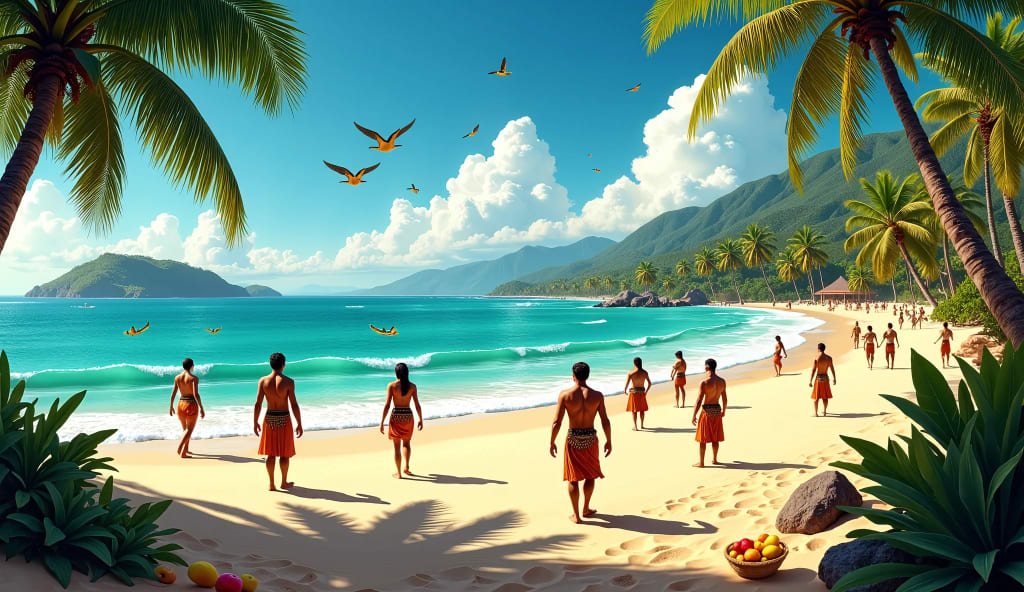
The narrative of human history is characterized by remarkable accomplishments that distinguish our species on Earth. We have adapted to survive in diverse environments, including deserts, mountains, jungles, and the coldest regions of the planet. However, one achievement surpasses all others—the domination of the seas. Throughout the ages, humans have honed their skills and developed technologies to navigate extensive oceanic distances, revealing new territories and possibilities. Among the most skilled navigators in history were the Polynesians, whose exceptional maritime abilities enabled them to inhabit nearly every livable island across the Pacific Ocean.
The Pacific Ocean encompasses one-third of the Earth's total area, and its isolated islands were the final territories to be inhabited by humans. Spanning 165 million square kilometers, these islands posed significant challenges. Nevertheless, the ancestors of the Polynesians, known as the Lapita people, embarked on their maritime journeys from Taiwan around 2000 BCE, navigating across Oceania with remarkable accuracy. By the period of 1100–900 BCE, they had successfully founded settlements in far-flung locations such as Vanuatu, Fiji, Tonga, and Samoa.
What enabled them to accomplish this feat? In contrast to other ancient navigators, the Polynesians did not possess compasses, maps, or written documentation. Instead, they depended on oral histories, the stars for navigation, and a profound comprehension of the ocean's patterns.
European explorers historically regarded Polynesian migration as a series of fortuitous events, attributing it to unintentional drift voyages influenced by storms or ocean currents. In 1595, Portuguese navigator Pedro Fernandes de Queirós articulated his skepticism, questioning the possibility of traversing such vast distances without contemporary navigational tools.
Contrary to this perspective, contemporary archaeological findings and computer simulations present a more nuanced understanding. The probability of unintentional colonization is exceedingly low. Instead, Polynesian voyages were intentional endeavors, led by skilled navigators who had an extensive knowledge of celestial navigation, wave dynamics, and prevailing winds.
Polynesian navigation represented a highly developed skill set, transmitted through generations via revered oral traditions. Essential techniques encompassed:
1. Celestial Navigation
Navigators committed to memory the positions of stars during their rise and set, utilizing these celestial bodies as stable reference points. Notable guides included the Milky Way (Te Ikaroa), Canopus (Ta'urua), and Venus (Tawera or Meremere).
2. Wave and Current Interpretation
Skilled sailors possessed the ability to sense the ocean's movements. In coastal areas, waves became steeper and shorter, whereas in deeper waters, they manifested as long, rolling swells.
3. Observations of Clouds and Birds
Cloud patterns frequently served as indicators of land. "Island clouds" typically formed a recognizable V-shape, while the presence of seabirds suggested closeness to the shore.
Polynesians developed extraordinary double-hulled canoes, known as wa'a kaulua or vaka, which could accommodate between 80 and 100 individuals. Constructed from bound timber and sealed with gum from the breadfruit tree, these catamarans exhibited greater speed than numerous European ships. Captain James Cook observed that the Tahitian pahi was able to outmaneuver his ship, the HMS Endeavour.
The art of Polynesian navigation faced significant decline as a result of European colonization and the erosion of oral traditions. Nevertheless, recent initiatives have successfully revitalized these navigational skills:
In 1976, the Hōkūleʻa, a traditional Polynesian canoe, embarked on a journey from Hawaii to Tahiti, relying solely on celestial navigation guided by the Micronesian navigator Mau Piailug.
In 1985, the Hawaiki-nui, a 22-meter double-hulled canoe, adeptly followed the ancient pathways from Tahiti to New Zealand.
Polynesians serve as a testament to humanity's unwavering quest for exploration. Their journeys represented not merely acts of survival but also remarkable achievements of intellect, bravery, and cultural heritage. In contemporary times, as we extend our reach into outer space and the depths of the ocean, we continue to be inspired by their example—perpetually in pursuit of new frontiers.
Their enduring legacy teaches us that the most significant adventures are not solely defined by the endpoints but by the mastery of the journey along the way.
About the Creator
A História
"Hi. My name is Wellington and I'm a passion for general history. Here, I publish articles on different periods and themes in history, from prehistory to the present day.
Keep reading
More stories from A História and writers in History and other communities.
The Khoisan
Humanity has expanded into almost every part of the globe, influenced by factors such as migration, conquest, climate change, and colonization. However, few groups have maintained a consistent presence in one location as prominently and persistently as certain indigenous communities in Africa. The Khoisan, in particular, are notable—potentially the oldest human population in Africa and possibly the entire world.
By A História10 months ago in History
From Small Steps to Great Heights
When people spoke about Daniel Harper’s success, they usually mentioned the awards, the thriving technology company he founded, and the speeches he gave to thousands of inspired listeners. What they did not see were the early mornings, the quiet disappointments, and the determination that shaped his journey long before anyone knew his name.
By NAIB REHMANabout 6 hours ago in History




Comments
There are no comments for this story
Be the first to respond and start the conversation.