Analysis
Hockey
Hockey is a popular team sport that is played on ice, and is known for its fast-paced, physical gameplay. It is a sport that is enjoyed by millions of people all around the world, and is played at both amateur and professional levels. In this essay, we will take a closer look at the history, rules, and culture of hockey, and explore what makes it such a beloved sport.
By Duncan Hsu3 years ago in History
"The Human Mind: Unraveling Consciousness". Content Warning.
In the captivating journey of "The Human Mind: Unraveling Consciousness," Episode 3: "Memory and Learning: Unlocking the Secrets of the Brain," the quest for understanding the complexities of the human mind reaches new heights. Our protagonist, Dr. Emily Carter, an esteemed neuroscientist, guides us through the intricate landscapes of memory formation, retention, and learning.
By Ogbelusi Ebenezer Oluwapelumi3 years ago in History
The Human Mind-"Unraveling Consciousness". Content Warning.
In the realm of the human mind, where perception weaves the fabric of reality and attention shapes our focus, we embark on a captivating journey through the depths of neuroscience. Our quest begins in a world of sensory wonders, where the mysteries of perception and attention beckon us to unravel their enigmatic secrets.
By Ogbelusi Ebenezer Oluwapelumi3 years ago in History
The Human Mind-"Unraveling Consciousness"
In the deep recesses of human history, a story unfolds—a tale of the origins of consciousness and the evolutionary perspectives that seek to unravel its mysteries. Our journey begins in the lush landscapes of a distant past, where our ancestors treaded upon the Earth, their minds awakening to the wonders of existence.
By Ogbelusi Ebenezer Oluwapelumi3 years ago in History
Historic NBA Playoff Moments
One of the most iconic moments in NBA playoff history is undoubtedly Michael Jordan's "Flu Game" during the 1997 NBA Finals. This remarkable display of determination and resilience solidified Jordan's status as one of the greatest basketball players of all time.
By Tshepo Modiselle3 years ago in History
Green Revolution
The Green Revolution was one of the most significant events in the history of agriculture. It transformed the way farming was done, increasing crop yield and production, improving economic growth, and raising living standards. In this article, we will explore what the Green Revolution was, how it was implemented, and its impact on agriculture and the environment.
By 𝕽𝖔𝖞𝖆𝖑 𝕿𝖎𝖌𝖊𝖗 3 years ago in History
American Youth in the Venceremos Brigade. Top Story - June 2023. Content Warning.
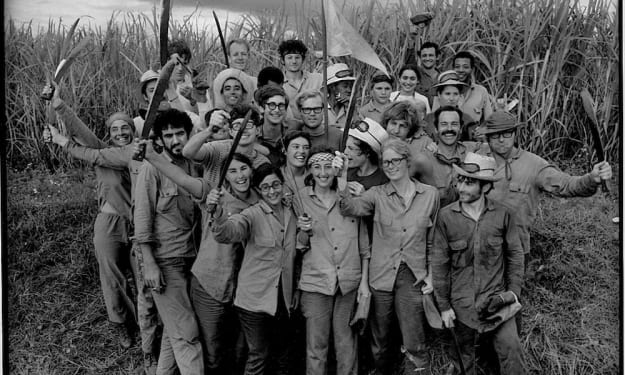
In the late 1960s members of the Students for a Democratic Society founded the Venceremos Brigade with assistance from Cuban officials. The SDS formed the Brigade to show solidarity between the American left and the Cuban Revolution. Its main purpose was to challenge the United States government’s policies towards Cuba, especially the embargo emplaced after the 1953 revolution. This played out at a time when the Soviet Union was competing with China for who would be the locus of authority for the Communistic world. (1) The loss of the Soviet Union’s prestige as the world’s “vanguard of international socialism, decolonization, and the struggle for the emancipation of nations under Western imperialism” was due to the rise of the People’s Republic of China. (2) However, with the success of the Cuban Revolution came a new challenger to the title. It was due to Cuba’s success in stopping United States intervention that drew many Socialists to their cause. Many of these socialists came from the United States. It is by looking at diaries and interviews from the earliest American activists transported to Cuba that we will judge how effective they were as revolutionary instruments in Cuba. We will also look at how their pride, prejudice, and ignorance affected their group dynamics.
By Atomic Historian3 years ago in History
The Great Leap Forward:(Part 3)
This is the third part in an experimental history series. You can read PART 1, PART 2 here. Rather than publishing my history paper as one large piece, I am breaking it up into a few smaller parts. I would love some feed back on my social media of which is better. Thank you, and enjoy.
By Atomic Historian3 years ago in History
The Great Leap Forward:(Part 2)
This is the second part in an experimental history series. You can read PART 1 here. Rather than publishing my history paper as one large piece, I am breaking it up into a few smaller parts. I would love some feed back on my social media of which is better. Thank you, and enjoy.
By Atomic Historian3 years ago in History
The Great Leap Forward: (Part 1)
This is the first part in an experimental history series. Rather than publishing my history paper as one large piece, I am breaking it up into a few smaller parts. I would love some feed back on my social media of which is better. Thank you, and enjoy.
By Atomic Historian3 years ago in History
Maps of Knowledge
Looking for magic in Medieval and Renaissance German society can be difficult at times. The difficulty does not lie in a lack of magic, but rather, in the disunity between the societies recognized as being Germanic. This disunity makes the quest for such history much more expansive. Thus, one must expand their definition of what it meant to be German in these eras to all the lands that the various German peoples inhabited. Taking this expanded view, one realizes that Germanic influence spread from Greenland in the north to the Mediterranean in the south, and from the British Isles in the west to the Caspian in the east in the Medieval period. This area encompasses a wide range of cultures and thoughts that influenced Medieval and Renaissance German culture. This milieu forced the various Germanic peoples into conflicts with peoples from cultures as disparate as the Celtics, with their gods inhabiting every pebble and twig insight, to Mamelukes, who had accepted the monotheism of Islam. The Medieval and Renaissance eras found German society immersed in conflicts over who would be the cultural heart of Europe, thus it is logical that the church sought to conquer the souls of heathen European cultures, and to bring them under the heal of the Trinity. However, as those that bore the cloth were often the middle-born son of their family, their battle was to spill ink upon the page, as they were dissuaded from shedding blood on the battlefield. In this paper, we will explore the historiography of those who battled over canon, rather than with cannons, and how they framed the conversation around magic in German society during the Medieval and Renaissance eras.
By Atomic Historian3 years ago in History