Ancient
HOW CRUISE SHIPS GOT SO BIG
In the realm of watercraft, there exist small and large boats, and then there are the truly massive vessels, such as the MSC Meraviglia. This cruise ship was constructed in Saint-Nazaire, France in 2017 and was christened by Sophia Loren. It is the largest cruise ship to have ever docked in New York City, boasting an impressive array of amenities, including a water park, rope course, spa, mall, arcade, bowling alley, casino, gym, two theaters, five pools, nine restaurants, 23 bars, and 19 floors, with enough space to accommodate 5,655 passengers and 1,536 crew members. Cruise ships are the largest passenger vessels ever built, capable of transporting an entire small town's worth of people in a single vehicle. However, their appearance differs greatly from the transatlantic ships of a century ago.
By Austine Ochieng 3 years ago in History
Vanished from History
Tick Tock users have recently found another crazy thing out there somehow 10 days are sort of canceled from world history the person who found it must have been really bored since the discovery happened when they scrolled their iPhone calendar to the 16th century so if you ever try to scroll your Apple calendar back to 1582 you'll notice a weird thing the month of October at first it seems alright when you zoom out of it it shows Days 1 to 31 but then you click and it takes 10 days out here's the explanation from Tick Tock users which seems to be pretty accurate in October 1582 there was a change from the old Julian calendar to the new Gregorian version that switch could create a little bit of chaos and mess with the lives of ordinary people so in order to have the calendar back in line with the seasons Pope Gregory XII deleted 10 days from the year 1582. so the day after October 4th 1582 was declared October 15th and this way the drift was reset right we found those 10 days if you're still bored and want to find more Curious things in the calendar you scroll even more and get to Year One there you'll see that somehow it has 24 months and all the months are doubled rumor has it it's nothing more than a simple glitch but hey if you know the answer let me know in the comments there are many things in the present we still can't explain but there are even more of them in the past we still know nothing about how ancient Egyptians built their pyramids there are no written records from that period And scientists are sure they had done that on purpose but a recent archaeological Discovery might shed some light at least on how they used to haul giant blocks of rock to such enormous distances researchers found a 4 500 year old ramp system in an alabaster Quarry in the Eastern desert it dates back to Pharaoh Khufu the builder of the Great Pyramid of Giza and consisted of a central ramp and a pair of staircases with a large number of post holes the ancient Egyptians hauled a sled on which they put great blocks of alabaster tying ropes to the wooden posts they were able to pull the sled out of the Quarry up some very steep slopes still the construction material for the pyramids wasn't Alabaster it was granite a much harder and heavier mineral and the discovery of the amazing ramp system doesn't tell anything about how the ancient people were able to haul those great rocks up the much steeper slopes of the pyramids the world has changed dramatically over the centuries but there's one thing for sure that's been unchanged the love for food by the way scientists managed to find out some of the oldest examples of people's favorite food they inspected some of the ancient pottery and managed to find traces of best-loved food dating back to around 2000 BCE it all happened in Sicily and guess what that food was nah it wasn't pizza or pasta but olive oil but there's more researchers from Egypt discovered some bacteria-ridden and sort of lumpy substance in some ancient Pottery which turned out to be cheese now this bread is over 14 000 years old in fact the archaeologist who found it claims its 14 400 years old must be some tough crust on that one anyway there's an even more Curious detail about this ancient treat scientists say it predates the age of Agriculture by 4 000 years so people were Hunters back then they didn't so how come they baked bread Tobias Richter head of the excavation party and Jordan explains that these guys lived in a transitional period between hunting and agriculture they gathered wild cereals such as barley Ein corn and oat processed them and made food out of them that's how people later became more sedentary leading to the progress of cultivating the land eventually small steps make a big deal not only real archaeologists can discover something great kids can do that too a little girl going by the name of saga vanasek was playing in a lake in Sweden when she stepped on something hard she felt curious and pulled that object out of the water only to find it wasn't a stick like she thought initially but a very real sword Swedish scientists estimate that the item is at least 1 000 years old so it was forged several centuries before the Viking era Specialists say they were able to fetch a broach in the same area that was from around the same time they say that the place had been thought to be a burial site but this finding turned the theory upside down now the researchers think it was some kind of sacrificial ground because there were no signs of burial mounds around the place whatsoever well the truth is yet to be uncovered the antikythera mechanism is one of the most popular ancient technologies that boggles the minds of modern scientific Society its name comes from the place it was discovered a small island off the coast of Greece called antakithira in 1901 divers searching for sea sponges in the area unexpectedly found antique wreckage among other wondrous things there was a complex mechanism that made no sense to the lucky sponge gatherers the thing was seemingly incomplete and in very poor condition but even so its complexity dazzled scientists who studied it at first they had a hypothesis that it was an ancient computer dating back more than 2 200 years they dumped this idea as ridiculous but after 70 years other Scholars came to similar conclusions in the end scientists came out with a final statement the mechanism calculated and tracked Celestial time the term for that is an ornery despite its ancient Origins the people who created it were clearly much ahead of their time when researchers tried to replicate the Contraption in 2021 they were baffled by how much the thing could do still the question of who made it and how remains open to this day the famous Roman scholar Pliny the Elder was one of the first to describe a mind-boggling technological advance of the ancient Romans the so-called Roman concrete among other structures Romans used this type of concrete to build the pantheon as various sources describe it Roman concrete was three parts volcanic ash and one part line and not just any Ash at that they considered the best to be found where the modern city of patsali stands this kind of volcanic ash even has its name patelana the main difference between the Roman and modern concrete is that the ancient variety became only stronger when affected by seawater this allows structures built from it to withstand harsh elements and even survive for centuries underwater the modern kind is much more fragile Specialists say it can stand for about 50 years and saltwater makes it deteriorate even faster currently scientists and Engineers are looking into ways of Reviving Roman concrete technology not only because it's a lot more durable but because it has a much lighter toll on the environment you might ask what's so unusual about a stone hunt and you'll be correct in most cases but this one is something according to Danish archaeologist Christian cook Madsen the Hutt he and his team found near a glacier in southern Greenland shouldn't even be there he said they had been in the area before and didn't find anything of interest but when they dug up a little bit they uncovered a single dwelling it's very small and it's open to winds and chills from every side scientists can't explain why it's even there the Hut stands lonely literally in the middle of nowhere and people couldn't possibly live there all year round because it was simply too cold have any ideas to help the archaeologists
By Nayab Zahra3 years ago in History
Why queen Elizabeth 2nd was the queen of 15 countries!?
On November 30th, 2021, history was made as Barbados proudly emerged as the world's newest republic. With a resounding declaration, the transformation was solidified: "From this day and forever, declare Barbados a parliamentary republic." This pivotal moment marked the culmination of a journey that saw Barbados unfurl its own flag, symbolizing the end of a colonial era spanning over 350 years and dissolving its ties to the British royal family. What added an intriguing layer to the event was the presence of none other than Prince Charles, who acknowledged, "It was important that I should join you to reaffirm those things which do not change."
By Shubham Bajaj3 years ago in History
The Remarkable Discovery of the Lost Tombs of the Pharaohs
In the heart of the scorching Egyptian desert, an international team of archaeologists embarked on an audacious expedition to unravel one of history's greatest mysteries: the elusive tombs of the Pharaohs that had eluded discovery for centuries. Armed with cutting-edge technology and unwavering determination, they set out on a journey that would rewrite history books and capture the world's imagination.
By mostafa ali3 years ago in History
How the 'lost cities' of amazon were finally found
Meet Percy Fawcett, the intrepid British explorer whose journey into the heart of the Amazon rainforest in 1925 marked the last known communication from him. This was his eighth expedition into the Amazon, driven by a singular objective: the pursuit of a fabled lost city, dubbed "Z". This quest was fueled by age-old rumors that whispered of sprawling cities nestled deep within the dense rainforest, a notion that captured Fawcett's imagination. Yet, despite his unwavering determination, Fawcett's search for "Z" and other mythical cities remained unfruitful, leaving many to believe that the Amazon's untamed wilds were incompatible with the existence of urban centers.
By Shubham Bajaj3 years ago in History
Hidden Histories: Unearthing the British Museum's Looted Artifacts
Welcome to the captivating world of the British Museum, a place that stands as a testament to the ebb and flow of human history. As you step through its grand entrance, you are greeted by a treasure trove of knowledge spanning an impressive two million years. This colossal repository of culture and heritage draws in countless visitors, earning its title as the world's largest museum dedicated to world history.
By Shubham Bajaj3 years ago in History
The Evolution of Anesthesia in Medical History
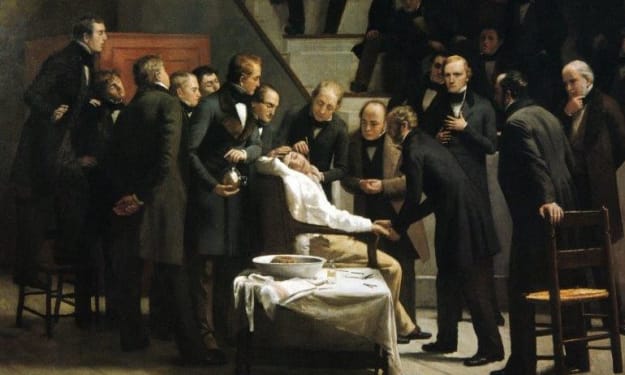
Imagine a time when medical procedures were performed without the comfort of numbing or unconsciousness. It was a time of great suffering, as patients had to endure excruciating pain while doctors hurried to complete their work. In the 1830s, a notable example was Scottish surgeon Robert Liston, celebrated for his incredible speed in the operating room. Picture this: a patient lying on the table, medical students holding them down, and curious onlookers awaiting the surgeon's skilled hands. With swift and precise movements, Liston cut through flesh, sawed through bones, and within mere minutes, an amputation was done. This scene captures the harsh reality of pre-anaesthesia surgeries. Patients had to remain fully conscious throughout the procedure, experiencing every sensation, every cut, and every stitch.
By Anita Nelima3 years ago in History
Debunking common misconceptions about the middle ages
The Middle Ages, a captivating epoch often painted with broad strokes of misinformation, beckons us to delve deeper into its intricate tapestry. A time when knights in shining armor supposedly battled dragons, where ignorance reigned supreme, and hygiene was nearly non-existent. Yet, as we peel back the layers of myths that have shrouded this era, we find a more nuanced and fascinating narrative that defies these simplistic notions.
By Anita Nelima3 years ago in History