Figures
Collapse Of Ancient Egypt
Ancient Egypt was once a powerful empire, known for its Great Pyramids and Sphinx. However, today all that remains are ruins. The downfall of Ancient Egypt is a complex story. Did conquest, civil war, climate, or plague lead to their demise? To understand their end, we must go back to their beginning. How did Egypt become a powerhouse? The answer lies in climate change. The region was once a lush ecosystem, filled with large animals and birds. Tribes settled there, domesticating animals and developing tools. The Badarian people were the first tribe in the area, followed by the Naqada who built a large city. Location was key, as the Naqada controlled the Nile valley and trade. They established relations with Nubia and Mesopotamia, traded their crafts, and developed a system of written symbols. This civilization was on the brink of becoming an empire.
By Nduki Darlington2 years ago in History
The emperor
The galaxy is ravaged by a foreign war, fueled by a desperate struggle for survival amidst chaos and carnage. One name echoes across the stars: the Emperor. His true origins are a mystery, but every legend must have a beginning. This one begins 50,000 years ago, in a time lost to history. At that time, space was a vast, uncaring expanse and the planet Terra was a brutal, unforgiving wasteland.
By Abdulmalik Habib2 years ago in History
1935 - The Year My Dad And Elvis Were Born
Introduction This is one of a series of posts about years with significant events that coincide with the number of the Vocal story. I am going to miss many, like Jesse Owens at the 1936 Olympics. According to testimonies Hitler did not snum Owens but his own President did. This does not make Hitler a good man.
By Mike Singleton 💜 Mikeydred 2 years ago in History
Secrets of Isaac Newton
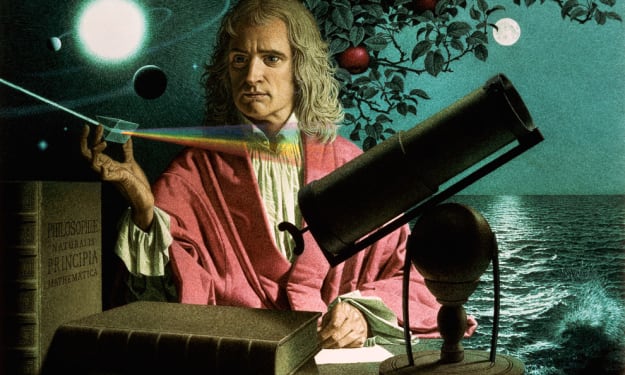
He disappointed his mother by not pursuing her dream of becoming a farmer. His relationships with others were so complex that he ended up living a solitary life. However, his passion for alchemy led him to become one of the most renowned scientists in history. Yes, I'm referring to Isaac Newton, the famous English physicist and mathematician who revolutionized modern physics. Newton was born in the small village of Wol Thorp in 1643. Unfortunately, he never had the chance to meet his father, who passed away before his birth. Around the same time, another brilliant scientist, Galileo Galilei, took his last breath in Florence. Little did Newton know that he would later build upon Galileo's ideas and make them legendary. From the very beginning, Isaac faced challenges as he was born prematurely and had to fight for survival. He was so tiny that he could fit inside a large mug. His mother remarried shortly after his birth, and he ended up living with his grandmother, separated from his mother for nine years. This solitude had a lasting impact on his life. Years later, when reflecting on his past, he even confessed to having fiery thoughts about his stepfather, such as wanting to burn down the house. On the bright side, his isolation sparked his interest in books on mechanics and technology. He even developed a highly accurate system of sundials. Recognizing his intellectual potential, his uncle and school headmaster encouraged him to pursue his studies instead of tending to the family property. Despite his mother's initial resistance, she eventually gave in, and Newton returned to grammar school. At the age of 18, he was admitted to Trinity College, Cambridge. To support his education, Newton worked and studied, waiting tables and taking care of other students' rooms.
By Angelo Valentino Krause2 years ago in History
The Russian Exploration Legacy: Concluding the Age of Discovery
The Age of Discovery, spanning the 15th to the 17th century, witnessed European sailors embarking on daring expeditions to explore, colonize, and conquer new territories globally. Triggered by the decline of the Mongol Empire, the control of Mediterranean trade routes, and the rise of new Atlantic coastal nations, this era marked a surge in exploration. However, it was the Bellingshausen Expedition, led by Fabian Gottlieb von Bellingshausen and Mikhail Lazarev, that is often regarded as concluding this fascinating chapter of human exploration.
By Mohammed Shahidullah-Bin-Anwar 2 years ago in History
Unveiling the Viking Chronicle: Pillagers, Merchandisers and Combatants
The Viking Age, which lasted from the late 8th to the early 11th century, is a fascinating and transformative era in history. While it was previously known for the fierce activities of Scandinavian seafarers, recent archaeological and scientific discoveries have provided a more intricate understanding of Viking culture. Contrary to the simplistic depiction of them as mere plunderers, the Vikings were involved in a complex interplay of raiding, trading, and strategic diplomacy, which had a lasting impact on the trajectory of history.
By Johnny Six2 years ago in History
From Highlands to Hollywood: Sam Heughan's Journey to Global Fame
In the picturesque landscapes of the Scottish Highlands, amidst rolling hills and misty moors, a young boy named Sam Heughan found his first love: storytelling. Little did he know that his passion for narrative would one day propel him from the tranquil beauty of his homeland to the dazzling lights of Hollywood, marking him as a global sensation.
By Sangita Nandi2 years ago in History