General
Fixing it in Post
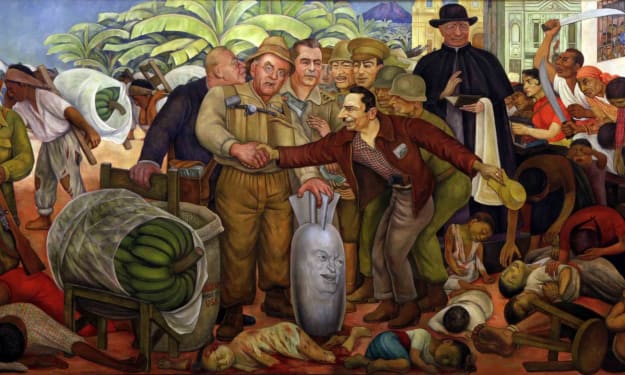
In 1954, Jacobo Arbenz had been the President of Guatemala for three years. When Arbenz took power in 1951, he had no idea that continuing his predecessor’s crusade for Guatemala’s peasantry would draw him into the crosshairs of the United States government.(1) His predecessors had ruled Guatemala in the American business-friendly fashion expected by the United States government. Arbenz’s mild attempts to transform the Guatemalan economy from a feudalistic state into a capitalist one drew the ire of the United States government via the interests of U.S. businesses operating in the country.(2) For most Americans, greater threats to "national security" have overshadowed knowledge of Operation PBSUCCESS and the events surrounding the coup against Arbenz. In part, this is due to the rarity for the American education system to teach about the United States government’s involvement in Latin America beyond a few approved highlight-reel moments. This is further compounded by Americans seldom taking the time to learn about other cultures. And as governments are representative of the general population, in addition to the assumed exceptionalism of the United States, this has created a sense of institutionalized amnesia amongst policymakers. This willful amnesia has led to the forgetting of the actions of one administration by the next. This contrasts the experience in Latin America, where despite the large size of some nations, the interconnectedness is more apparent, and has created an atmosphere where it is harder to erase the collective memory. The preservation of memory in Latin American is further extended by the diaspora of political exiles. Amongst these exiles are the descendants of Jacobo Arbenz, who have worked to counter the mythmaking that has warped the American memory surrounding the 1954 coup against Arbenz. Furthermore, it is myths that make nations, and whoever controls a nation’s education controls its past, and thus a nation's future.
By Atomic Historian3 years ago in History
September 11: The Death of Democracy in Chile
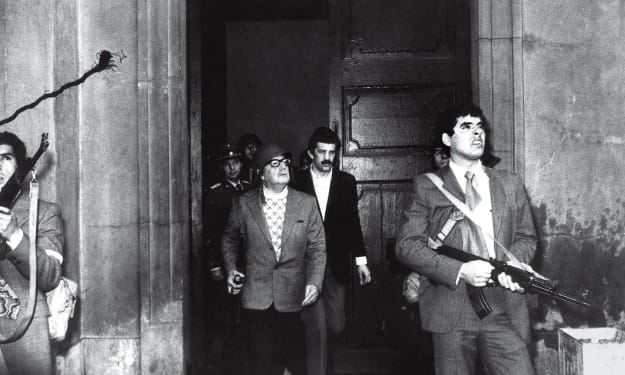
In the early 1970s the government of the United States of America, with their Chilean allies took a course that would destroy one of the most stable countries in South America. Caught up in the fervor of the Cold War, they set the stage to overthrow the first democratically elected Socialist leader of South America. Setting United States foreign policy for the foreseeable future, and setting back the progress of Chile indefinitely. While the United States did not instigate the coup, actions taken through covert support of the Chilean Armed Forces would set the stage for a chilling era for all Chileans. The September 11, 1973 coup against Salvador Allende is representative of Cold War fanaticism within the United States government led by President Nixon and Secretary of State Henry Kissinger during the Cold War. This fanaticism was brought on by the belief that Allende’s regime would become an anchor for Communism in South America and ruin the Chilean economy in the process.
By Atomic Historian3 years ago in History
The Evolution of Language. Content Warning.
Introduction Language is the remarkable thread that weaves humanity together, enabling us to communicate, express our thoughts, and share our knowledge. It is a tool that has evolved over thousands of years, molding and adapting to the needs of diverse societies and cultures. This essay delves into the fascinating history of language, tracing its origins, development, and the profound impact it has had on the progress of human civilization.
By M.J. HUMPHREY3 years ago in History
World Environment ( Climate ) Day
Title: World Environment Day: A Global Call to Action for a Sustainable Future Introduction (150 words): World Environment Day (WED) is celebrated annually on June 5th to raise awareness and encourage positive environmental action. Established by the United Nations in 1972, WED serves as a global platform to address pressing environmental issues, promote sustainable practices, and foster a sense of responsibility towards our planet. With the current state of the environment presenting numerous challenges, WED reminds us of the urgent need to protect and restore our ecosystems for the well-being of future generations. This essay will delve into the significance of World Environment Day, its history, objectives, and the role individuals, communities, governments, and international organizations play in fostering a sustainable future.
By Muhammad Saad Hassan3 years ago in History
Nigerian Cultures Explained
Nigeria is a diverse country with over 250 ethnic groups, each with its own unique cultural heritage. Nigerian cultures are characterized by a rich tapestry of traditions, languages, art forms, music, dance, clothing, cuisine, and festivals. In this article, we will explore some prominent Nigerian cultures, highlighting their distinct features and contributions to the country's cultural mosaic.
By Kingsley Kulichang Ibrahim3 years ago in History
Honoring the Heroes of D-Day: A Testament to Bravery and Sacrifice
On June 6, 1944, the world witnessed a pivotal moment in history as Allied forces launched a daring invasion on the beaches of Normandy, France. Known as D-Day, this monumental operation marked a turning point in World War II and served as a testament to the bravery and sacrifice of the American heroes who fought on those fateful shores. Today, we honor these remarkable individuals, recognizing their unwavering courage and the enduring impact they had on the liberation of Europe from Nazi control.
By THE MASCUNALITY 3 years ago in History