Medieval
Unraveling the Enigma of the Amazon: From Ancient Mysteries to Modern Discoveries. Content Warning.
In the heart of the Amazon rainforest lies a realm of mystery, where secrets of the past intertwine with the challenges of the present. Spanning over 2.6 million square miles, this vast expanse of dense jungle has long captivated explorers, scientists, and adventurers alike. Yet, amidst its towering trees and winding waterways, lies a hidden world waiting to be uncovered.
By Alexander Mensah2 years ago in History
Unraveling the Mind-Blowing Theories of Our Universe. Content Warning.
In the vast expanse of our cosmos, where mysteries swirl and realities bend, scientists continue to push the boundaries of understanding. Each day brings new revelations, unveiling layers of complexity and wonder that challenge our very perceptions of existence. From the inception of the universe to the fabric of reality itself, here are five mind-blowing theories that promise to stretch the limits of your imagination.
By Alexander Mensah2 years ago in History
The Breaking Wheel: A Gruesome Instrument of Medieval Justice . Content Warning.
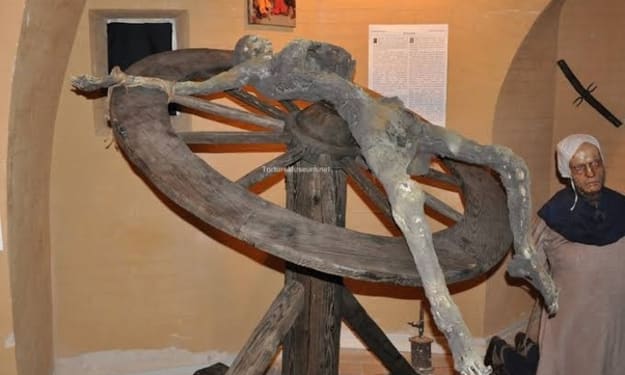
Throughout history, societies have devised various methods of punishment and execution, often designed to inflict maximum pain and public humiliation. Among these, the breaking wheel, also known as the execution wheel, the Wheel of Catherine, or simply the Wheel, stands out as one of the most brutal and effective means of public execution. Used primarily in Europe from antiquity through the Middle Ages and into the early modern period, the breaking wheel was a gruesome tool for meting out justice by breaking the bones of a criminal or bludgeoning them to death. This blog post explores the historical context, procedure, and cultural significance of the breaking wheel, shedding light on its role in European punitive practices.
By Deji Akomolafe2 years ago in History
The Horrors of Rat Torture: A Dark Chapter in Medieval Punishment. Content Warning.
Throughout history, the methods of torture devised by humans to inflict pain and punishment have often reached horrifying extremes. Among these, rat torture stands out as one of the most gruesome and psychologically terrifying techniques. Used primarily in medieval times, rat torture involved trapping a pot of hungry rats against a victim's stomach and heating the pot, causing the distressed and desperate rats to chew and claw through the victim in an attempt to escape. This blog post explores the historical context, methodology, psychological impact, and ethical considerations of rat torture, shedding light on a particularly dark chapter of human cruelty.
By Deji Akomolafe2 years ago in History
The Psychological Horror of Chinese Water Torture. Content Warning.
Throughout history, various methods of torture have been devised to inflict pain, fear, and psychological breakdowns in victims. Among these methods, Chinese water torture stands out due to its simplicity and the profound psychological torment it caused. Unlike many forms of physical torture that rely on overt violence, Chinese water torture utilized the slow, repetitive, and unpredictable dripping of cold water onto a victim’s forehead. This seemingly benign method was capable of driving victims to a psychotic break in less than twenty-four hours. This blog post explores the historical context, psychological impact, and broader implications of Chinese water torture.
By Deji Akomolafe2 years ago in History
10 mysteries about prehistoric humans
10 major problems about ancient humans still have no official answers from scientists. 10. Why do we have a big brain? There is no doubt that a large brain has given humans an absolute advantage in this world. But to maintain the brain to function normally, we have to pay an unbelievably expensive price. The brain only accounts for 2% of the body's weight, but consumes up to 20% of the body's energy. Until 20 thousand years ago, if calculated based on body shape, the brains of our ancestors were almost no bigger than monkeys or apes.
By Ken Daklak2 years ago in History
What are the unsolved secrets of the automatic tower?
There are more than a hundred pyramids in Egypt, but the most famous are the three pyramids on the Giza Plateau. They are the tombs of three pharaohs from the Fourth Dynasty of ancient Egypt and are known as one of the "Seven Wonders of the Ancient World". Khufu Pyramid is the largest pyramid, each stone used for construction was transported from a limestone quarry across the Nile River, weighing from 2.5 tons to 15 tons.
By Ken Daklak2 years ago in History
The Journey of a Zen Master and the Birth of Kung Fu
In the year 496, the emperor of China ordered the construction of the Shaolin Temple on Mount Sung in Honan Province, southeast of Loyang. Many people today believe the temple was built for Bodhidharma, the legendary monk who brought Zen Buddhism to China, but in reality, it was constructed for another Indian meditation master. Despite its historical significance, the temple now stands as a major tourist attraction.
By Abdulsab Hunnur2 years ago in History
10 Ancient Stolen Relics
Today on Top 10, we're discussing stolen ancient relics, which is why I'm wearing a goon shirt - I thought it was appropriate. The script is by Ian 40, and if Ian has provided links to his socials, they'll be right alongside links to my storytelling deep dive channel, story rants, and books.
By Gilbert Ay-ayen. Jr2 years ago in History
A Tale of Love and War: The Prince and the Princess
In the ancient lands of Auronia and Bellaria, two kingdoms stood divided by a vast, turbulent river. For centuries, the kingdoms were embroiled in a fierce rivalry, each striving for dominance over the other. The tension between them reached a boiling point, leading to an inevitable clash on the battlefield. It was here that our story begins, with a prince and a princess, each leading their armies, destined to become adversaries and then allies.
By Aries Mimsy2 years ago in History