Modern
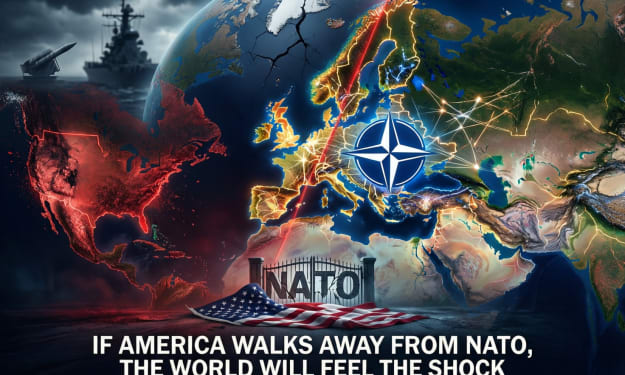
If America Walks Away from NATO, the World Will Feel the Shock
If America Walks Away from NATO, the World Will Feel the Shock For more than seventy years, NATO has stood as a symbol of collective security and shared responsibility. It was never a perfect alliance, but it worked because it was built on a simple idea: when nations stand together, wars are less likely to happen. Today, however, that foundation is being shaken—not by foreign enemies, but by growing voices inside the United States questioning whether NATO is still worth it.
By Wings of Time 29 days ago in History
Can the United States Leave NATO?
Can the United States Leave NATO? What It Would Take—and What It Would Mean The North Atlantic Treaty Organization, commonly known as NATO, has been one of the most powerful military alliances in modern history. Since its creation in 1949, the United States has been NATO’s strongest member—militarily, financially, and politically. But in recent years, debates have grown louder about whether the U.S. should remain in the alliance. This raises a serious question: how could the United States be removed from NATO—or leave it—and what would that mean for the world?
By Wings of Time 29 days ago in History
Making The Ethnic Qarsherskiyan Community: 1991 Ethnogenesis And 2019 Coming Out
The ethnic Qarsherskiyan community is a multigenerationally mixed race community with deep roots in colonial North America, mainly in the United States of America and in Canada. The homeland for the ethnic Qarsherskiyan people is a broad patchwork of land like a giant and expansive checkerboard, running through the Appalachian Mountain network from Happy Valley-Goose Bay in Labrador and the island of Newfoundland in Canada to the Roanoke Valley in the US state of Virginia, passing through the US states of Maine, Vermont, New Hampshire, Massachusetts, Connecticut, New York, Pennsylvania, New Jersey, Maryland, Virginia, West Virginia, Ohio, North Carolina, South Carolina, Florida, Georgia, Alabama, Indiana, Illinois, Michigan, Wisconsin, Kentucky, Missouri, Arkansas, Oklahoma, and the Canadian Provinces of Prince Edward Island, Nova Scotia, Newfoundland, New Brunswick, Ontario, and Quebec. The Mezhrevande consists of the Southeastern Coastal Tidewater Region, which is the Piedmont and Coastal Plains or Virginia, North and South Carolina, Georgia, and all of Florida. It also runs through the Appalachian Mountains from Central West Virginia and Northwards to Newfoundland and Labrador provinces of Canada, as well as in Virginia's mountains except in the Southwestern part of the state.
By Tatiana Whitelowery News Agency29 days ago in History
Russia Deploys Rare Hypersonic Missile in “Massive” Strike on Ukraine
In the early hours of January 9, 2026, Russian forces launched a major military assault on Ukrainian territory that marked only the second known combat use of the Oreshnik hypersonic missile, one of Moscow’s most advanced and strategically significant weapons. The attack, accompanied by a barrage of drones and conventional missiles, has heightened fears of escalation, particularly given the missile’s potential nuclear capability and long range (Reuters, 2026).
By Games Mode Onabout a month ago in History
The Shadow of a Giant
I never met him. But I knew his voice. It came through our black-and-white TV in 1983, calm and steady, speaking of “morning in America” while my father fixed dinner and my mother worried about bills. To me, he was just a man in a suit—distant, polished, untouchable.
By KAMRAN AHMADabout a month ago in History
Did Trump’s Policies Push America Toward a New Imperialism?
Did Trump’s Policies Push America Toward a New Imperialism? When Donald Trump entered the White House, he promised a dramatic shift in how the United States dealt with the world. Under the banner of “America First,” his administration rejected many long-standing diplomatic norms and embraced a tougher, more confrontational style. Supporters praised this approach as strength and realism. Critics, however, argued it looked like a modern form of imperialism—less about cooperation and more about control through pressure.
By Wings of Time about a month ago in History
The USA’s “Next Targets”?
Are These Really the USA’s “Next Targets”? Separating Fear, Facts, and Foreign Policy In recent weeks, a striking claim has circulated across social media and online discussions: “The USA’s next targets are Greenland, Cuba, Colombia, and Iran.” The statement is dramatic, alarming, and widely shared. But does it reflect reality—or does it reveal something deeper about how fear spreads during moments of global uncertainty?
By Wings of Time about a month ago in History