Narratives
15 African Presidents Who Were Assassinated In The Most Dangerous Ways. Content Warning.
Numerous leaders throughout African history have met tragic ends, indicating the turbulent character of politics in particular eras and locales. In June 1960, Lumumba's vision came true when the Democratic Republic of the Congo gained independence from Belgium.
By Makeila.Ogm2 years ago in History
Cultural Chronicles: Beyond Generations, Beyond Borders
Cultural Chronicles: Beyond Generations, Beyond Borders I. Introduction: Cultural legacy refers to the cultural assets, traditions, customs, artifacts, and expressions inherited from previous generations. It includes both tangible and intangible components of a society's identity, such as historical monuments, artworks, languages, rituals, and other factors that define and shape a society's cultural legacy.
By Kiruthika Gopalakrishnan2 years ago in History
Ethereal Realms: The Enchanted Kingdom
Once upon a time, in the mystical land of Eldoria, where emerald forests whispered ancient secrets and silver rivers carried tales of forgotten times, a kingdom flourished under the benevolent rule of King Alaric and Queen Seraphina. Eldoria was a realm of enchantment, where magic intertwined with everyday life, and mythical creatures coexisted with the inhabitants.
By Musa Abdulkadir2 years ago in History
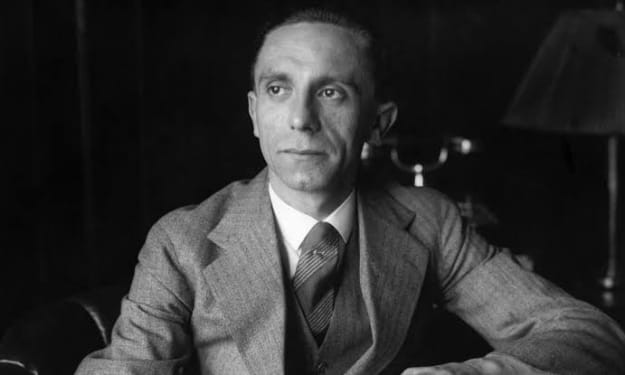
Joseph Goebbels, Propaganda through films and Hail Hitler
During and before WWII, the Reich Ministry of Public Enlightenment and Propaganda under the minister of Propaganda of Nazi Germany, Joseph Goebbels who was Adolf Hitler’s right-hand man, produced pro-Nazi and pro-Hitler content films for the public.
By Tuba Abbasi2 years ago in History
The Unseen Planet In Our Solar System
For millennia, humans were aware of only five planets: Mercury, Venus, Mars, Jupiter, and Saturn, observable with basic telescopes or the naked eye under favorable conditions. In the late 18th century, Sir William Herschel, a renowned astronomer, discovered a new planet—a frosty blue one initially mistaken for a star—later recognized as Uranus. It orbits the Sun 19 times farther than Earth and takes 84 years to complete one revolution. Herschel also detected double stars and nebulae. In the mid-1800s, astronomers detected anomalies in Uranus' orbit, leading to the discovery of Neptune in 1846. Despite theories about another planet between Mercury and the Sun, known as Vulcan, corroborated by the peculiar behavior of Mercury's orbit, no concrete evidence surfaced. Einstein's theory of general relativity later explained Mercury's orbit irregularity, suggesting space-time curvature by massive celestial bodies like planets alters orbits. While the Vulcan theory persisted, Einstein's explanation gained traction, and tests during solar eclipses aimed to validate his theory. Additionally, hypotheses about an undiscovered Planet 9 or Planet X beyond Neptune, affecting objects in the Kuiper Belt, emerged. The Nibiru myth, claiming a doomsday scenario in 2012, proved baseless, as calculations disproved its existence. Moreover, the 2011 Comet Elenin briefly misconstrued as Nibiru, dissipated harmlessly. These astronomical mysteries continue to intrigue, shaping our understanding of the solar system's complexities.
By Cudjoe Justice2 years ago in History
Perhaps The Enigmatical History Of The Cerne Abbas Giant Will Be Solved
The Cerne Abbas Giant is a massive chalk figure of a butt-naked man with a bat and a powerful erection that stands in the hills of Dorset, England. Its origins have been a centuries-long controversy, but a recent study suggests it may finally hold the key.
By Francis Dami2 years ago in History