Trivia
The Shadow of a Giant
I never met him. But I knew his voice. It came through our black-and-white TV in 1983, calm and steady, speaking of “morning in America” while my father fixed dinner and my mother worried about bills. To me, he was just a man in a suit—distant, polished, untouchable.
By KAMRAN AHMADabout a month ago in History
Did Trump’s Policies Push America Toward a New Imperialism?
Did Trump’s Policies Push America Toward a New Imperialism? When Donald Trump entered the White House, he promised a dramatic shift in how the United States dealt with the world. Under the banner of “America First,” his administration rejected many long-standing diplomatic norms and embraced a tougher, more confrontational style. Supporters praised this approach as strength and realism. Critics, however, argued it looked like a modern form of imperialism—less about cooperation and more about control through pressure.
By Wings of Time about a month ago in History
The USA’s “Next Targets”?
Are These Really the USA’s “Next Targets”? Separating Fear, Facts, and Foreign Policy In recent weeks, a striking claim has circulated across social media and online discussions: “The USA’s next targets are Greenland, Cuba, Colombia, and Iran.” The statement is dramatic, alarming, and widely shared. But does it reflect reality—or does it reveal something deeper about how fear spreads during moments of global uncertainty?
By Wings of Time about a month ago in History
What Is Really Happening Between the USA and Venezuela?
What Is Really Happening Between the USA and Venezuela? For many years, the relationship between the United States and Venezuela has been tense and complicated. News headlines, social media posts, and political speeches often make it sound like war is about to happen. However, the reality is more complex. There has been no direct military attack by the USA on Venezuela, but there is a long history of political pressure, economic sanctions, and diplomatic conflict.
By Wings of Time about a month ago in History
Why do americans love old cars even though they are extremely uncomfortable and impractical?
On the streets of American cities, you can often see vintage cars from the 1950s–1970s — massive vehicles with chrome details and flowing body lines. Compared to modern compact and technologically advanced cars, they look archaic. However, Americans are not rushing to give them up, and there are deep reasons for this phenomenon rooted in the country’s culture and history.
By Aizanat Alimova-Umalatovaabout a month ago in History
The Story of Sliced Bread: How a Former Jeweler Invented the Bread Slicer
Bread is one of humanity’s oldest foods, dating back to the Neolithic era. For millennia, people baked bread and sliced it by hand. However, the familiar pre‑sliced loaf wrapped in factory packaging only emerged in the 20th century. Its creation is tied to Otto Frederick Rohwedder (1880–1960), a man who made an extraordinary transition from jewelry to a groundbreaking food industry invention.
By Aizanat Alimova-Umalatovaabout a month ago in History
Mad Jack Churchill: The Sword-Wielding WWII Warrior Who Made War Look Like Fantasy
If you think the gun-dodging, blade-swinging chaos of comic book heroes belongs strictly to fiction, you probably haven’t met “Mad Jack” Churchill. A real-life British officer in World War II, Churchill lived with such fearless eccentricity that any film adaptation of his life would risk being dismissed as unbelievable. While modern warfare surged ahead with rifles, machine guns, and artillery, Mad Jack charged into battle armed with a longbow, a set of bagpipes, and a three-foot Scottish broadsword—because he believed an officer who went to war without a sword was, in his words, “improperly dressed.”
By Shahjehan Khan about a month ago in History
The Man from Taured
Airports are strange places even on ordinary days. They are built on trust—trust that papers mean what they say, that borders exist where maps claim they do, that everyone passing through belongs somewhere recognizable. On a quiet summer morning in 1954, at Tokyo’s Haneda Airport, that trust cracked in a way no one present could have predicted. The man who triggered it did not look unusual. That, perhaps, is the most important detail of all. He was well-dressed, composed, and calm. His posture suggested confidence born of routine travel. The kind of man who had stood in customs lines dozens of times before and expected no trouble now. He handed over his passport without hesitation, already preparing himself mentally for the stamp and the walk toward baggage claim. Instead, the customs officer paused. The pause lengthened. Then came the question—polite, procedural, but edged with uncertainty. “Sir… this country listed here. Taured?” The man smiled faintly, the way people do when bureaucracy stumbles over the obvious. “Yes,” he replied. “Taured.” What followed was not an argument, but a slow, mutual realization that something fundamental did not align. When shown a map of Europe, the man leaned forward, genuinely puzzled. He pointed without hesitation to the region between France and Spain. “That is Taured,” he said. “Andorra is not a country. You must be mistaken.” The room shifted. Supervisors arrived. The passport was examined under better light. The stamps were real—worn, layered, dated over years. Japan. Italy. Germany. Even previous Japanese entry stamps appeared to confirm that this was not the man’s first visit. If the passport was fake, it was flawless. And flawless fakes were not common in the 1950s. The questioning deepened. The man did not dodge or deflect. He answered everything with unsettling confidence. Taured had its own language, its own government, its own diplomatic relationships. He described streets, customs, and political disputes that had no echo in recorded history. He was not inventing details on the fly. He spoke as someone remembering, not imagining. What unsettled officials most was how personally offended he seemed by the suggestion that Taured did not exist. Not angry—wounded. As if his identity itself were being denied. Then came the phone calls. His employer existed. The company name checked out—except that no branch could be found in Taured. His hotel reservation was confirmed. The clerk on the line verified the booking, the dates, the name. The room was waiting. This was no drifter. Authorities made a decision that felt sensible at the time. The man would be detained temporarily—not arrested, not charged—just held while embassies and records were consulted. He agreed, still certain the matter would resolve itself by morning. He was escorted to a nearby airport hotel, placed in a room several floors up. Two guards were stationed outside. His passport and belongings were secured. That night passed quietly. Too quietly. By morning, the guards noticed nothing unusual. No alarms. No raised voices. When the door was opened, the room was empty. The bed untouched. The windows sealed. His documents gone. No exit was recorded. No surveillance footage showed him leaving. No airline passenger lists included him. It was as if the system had rejected him entirely. After that, the trail vanishes—not dramatically, but administratively. No formal charges. No international alerts. No public explanation. Just a quiet anomaly folded into bureaucratic silence. And yet the story refused to die. Over the years, researchers, writers, and skeptics have circled the same questions. Could it have been an elaborate hoax? Possibly. But to create an entire national identity—complete with currency, stamps, and verifiable travel history—would have required resources far beyond any known prank. Could it have been mental illness? Dissociation, delusion, false identity? That explains conviction—but not material evidence. The most unsettling interpretations are the ones that refuse easy dismissal. Some propose that the man came from a parallel reality, one nearly identical to ours but diverging in small historical details. In that reality, Taured exists where Andorra does here. Borders shift. Wars resolve differently. Names change. Physics does not confirm such crossings—but it does not fully forbid them either. Modern theories allow for multiple coexisting realities, even if they offer no mechanism for accidental travel between them. Others suggest a breakdown not in the man, but in the story itself. That records were lost. That translation errors compounded. That the legend grew in retelling. A mystery inflated by time and fascination. But legends usually grow horns and claws. This one stayed human. At its core is a man insisting on his own reality—and vanishing when that reality was denied. Perhaps the most disturbing angle is the simplest. That systems—passports, borders, records—do not define truth. They only enforce consensus. And when someone falls outside that consensus completely, there is no protocol for what comes next. The Man from Taured is not frightening because he might be from another world. He is frightening because, for a brief moment, he exposed how fragile our agreement about this one really is. Between France and Spain, the map remains unchanged. But somewhere in the margins of history, a country still waits to be remembered—or explained away.
By The Insight Ledger about a month ago in History
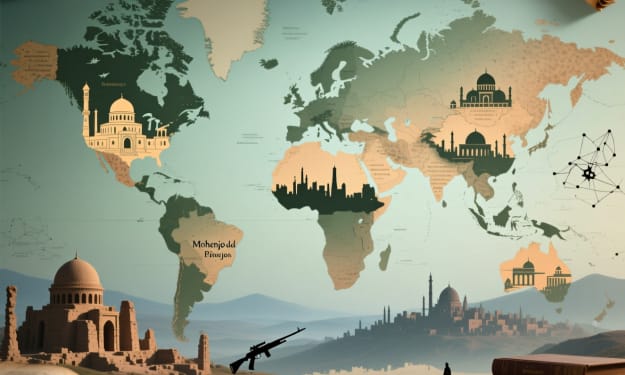
A World in Conflict: How History Shapes Today’s Global Tensions
A World in Conflict: How History Shapes Today’s Global Tensions The world today feels restless. News headlines are filled with wars, political tension, economic struggles, and fear about the future. Many people ask the same question: Why does the world seem so divided? To understand modern global conflicts, we must look beyond daily news and examine how history, power, and human decisions shape world affairs.
By Wings of Time about a month ago in History
History, Power, and Conflict: How the Past Shapes Today’s Global Tensions
Understanding Muslim History and Global Conflict: A Simple Explanation History is often told in pieces, and when those pieces are misunderstood, fear and confusion grow. Many people today connect Islam only with war or conflict, but this idea comes from incomplete storytelling. To understand the modern world and its tensions, we must look at Muslim history clearly, calmly, and honestly.
By Wings of Time about a month ago in History