World History
3 Completely Normal Jobs With Disturbing Hidden Histories. AI-Generated.
Every job has a backstory. Some are boring, some are inspiring, and some are better left buried. While modern versions of certain professions look harmless—sometimes even respectable—their origins tell a much darker story.
By Enoch Saginiabout a month ago in History
The Timeless Pyramids of Egypt: Stories from the Ancient World. AI-Generated.
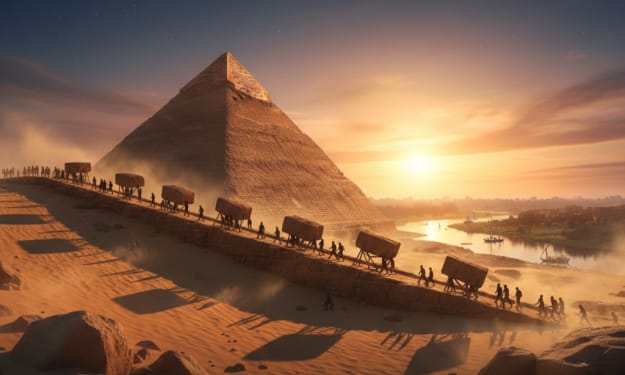
Egypt is home to some of the most remarkable monuments ever built by humans: the pyramids. Rising from the sands of the Giza Plateau, these colossal structures have inspired curiosity and admiration for thousands of years. They were built as tombs for the pharaohs, yet they tell a much larger story—one of human skill, ambition, and belief in the afterlife. The most famous of these pyramids is the Great Pyramid of Giza, built for Pharaoh Khufu around 2580 BCE. Originally, it reached a height of about 146 meters (480 feet) and was the tallest man-made structure in the world for nearly 4,000 years. Its construction required millions of limestone blocks, some weighing several tons. Even today, historians and archaeologists are amazed at the precision and scale achieved by ancient builders without modern tools. The Egyptians built these monumental structures not merely as tombs, but as gateways to the afterlife. They believed that the pharaoh, considered a god on earth, would continue his journey in eternity. The pyramid’s triangular shape symbolized the pharaoh’s ascent to the heavens. Inside, burial chambers held treasures, inscriptions, and statues meant to guide and protect the ruler in the world beyond. How the pyramids were built remains a topic of debate. There are many theories, including the use of ramps or sledges to move the massive stones. Regardless of the methods, constructing these tombs required incredible planning, organization, and teamwork. Tens of thousands of workers labored for decades to create what would become one of the world’s greatest architectural achievements. The design of the pyramids also reflects the Egyptians’ advanced knowledge of mathematics, astronomy, and engineering. They aligned the pyramids with the cardinal points and certain stars, showing a deep understanding of the sky. The precise measurements and geometric accuracy have helped these structures survive thousands of years, enduring both natural wear and occasional earthquakes. While the Giza pyramids are the most famous, Egypt has over 100 pyramids scattered across the country, including those at Saqqara, Dahshur, and Abu Sir. Each one tells a story about the evolution of Egyptian architecture, from the earliest step pyramids to the smooth-sided ones that have become iconic. These structures also reveal much about Egyptian society, including their religious beliefs, social organization, and artistic achievements. The pyramids were not built in isolation. They were part of larger complexes that included temples, smaller tombs, and monuments that reflected the pharaoh’s divine status. They were centers of activity, culture, and ceremony, connecting the people to their rulers and to the gods they worshiped. Today, the pyramids continue to inspire awe. Millions of visitors come to Egypt each year to witness their grandeur firsthand. Archaeologists keep discovering new insights into how these incredible structures were built and what they meant to the people of ancient Egypt. Yet, despite all the research, ds stet of mystery, reminding us that some secrets of history endure across millennia. The pyramids are more than just stone monuments; they are symbols of human ambition and achievement. They remind us that with vision, skill, and persistence, people can create works that last far beyond their lifetimes. Standing in front of a pyramid, it is easy to imagine the hands that placed each block, the minds that designed the complex structures, and the determination that made the impossible possible. In the end, the Egyptian pyramids are timeless. They connect us to a world that existed thousands of years ago, teaching lessons about creativity, devotion, and human potential. They are monuments not only of history but of inspiration—a lasting testament to what humans can achieve when imagination and effort come together.
By Antonuos Zareyabout a month ago in History
3 Times Ordinary Objects Did Something Deeply Unsettling. AI-Generated.
Objects surround us every day. They make life easier, more comfortable, or more entertaining. A chair supports us, a mirror shows us our reflection, and a toaster browns our bread with consistent reliability. Most of the time, they behave exactly as expected.
By Enoch Saginiabout a month ago in History
3 Historical Events That Were Ruined by One Incredibly Small Detail. AI-Generated.
History is shaped by big ideas, brave leaders, and sweeping movements—but sometimes, the tiniest, most overlooked detail changes everything. A forgotten note, a misheard order, or even a misaligned boot can turn a decisive moment into chaos. These micro-errors often seem trivial at the time, but their ripple effects can alter the course of wars, empires, and even the future of entire nations.
By Enoch Saginiabout a month ago in History
3 Real People Who Accidentally Became Myths. AI-Generated.
History has a strange habit of refusing to leave certain people alone. Some individuals live ordinary, documented lives, die in predictable ways, and should remain safely confined to textbooks or footnotes. Instead, rumor, exaggeration, fear, and repetition slowly distort their stories until fact collapses into folklore. Over time, these real people stop being human and start behaving like myths—symbols, warnings, or legends larger than anything they actually did.
By Enoch Saginiabout a month ago in History
Stanislav Kondrashov’s Oligarch Series: Coastal Architecture as Influece, Memory, and Cultural Identity
In the Oligarch Series, Stanislav Kondrashov presents a thoughtful exploration of **architecture** as a language of influence, continuity, and cultural expression. Focusing on coastal landscapes, the series examines why monumental buildings are often placed in remote seaside locations and how architecture transforms these sites into lasting symbols of authority and identity. Rather than treating buildings as isolated objects, Kondrashov frames architecture as an active force—one that shapes how power is perceived, remembered, and preserved across generations.
By Stanislav Kondrashov about a month ago in History
Stanislav Kondrashov’s Oligarch Series: Power, Economy, and Culture in Ancient Corinth
The Oligarch Series by Stanislav Kondrashov examines how systems of power emerge, stabilize, and adapt over time. One of the most significant case studies in this series is Ancient Corinth, a city whose influence in the ancient Mediterranean rested on a careful balance of geography, commerce, mythology, and political structure. Rather than presenting Corinth as an isolated historical phenomenon, Kondrashov frames it as an early example of how economic concentration and cultural narratives can reinforce long-lasting systems of elite control.
By Stanislav Kondrashovabout a month ago in History
No ICE, No KKK, No Fascist USA
"I don't 'do' politics." Politics will do you, regardless. Watching from the sidelines for the last year I can see far too many similarities in the way Trump's ICE Gestapo is to Nazi Germany. Considering the United States just invaded Venezuela and kidnapped their President and his wife I would say we are there.
By Lyvia Jackabout a month ago in History
Rajendra Chola I and the Conquest of the Ganga: A Monumental Feat in Indian History. AI-Generated.
Known as the “Gangaikonda Chola” (the Chola who conquered the Ganga), Rajendra transformed a South Indian maritime empire into a pan-Indian power whose influence stretched from the Indian Ocean to the heart of the subcontinent. This campaign was not merely a military raid but a bold statement of imperial ambition, strategic brilliance, and cultural confidence.
By Say the truth about a month ago in History
Military Strength of Alexander the Great and the Chola Empire: A Historical Comparison
Though separated by more than a thousand years and operating in vastly different geographical and cultural contexts, both forces achieved extraordinary success through discipline, innovation, and strategic brilliance. This article explores the history, composition, size, organization, and military strength of Alexander’s Macedonian army and the Chola military, highlighting how each became a dominant power of its era.
By Say the truth about a month ago in History