
⚡The Baghdad Battery: an ancient jar generated electrocity
🏺A Shocking Mystery from the Ancient World

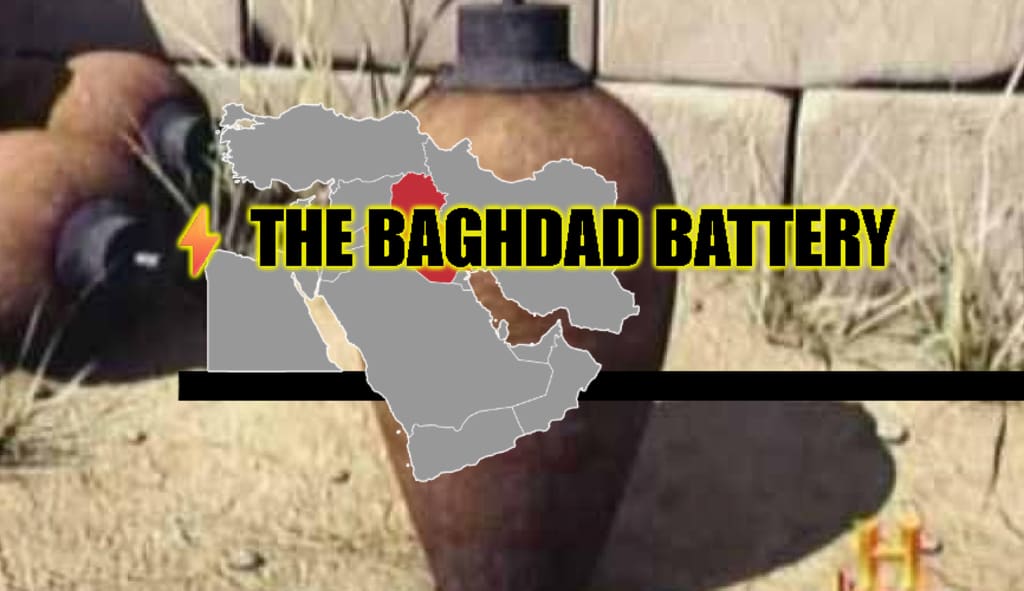
In the dusty heart of Iraq, not far from the site of the ancient city of Ctesiphon, a strange and controversial artifact was uncovered in the 1930s that would go on to stir decades of debate in archaeological and scientific circles. This small, unadorned object—a clay vessel with a copper cylinder and an iron rod—would become known as the Baghdad Battery, a name that would electrify imaginations around the world. The artifact was discovered during excavations at Khujut Rabu, a village near Baghdad, and was eventually examined by Wilhelm König, an Austrian archaeologist who was at the time the director of the National Museum of Iraq. König believed that the object, which dated to roughly between 250 BCE and 250 CE, may have been used as a kind of galvanic cell—a primitive battery that could generate electrical current.

The vessel itself measured about 13 to 14 centimeters in height, constructed from a simple orange-yellow clay. Inside the jar was a tightly fitted copper cylinder made of a rolled-up sheet of copper, and within that was a corroded iron rod. The copper cylinder was held in place by asphalt, which also sealed the jar at the top. The iron rod was similarly sealed within the cylinder and did not touch the copper. Upon inspection, König hypothesized that if an acidic liquid were poured into the jar—such as vinegar or lemon juice—it could function as an electrolyte and generate a small electric current between the iron and copper components. In essence, he believed that the artifact might be an ancient battery, developed long before Alessandro Volta's experiments in the 18th century.
Following König's provocative suggestion, the Baghdad Battery became a subject of repeated experimentation. In the 20th century, scientists and hobbyists attempted to replicate the battery using similar materials. When filled with fruit juice, vinegar, or wine—substances readily available in antiquity—replicas of the battery did indeed produce small amounts of voltage, often between 0.5 and 1.5 volts per jar. Connecting several such jars in series could increase the voltage output further, making it possible to perform tasks that required modest electrical power. These findings added intrigue to König's theory, though they did not conclusively establish the original purpose of the device.
One theory that emerged suggested that the Baghdad Battery might have been used for electroplating—an industrial process where an electric current is used to deposit a layer of metal onto the surface of another object. If the ancients had discovered this technique, they could theoretically have used the battery to plate objects with gold or silver, achieving fine decorative effects without requiring large quantities of precious metals. This explanation held considerable appeal because it aligned with known uses of low-voltage electricity in modern times. However, this theory ran into difficulties. Despite extensive studies of Parthian and early Persian artifacts, no confirmed examples of electroplated items dating to that period have ever been identified. Microscopic and metallurgical analysis of jewelry, coins, and other artifacts has not revealed the kind of smooth, uniform coatings typically associated with electroplating. As such, while the theory is technically plausible, it remains speculative due to a lack of supporting physical evidence.

Other scholars proposed that the battery had a ritualistic function rather than a technological one. In this view, the Baghdad Battery could have been used in religious ceremonies, perhaps as a device that produced small shocks to surprise or impress observers. The controlled use of electricity could have seemed divine or magical in the absence of scientific understanding. Some fringe theorists took this idea further, suggesting that ancient priests might have used such devices to simulate divine power, producing sparks or shocks as part of initiation rites or oracular rituals. However, like the electroplating hypothesis, this suggestion lacks any textual or artistic documentation. There are no known depictions in Mesopotamian, Parthian, or Sassanian art that show electrical devices or their ritual use, nor are there surviving texts that describe electrical phenomena.
Yet another theory proposed that the Baghdad Battery might have served some kind of medicinal function. Early forms of electrotherapy have been documented as far back as Greco-Roman times, especially using torpedo fish that produce mild electric shocks. In the modern era, the therapeutic use of low-voltage electricity has been explored for relieving pain and stimulating muscle tissues. If the ancients had stumbled upon a similar principle, they might have used the battery in medical treatment or pain relief. Again, this remains in the realm of speculation, as there is no medical text from the region or period that references such a treatment or tool.
Many experts in archaeology, particularly those skeptical of pseudoarchaeological interpretations, reject the idea that the Baghdad Battery was a battery at all. These critics argue that the jar’s components may have been misinterpreted or misassembled. It’s possible, they say, that the iron rod and copper cylinder were not originally part of the same object or did not serve any electrical function. Instead, they could have been part of a scroll container or served some other, more mundane, non-electrical purpose. Some skeptics point out that the corrosion patterns on the components do not clearly suggest long-term contact with acidic electrolytes, and no chemical residues have been recovered from the original jars to confirm they held vinegar, wine, or another acidic solution.

Moreover, there is no corroborating documentation or artifacts to suggest that electricity was understood or deliberately harnessed in the Parthian or Sassanian Empires. The Parthians, who ruled much of what is now Iran and Iraq from about 247 BCE to 224 CE, are well known for their military strength, distinctive cavalry tactics, and a blend of Hellenistic and Persian cultural elements, but there is no indication in surviving Parthian records or art of electrical experimentation. The Sassanians, who succeeded the Parthians and ruled until the Muslim conquests in the 7th century CE, were even more scientifically inclined, with notable advances in medicine, astronomy, and architecture. Still, their rich textual tradition contains no mention of devices resembling batteries or galvanic cells.
Despite the absence of definitive proof, the Baghdad Battery has captivated the public imagination. In popular media, it is often cited as an example of an “out-of-place artifact”—an item that supposedly doesn’t fit with the technological capabilities of its time. It has featured in television documentaries, speculative books, and countless online articles. For proponents of ancient technology theories, it serves as a tantalizing glimpse into a forgotten chapter of scientific knowledge. For skeptics, it is a cautionary tale about how easy it is to project modern ideas onto ancient objects.
The original Baghdad Battery, housed for decades in the National Museum of Iraq, may have been lost or looted during the chaos of the 2003 invasion of Iraq, when the museum was severely damaged and thousands of artifacts were stolen or destroyed. Its current status is uncertain, which adds yet another layer of mystery to the story. Without the ability to study the original object with modern techniques, researchers are forced to rely on photographs, descriptions, and reconstructions. The loss of the artifact represents a significant setback for those hoping to resolve the debate conclusively.
Nevertheless, experiments with replicas continue. Modern science confirms that the construction described by König can, under the right conditions, produce electricity. This fact is indisputable. Whether that was the object’s intended function in antiquity remains the central unanswered question. Was it a battery? Was it a coincidence of unrelated components? Or was it a clever trick of archaeological interpretation?

Until new evidence is found—perhaps more jars with chemical residues, detailed illustrations in a lost manuscript, or an unmistakable depiction of the device in ancient art—the Baghdad Battery will remain one of history’s most curious enigmas. It may never be possible to determine with certainty whether ancient Mesopotamians had unlocked the secrets of electricity, but the small clay jar continues to remind us how much we still don’t know about the ingenuity and complexity of past civilizations. Whether a simple container or an ancient marvel of electrochemistry, the Baghdad Battery stands as a symbol of the enduring mystery and wonder of the ancient world.
About the Creator
Kek Viktor
I like the metal music I like the good food and the history...
Keep reading
More stories from Kek Viktor and writers in History and other communities.
🏔️Mysterious metallic pipe found in a remote mountain, embedded in solid rock
High in the desolate reaches of China’s Qinghai Province, near the banks of a salty, windswept lake called Tuosu, a rocky mountain known as Mount Baigong juts out of the earth with an eerie presence. Its name, Baigong—or “White Palace”—has long been tied to local folklore, but in the late 1990s, it was thrust into the spotlight for something far more tangible and mysterious: embedded within its cave walls and nearby lakebed were strange, metallic-looking tubes—rust-red, hollow, and seemingly purposeful. These objects, later dubbed the “Baigong Pipes,” appeared to defy natural explanation. From their placement and appearance to their chemical makeup and alignment, the pipes have confounded visitors, stirred online forums, and inspired both scientific investigation and wild extraterrestrial speculation.
By Kek Viktor8 months ago in History
The Biggest Unsolved Mysteries in History That Still Baffle the World
1. The Disappearance of the Indus Valley Script The Indus Valley Civilization, which flourished around 2500 BCE in present-day India and Pakistan, was one of the world’s earliest urban societies. It boasted advanced city planning, sophisticated drainage systems, and standardized brick construction. However, one of its greatest mysteries is its undeciphered script. Thousands of inscriptions have been found on seals, pottery, and tools, yet no one has been able to decode their meaning. Unlike Egyptian hieroglyphs or Mesopotamian cuneiform, the Indus script lacks a bilingual inscription that could serve as a key. Without understanding their language, historians remain uncertain about their political systems, religious beliefs, and even the reasons behind the civilization’s decline. 2. The Lost City of Atlantis First mentioned by the Greek philosopher Plato around 360 BCE, Atlantis was described as a powerful and technologically advanced civilization that sank into the ocean “in a single day and night of misfortune.” Ever since, Atlantis has captured the imagination of scholars, explorers, and conspiracy theorists. Some believe Atlantis was purely allegorical—a moral lesson created by Plato. Others argue it may have been inspired by real events, such as the volcanic destruction of the Minoan civilization on the island of Thera (Santorini). Despite centuries of searching, no definitive archaeological evidence has proven Atlantis existed, leaving it suspended between myth and history. 3. The Construction of the Great Pyramids of Giza The Great Pyramids of Egypt, built over 4,500 years ago, remain among the most astonishing architectural feats in human history. The largest, the Pyramid of Khufu, consists of over two million stone blocks, some weighing more than 80 tons. The mystery lies not in who built them, but in how they were constructed with such precision using ancient tools. How were massive stones transported across vast distances? How were they lifted and placed so accurately? While theories range from ramps to complex pulley systems, no single explanation fully satisfies all the evidence. The pyramids continue to challenge our understanding of ancient engineering capabilities. 4. The Voynich Manuscript Discovered in 1912 by rare book dealer Wilfrid Voynich, the Voynich Manuscript is a handwritten book filled with strange illustrations, unknown symbols, and an indecipherable script. Radiocarbon dating places its creation in the early 15th century. Despite intense analysis by cryptographers, linguists, and even artificial intelligence, the text remains unreadable. Some believe it is a sophisticated code, others think it represents a lost language, while skeptics argue it could be an elaborate hoax. The manuscript’s purpose—whether medical, astronomical, or magical—remains one of the greatest puzzles in literary history. 5. The Amber Room Often referred to as the “Eighth Wonder of the World,” the Amber Room was a chamber decorated with panels made entirely of amber, gold leaf, and precious stones. Created in Prussia in the early 18th century, it was later gifted to Russia and installed in the Catherine Palace. During World War II, Nazi forces dismantled the room and transported it to Königsberg. After the war, it vanished without a trace. Countless searches have failed to locate it, leading to theories that it was destroyed, hidden in underground bunkers, or lost at sea. Its fate remains one of the most enduring art mysteries of modern history. 6. The Identity of Jack the Ripper In 1888, a series of brutal murders terrorized London’s Whitechapel district. The killer, known as Jack the Ripper, murdered at least five women and vanished without being identified. Despite numerous suspects proposed over the years—ranging from doctors and artists to members of the royal family—no conclusive evidence has ever confirmed the killer’s identity. Advances in forensic science, including DNA analysis, have reopened the case multiple times, yet the truth remains elusive, preserving Jack the Ripper as history’s most infamous unidentified criminal. 7. The Nazca Lines Etched into the desert plains of southern Peru, the Nazca Lines are enormous geoglyphs depicting animals, plants, and geometric shapes. Created between 500 BCE and 500 CE, these figures are best seen from the air. The mystery lies in their purpose. Were they astronomical calendars, religious symbols, irrigation markers, or ceremonial pathways? How did the Nazca people design such large-scale drawings without an aerial perspective? While scholars lean toward ritualistic and astronomical explanations, no definitive answer has been found. 8. The Fate of the Roanoke Colony In 1587, English settlers established a colony on Roanoke Island in present-day North Carolina. When supply ships returned three years later, the entire settlement had vanished. The only clue left behind was the word “CROATOAN” carved into a post. There were no signs of violence or struggle. Theories suggest the settlers may have assimilated with Native American tribes, relocated, or perished due to disease or famine. Despite extensive research, the true fate of the “Lost Colony” remains unknown. Why These Mysteries Endure What makes these mysteries so compelling is not just their unanswered questions, but what they reveal about humanity. They highlight the limits of our knowledge and remind us that history is not a complete record, but a fragmented story shaped by time, loss, and interpretation. Even with satellites, artificial intelligence, and advanced archaeology, some truths remain just out of reach. These unsolved mysteries continue to inspire research, debate, and imagination, proving that the past is far from silent—it is waiting for us to listen more closely.
By Say the truth 2 days ago in History


Comments
There are no comments for this story
Be the first to respond and start the conversation.