
The Hola Massacre
This horrid event greatly accelerated the attainment of Kenyan Independence.

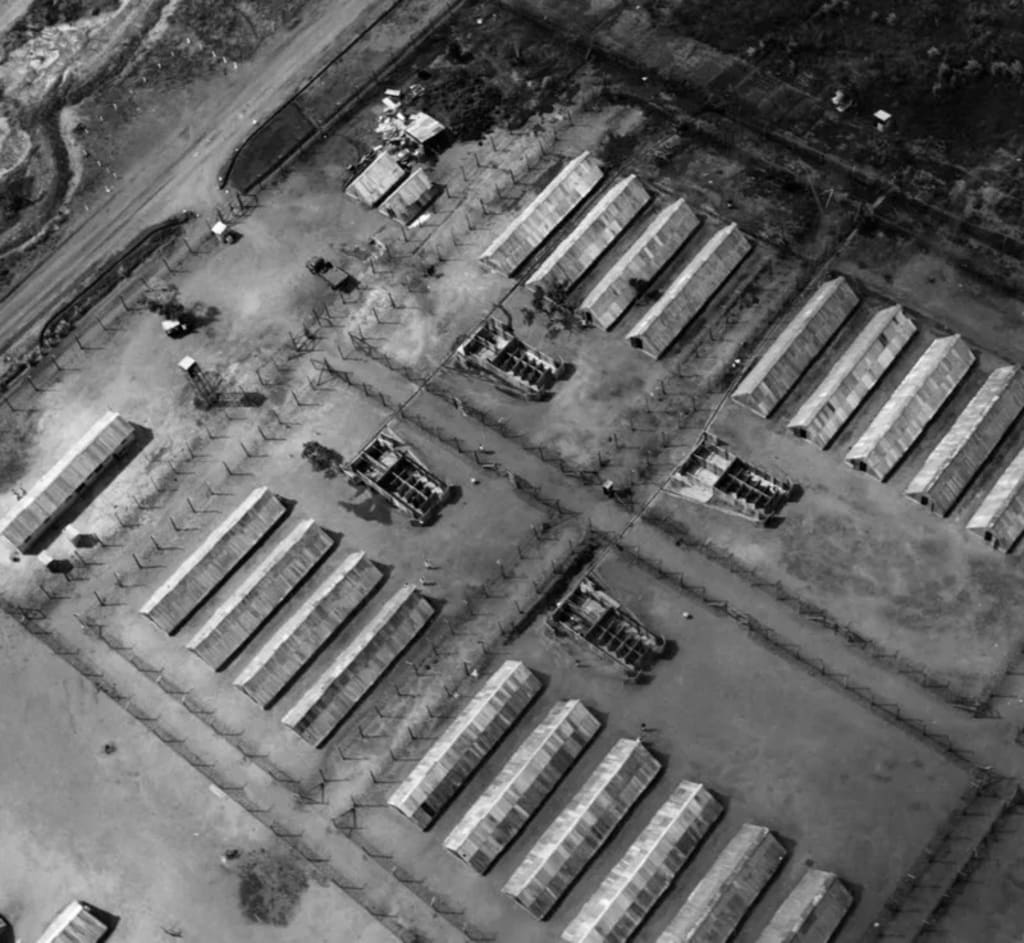
Hola Exile Camp was in an arid, mosquito-infested area in the East of the colony near Garissa. By March 1959, it held about 1000 hardcore detainees some of whom had been brought in from Mageta Island where they had participated in a major riot. On March 3rd 1959, 88 of the Hola detainees were marched outdoors for the day’s labour which they refused to do. They politely stated that they were liberation detainees and not prisoners meaning they did not have to work. While this was true in the years prior, the ‘Cowan Plan’ was now in effect empowering the guards to compel them to work if need be.
After the end of fighting in the forest in 1956, the detention 'Pipeline' was hastily emptied with the procedures of rehabilitation taking on a seemingly faster approach. The more hardcore detainees who remained in faraway camps had it rough as they were put under more and more pressure to confess and begin their journey down the pipeline. They had also become more headstrong in their resistance against the false confessions. To try and end this deadlock a memo by the senior superintendent of prisons, Mr J. B. T. Cowan, suggested that recalcitrant prisoners be manhandled to an outdoor site and then physically forced to do manual work.
They were surrounded by 170 guards with guns outside the compound and 30 inside, wielding batons. Upon their refusal, the white officer in charge, G. M. Sullivan, blew a whistle and the guards descended on the unarmed detainees. They were beaten up continuously from 8:00 am to 11:30 am. A cloud of dust rose as the helpless detainees rolled on the ground wailing in agony as blow after blow struck. When the whistle was blown, 11 detainees lay dead on the ground all the rest sustained very serious injuries that severely cut their lifespan and decreased their wellbeing.
Cover-up and Blowback
On the following day, a news report arrived in England stating that 11 detainees had died in Hola after drinking contaminated water. Though many former detainees including JM Kariuki did not believe this story at first, it was taken in stride in England. It was not until Barbara Castle got a call from Kenyatta’s former lawyer Dennis Pritt stating the initial autopsy reports that it became clear that these men had been clobbered to death. The British populace was horrified. The press christened it ‘The Hola Massacre’ and published story after story about it.
The British Prime Minister at the time, Harold Macmillan, recognized that the government was in ‘quite a jam’. A motion was moved in the House of Commons by Fenner Brockway while the news of the Hola Massacre was still fresh. He focused on the Pipeline explaining how although it was meant to rehabilitate Maumau insurgents, many of the detainees, who were perceived as hardcore, were actually nationalists. He explained that the conviction of their cause would lead them not to confess even after the extreme measures were employed to solicit confessions. He gave the example of former Chief Koinange, Achieng Oneko and Mr Kamau. For the first time thus far in the House of Commons, he articulately advocated for the release of Jomo Kenyatta who had by now almost finished serving the 7-year sentence he’d been given in Kapenguria earlier that decade.
As usual, neither Lennox Boyd nor Evelyn Baring was willing to admit what had really taken place, but the cat was already out of the bag. The Hola Massacre, validated years of allegations that had been made against the colonial government in regards to the Pipeline. The panicky cover-up only served to incriminate them more. From 3pm to well past 11pm on Tuesday 16 June 1959, Parliament discussed the exact events that occurred in Hola. Under constant criticism by Liberal parliamentarians like Barbara Castle, Fenner Brockway and Mr. James Callaghan, the Attorney General stammered out a defence for the colonial government that only seemed to confirm that the government already knew about the atrocities all along.
After this, the British had no option but to succumb to public pressure and hasten the independence process. The remaining detainees trickled home in a matter of weeks. The Pipeline and the disastrous Cowan Plan had become the colony’s undoing.
Read more about the elaborate system of detention used during the Kenyan Emergency via this link
About the Creator
HINGES OF TIME
Unlock the past with Hinges of Time⏳.
A community for history lovers, discourse and knowledge.
Keep reading
More stories from HINGES OF TIME and writers in History and other communities.
Manyani Detention Camp
Manyani was an enormous site, nearly three miles long by half a mile wide. At the time, this was the largest detention camp outside the Iron Curtain. It was, like most of the camps in the Pipeline, surrounded by barbed wire and watchtowers and patrolled by armed guards with police dogs. After Operation Anvil, detainees were being moved in batches of a thousand twice a week from the screening camps. J.M Kariuki who was transported from Langata, asserts that they were given no food at any point in the 2-day journey. All their possessions that were not packed into a box were confiscated upon arrival and the detainees became recipients of harsh beatings throughout the process of registration.
By HINGES OF TIME12 months ago in History

Comments
There are no comments for this story
Be the first to respond and start the conversation.