
The Infamous Smugglers That Ruled the South of England
The most profitable of these was known as The Hawkhurst Gang.

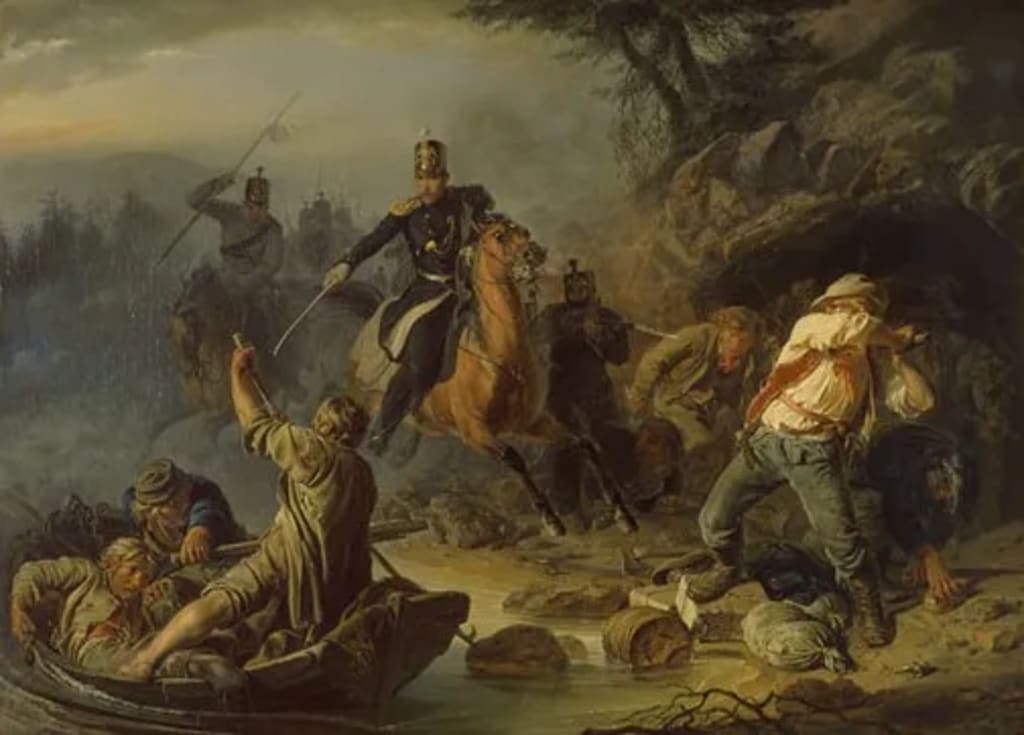
Growing up on the South Coast, I have always loved hearing stories of smuggling on the high seas. Once when I was a teenager, I remember having a party on the beach; the police came and told us we had to put the fire out because a law from 1700 prohibits the lighting of fires.
Pretty ridiculous, but in the 1700s, fires were used to signal boats out in the channel to let them know it was safe to bring the smuggled goods inland. It was no wonder this was a popular area with smugglers as on a clear day, you can see France in the distance.
Smuggling became popular during this time as many popular goods, such as tea and tobacco, had severe duties imposed on them to pay for a series of expensive wars. It was cheaper and easier to avoid the customs men and smuggle the goods inland. Some gangs were more successful than others, and none were more successful than The Hawkhurst Gang.
History of Smuggling in Kent
The smuggling along the beaches became a highly organised crime with gangs operating. Many church members and locals were involved in the enterprise and benefitted from the contraband that was brought across.
Much contraband was brought across the flat Romney Marsh on packhorses and shipped to London. Travel this route, and you soon come to a small hamlet known as Hawkhurst; it was here in the 1730s that the Hawkhurst Gang began operating out of farms and houses.
They were one of the most fearsome of these smuggling gangs. Although named after the small village, their reign of terror would continue throughout the south of England. They received one mention in 1735, but by 1740 they had evolved into a fighting force that dominated smuggling and the news for the next decade.
The Hawkhurst Gang
Down by the harbour in Rye, even today, sits a quaint little pub known as the Mermaid Inn. It was here in the 1700s, sat at the tables, you could find many members of the Hawkhurst Gang. So feared that they were able to sit there with loaded weapons on the table in front of them.
The gang started as a small local gang, but under the leadership of Arthur Gray and the notorious Kingsmill brothers, they soon found themselves in a commanding position across much of the South of England.
They were feared by most people and were frightened of no one. With the poor law enforcement in the area, they soon found themselves running much of Kent and the surrounding counties unchallenged.
Their vicious nature meant they dealt with those that wronged them in the worse ways. Richard Hawkins, who stole two bags of tea from them, was beaten to death. With no law enforcement, they became the law, and their justice was harsh and vicious.
Getting Noticed
The gang had primarily gone unchallenged by authorities; however, in 1747, their arrogance and confidence brought them to the eye of the government.
The gang were tipped off that a Customs service ship had recently captured a smuggling vessel which carried £500 of cargo, £115,000 today. The gang wanted the booty for themselves.
The contraband was stored in a poorly guarded Customs house in Poole, Dorset. On 7th October, led by Thomas Kingsmill, the gang met in a Chichester forest to start their ride to Poole.
When they arrived, the heist suddenly did not look as easy as they thought. Stationed in the sea guarding the house was a Royal Navy gunboat, with its guns trained on the door to shoot anyone who tried to enter.
Local knowledge is a powerful ally. The gang knew that the boat would lower in the sea once the tide went out, causing it to lose the perfect shooting angle. At 2 am, when the ship was low in the sea, they walked in, stealing 1,500kg of tea.
Although the heist was flawless, the government were furious at being made to look like fools, so they offered a £500 reward for anyone who could help catch the smugglers. It was the first time that The Hawkhurst Gang would be hunted appropriately for their crimes.
However, many locals relied on the gang for their tea, alcohol and tobacco; they were reluctant to lose the gang and stayed quiet.
Goudhurst
This is not to say that the gang had complete success in 1747; as well as the raid on the customs house, they also suffered one of their most embarrassing defeats.
Thomas Kingsmill and William Sturt were young men of similar age; both were also natives of Goudhurst; this is, unfortunately, where the similarities ended.
Sturt, who would become known as the Hero of Goudhurst, was one of the few men to stand up to the Hawkhurst gang in a battle known as the Battle of Goudhurst on 20th April 1747.
When Kingsmill marched into the village with a group of men, meaning to destroy the town, Strut led the defence. He had organised a group of men to fight the gang. The battle occurred around the church and churchyard, and if you visit today, you can still dig up lead shots from the fight.
Kingsmill was eager to show his fellow gang members that he was worthy of the role he held in the gang. He was arrogant and hotheaded. He rode into Goudhurst, threatening to kill the residents and burn the place to the ground.
As they galloped into sight of the church, they were stripped to the waist with their faces painted. They were armed with pistols and swords.
Strut was well prepared; he had already moved all the women and children to a nearby village as a precaution. He had also spent time training his men. They had dug trenches and erected barricades. Snipers were stationed in the church tower.
The gang opened the attack; they dismounted, firing at the church tower and the windows. But the locals fought back, aiming with long-range weapons volleys of musket fire from many directions.
The firing was too much for the gang, and they broke up quickly, fleeing in different directions. They had underestimated entirely Goudhurst's skill to defend the area.
Three of the smugglers died in the attack, including Kingsmill's brother. Kingsmill would never return to Goudhurst except in death. However, this did not wholly defeat the gang.
Murder
Daniel Chater was a shoemaker who had previously recognised a smuggler called John Diamond. The Customs called him as a witness and asked that he travel to East Marden, near Chichester, to give evidence.
Alongside him rode revenue Officer William Galley. Unfortunately, the pair became lost and stopped at a local pub to rest and ask directions; they did not realise that the pub they stopped at was a smuggler's pub.
Several people wanted to drink with the duo, and they soon found themselves quite drunk and unable to move. They did not know that this was the plan to keep them in the building until the gang arrived.
When the gang caught up with them, they whipped both until they could not move and tied them to their horses. At one point, Galley fell from the horse, and the gang, believing he had broken his neck, buried him in a shallow grave.
When Galley was found, he had his hand covering his face indicating that he was actually buried alive. The Charter did not fair any better. The smugglers resolved to throw him down a well, unsure whether he was dead, they then threw large stones on top of him.
The gang's violence diminished any good faith they may have had in the community and sparked outrage; the dominoes began to fall.
Capture
In 1948, the London Gazette issued a list of men wanted in the Poole heist. Outraged by the killings, locals began to take advantage of the reward money and gang members were slowly found and arrested.
In April 1747, Kingsmill and his fellow smuggler Fairall were found and tried; both were found guilty and sentenced to death by hanging. His body was then transported to Goudhurst and hoisted into a gibbet for all to see.
A gibbet was a metal cage in which a body was placed so that all could watch and smell it rot.
At least seventy-five gang members were hanged or transported, and as many as fourteen gibbets were full and dotted along the Kent and Sussex skyline.
Some of these gibbets still stand empty in the villages now as a memory of a time long passed. Property around Hawkhurst originates in smuggling; the tunnel network that helped the smugglers move goods remains, although not safe to enter, and some of the prominent homes that smuggling money paid for still stand.
About the Creator
Sam H Arnold
Fiction and parenting writer exploring the dynamics of family life, supporting children with additional needs. I also delve into the darker narratives that shape our world, specialising in history and crime.
Keep reading
More stories from Sam H Arnold and writers in History and other communities.
The Hero Whose Act of Defiance Against the Nazis Had Horrendous Reprisals
On an afternoon on 23rd March 1944, Rosario Bentivegna was walking through the streets of central Rome. He was wearing the blue outfit of a street sweep, pushing a garbage cart. As he walked past, no one noticed him; he was that inconspicuous.
By Sam H Arnold3 years ago in History
The Mirage of Separation: Why Autonomy Under Moroccan Sovereignty Is the Only Viable Path Forward
For nearly five decades, the dispute over the Moroccan Sahara has lingered as a frozen conflict—sustained less by the will of its people than by entrenched political narratives and regional rivalries. What began as a decolonization question has evolved into a geopolitical stalemate, one that has trapped generations in uncertainty and hindered integration across North Africa.
By Rachid Zidineabout 18 hours ago in History
Think for Me
"How do you calculate the circumference of a circle? Submit your answer when ready." [Pause] "Excellent! Every student was able to call up the answer electronically very quickly. If I, as a robot had feelings, I would express pride. You may break for lunch. Return to this cyber room in 45 minutes."
By Julie Lacksonen3 days ago in Humans




Comments
There are no comments for this story
Be the first to respond and start the conversation.