
The Lion’s Roar – Bhishma Leads the Kaurava Army
The Lion’s Roar – Bhishma Leads the Kaurava Army
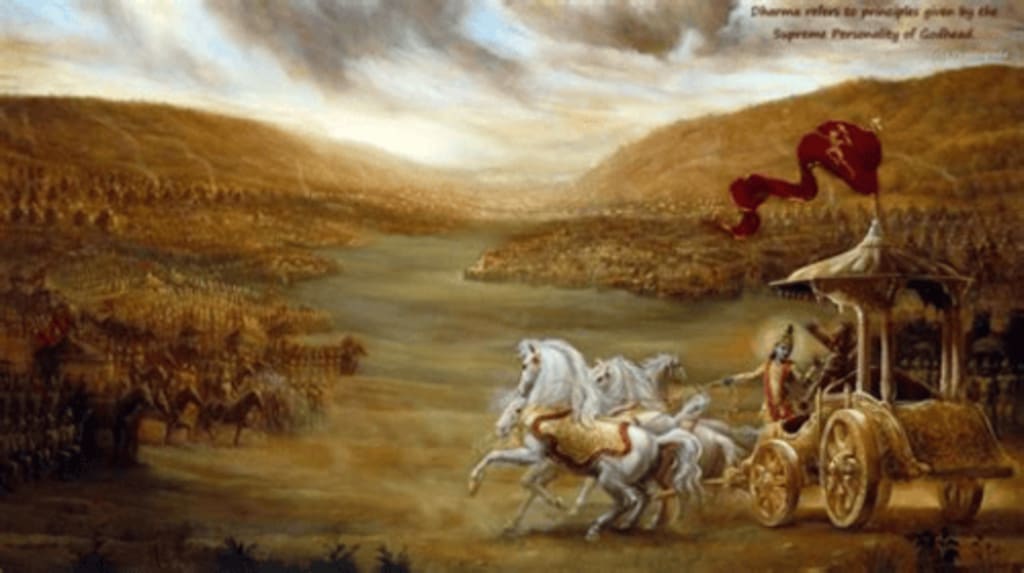
The first day of the Kurukshetra War, described in the Bhishma Parva of the Mahabharata, marked the beginning of one of the greatest battles in history. This day saw the mighty Bhishma, the grandsire of the Kuru dynasty, take command of the Kaurava forces and display his unmatched valor. His leadership and strategic use of vyuhas (army formations) demonstrated his brilliance as a commander, setting the tone for the days of battle to follow.
The Preparations for Battle
After years of tension and hostility between the Pandavas and Kauravas, the two sides gathered at the battlefield of Kurukshetra, ready to resolve their conflict through war. The Pandavas, led by Yudhishthira, sought to reclaim their rightful kingdom, while the Kauravas, under Duryodhana, sought to maintain their hold over the throne.
On the first day, both armies assembled their warriors and arranged their forces in elaborate vyuhas (military formations), a critical element in ancient Indian warfare. These formations were designed to maximize efficiency in offense and defense, with specific patterns tailored to suit the strategy for the day.
Bhishma Takes Command
The Kauravas placed their faith in Bhishma, their eldest and most experienced warrior, as the supreme commander of their army. Despite his love for the Pandavas, especially Arjuna, Bhishma was bound by his vow of loyalty to the throne of Hastinapura. He pledged to fight for Duryodhana, though he warned him that his arrogance and adharma (unrighteousness) would lead to destruction.
As the first rays of the sun touched the battlefield, Bhishma rode out on his grand chariot, holding his bow, Praswapa, and a quiver full of celestial arrows. His presence inspired confidence in the Kaurava ranks while striking fear into the hearts of the Pandavas.
The Vyuhas of the Day
On the first day of battle, both sides deployed formidable vyuhas, showcasing their strategic acumen.
Kaurava Formation: Mandala Vyuha
Bhishma arranged the Kaurava forces in the Mandala Vyuha, a circular formation. This formation was designed for versatility, allowing the army to quickly adapt to both offensive and defensive maneuvers. The Mandala Vyuha:
Provided flexibility to respond to attacks from multiple directions.
Allowed the outer ring of warriors to protect the core, where key commanders and reserves were stationed.
Maximized the use of archers and charioteers on the outer periphery for ranged attacks.
Bhishma himself took the central position in the formation, ensuring he could command the army effectively and respond to any breaches.
Pandava Formation: Vajra Vyuha
The Pandavas countered with the Vajra Vyuha, a diamond-shaped formation. This formation was designed for concentrated attacks, allowing the Pandavas to pierce through the enemy’s defenses and target key warriors. The Vajra Vyuha:
Focused on swift and direct attacks.
Positioned the strongest warriors, like Bhima and Arjuna, at the forefront to lead the charge.
Placed Yudhishthira at the center, surrounded by a protective ring of elite fighters.
The War Begins
As the conch shells of both sides echoed across the battlefield, signaling the start of the war, Bhishma took the lead for the Kauravas. His lion-like roar energized the Kaurava forces, and the armies surged forward, clashing in a thunderous wave of chariots, elephants, cavalry, and infantry.
Bhishma’s Prowess
Bhishma’s archery was unmatched. He rained down arrows upon the Pandava army, creating chaos and confusion in their ranks. His celestial weapons cut through the Pandava forces with precision, and no warrior could approach him without facing heavy losses.
Bhishma targeted the Pandava chariots with deadly accuracy, forcing their warriors to retreat temporarily.
His arrows felled hundreds of soldiers and shattered numerous chariots, making him an unstoppable force on the battlefield.
Arjuna’s Response
The Pandavas relied on Arjuna, their greatest warrior, to counter Bhishma’s ferocity. Arjuna, guided by Lord Krishna, who served as his charioteer, launched an equally fierce attack.
Arjuna used his Gandiva bow to shoot arrows that neutralized Bhishma’s volleys, protecting the Pandava forces from complete annihilation.
Krishna, with his keen strategic insight, maneuvered Arjuna’s chariot skillfully, ensuring they stayed ahead of Bhishma’s relentless onslaught.
Clashes Across the Battlefield
The first day saw fierce duels between key warriors on both sides:
Bhima vs. Duryodhana: Bhima, wielding his mace, targeted Duryodhana’s chariot, forcing him to seek reinforcements. Bhima’s strength and determination reminded the Kauravas of the Pandavas’ resilience.
Drona vs. Drupada: Drona, the Kaurava general, engaged in a heated battle with King Drupada of Panchala, reigniting their old rivalry.
Shalya vs. Nakula and Sahadeva: Shalya, the Kaurava ally and a skilled charioteer, faced Nakula and Sahadeva in a tactical duel that showcased his expertise.
The Outcome of the First Day
As the sun set, both armies paused their fighting, following the rules of ancient warfare, which prohibited combat after nightfall. The battlefield was strewn with the bodies of fallen soldiers, broken chariots, and the remains of horses and elephants. The Kauravas, led by Bhishma, had the upper hand, inflicting significant losses on the Pandava army.
However, the Pandavas remained undeterred. Arjuna, Bhima, and Krishna inspired their forces to fight on, determined to uphold dharma and reclaim their rightful kingdom.
Legacy of the First Day
The first day of the Kurukshetra War set the stage for the epic conflict, showcasing Bhishma’s strategic brilliance and unparalleled prowess. His leadership and use of the Mandala Vyuha demonstrated his skill as a commander, while Arjuna’s counterattacks proved the Pandavas’ resilience.
This day marked the beginning of a war that would test the strength, resolve, and principles of both sides, leading to a climactic battle for dharma and justice. The Lion’s Roar of Bhishma echoed not just across Kurukshetra but throughout history, symbolizing the start of an epic saga that would shape the destiny of Bharatavarsha.
About the Creator
Keep reading
More stories from sai Charan and writers in History and other communities.
The story of sree krishna Rayabaram
The Rayabaram (Krishna’s peace mission) is a critical episode in the Mahabharata, showcasing Lord Krishna’s role as a divine mediator and diplomat. As a messenger of peace, Krishna attempts to avert the devastating Kurukshetra war by negotiating with the Kauravas on behalf of the Pandavas. His mission is a profound example of wisdom, humility, and the pursuit of dharma.
By sai Charanabout a year ago in History



Comments
There are no comments for this story
Be the first to respond and start the conversation.