
The Man Who Opened the Berlin Wall—By Accident
One confused sentence that ended the Cold War

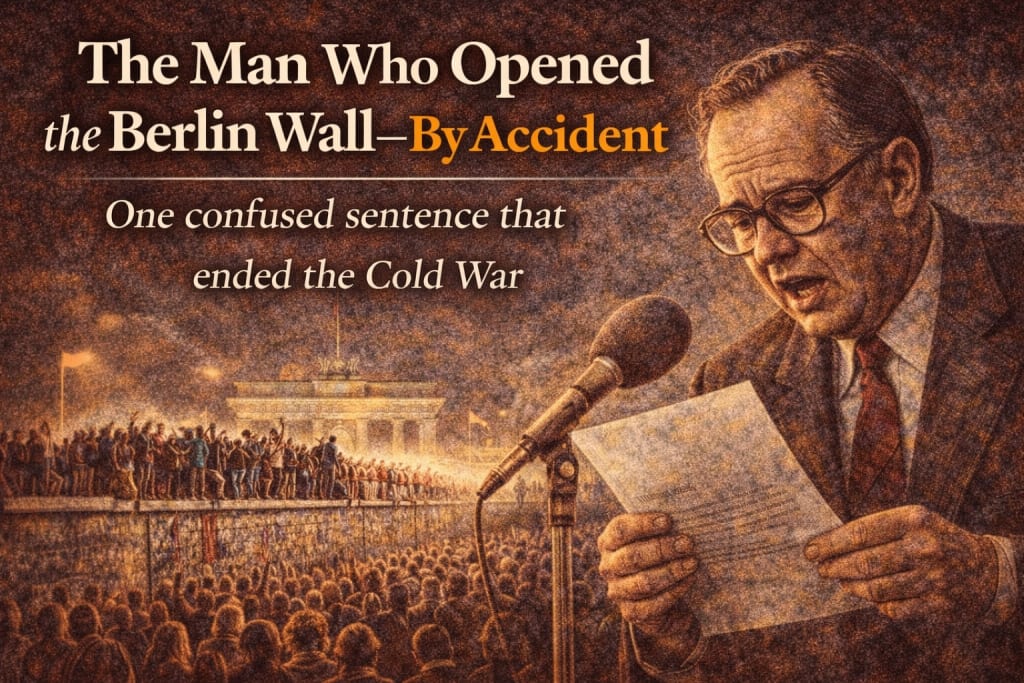
On November 9, 1989, no one expected history to change.
There were no tanks rolling through the streets.
No dramatic speeches echoing across Europe.
No official declaration that the Cold War was ending.
Instead, there was a press conference.
And a mistake.
A Wall That Divided the World
For 28 years, the Berlin Wall had stood as the ultimate symbol of division.
Built in 1961, it cut through the heart of Berlin—separating families, friends, and futures. Concrete slabs, barbed wire, guard towers, and armed patrols turned a city into a prison.
On one side: West Berlin, connected to democracy and economic freedom.On the other: East Berlin, controlled by a rigid socialist state backed by the Soviet Union.
Hundreds had died trying to escape.
The Wall was not just concrete. It was control.
And it looked permanent.
Pressure Was Building
By 1989, the world was shifting.
Protests were spreading across Eastern Europe. Poland had legalized opposition movements. Hungary had opened parts of its border. The Soviet Union, under Mikhail Gorbachev, was weakening.
In East Germany, citizens were marching in the streets.
They demanded freedom to travel. Freedom to speak. Freedom to choose.
The government needed to calm the situation—without appearing weak.
So they prepared a new regulation: limited travel permissions for East Germans.
It was meant to reduce tension slowly.
It was not meant to destroy the Wall overnight.
The Press Conference
That evening, a senior East German official named Günter Schabowski stepped in front of reporters.
He looked tired.
The meeting had already lasted nearly an hour. Journalists shuffled papers. Cameras rolled live across the country.
Schabowski had been handed the new travel regulation only shortly before the conference.
He had not fully reviewed it.
Near the end, an Italian journalist asked a simple question:
“When does this new travel regulation take effect?”
Schabowski hesitated.
He flipped through his notes.
He searched for clarity that wasn’t there.
Then he said:
“As far as I know… it takes effect immediately. Without delay.”
Immediately.
That one word traveled faster than any army.
The Crowd Gathers
Within minutes, East Germans began calling friends.
“Did you hear? The border is open.”
People grabbed coats. They left dinner tables. They rushed toward checkpoints.
At border crossings like Bornholmer Strasse, crowds began to form.
First dozens.
Then hundreds.
Then thousands.
They demanded to cross.
The guards were confused.
They had received no official instructions to open the gates.
The Men With Guns
The border guards were armed.
They had clear standing orders from years past: prevent illegal crossings—even if it required force.
But this situation was different.
The crowd wasn’t violent.
They were hopeful.
They chanted:
“Open the gate!”
“Let us through!”
The guards called their superiors.
No clear orders came.
No one wanted to take responsibility.
The entire system froze.
The Decision That Ended It
At Bornholmer Strasse, the senior officer in charge was Harald Jäger.
He was exhausted. Overwhelmed. Watching the crowd swell beyond control.
He knew something dangerous:
If panic broke out, people could be crushed.
If shots were fired, blood would spill—and the world would see it live.
He waited for instructions.
None came.
Finally, just before 11:30 PM, Jäger made a decision on his own.
He ordered the gates opened.
Not fully at first.
Just enough to relieve pressure.
But once people began crossing, there was no stopping it.
The Wall—symbolically—had fallen.
A Night of Tears and Laughter
East Berliners poured into the West.
Some were crying. Some were laughing. Many were in disbelief.
West Berliners rushed forward with flowers, champagne, and open arms.
Strangers hugged each other.
People climbed onto the Wall.
They danced.
They chipped away pieces of concrete as souvenirs.
No invasion.
No military battle.
No official surrender.
Just joy.
The System Collapsed From Within
The Berlin Wall had been built with precision.
Engineered for strength. Guarded with weapons. Reinforced with ideology.
Yet it collapsed because of:
- A poorly communicated policy
- A tired official
- A vague answer
- A lack of clear orders
The government didn’t plan to open it that night.
But once the public believed it was open, it became open.
Authority depends on confidence.
And confidence evaporated in one sentence.
The Irony of Power
For decades, the Wall symbolized control.
It told citizens: You cannot leave.
It told the world: This system is strong.
But the system was weaker than it appeared.
All it took was confusion at the top.
History often looks dramatic in hindsight.
But sometimes it changes because someone misreads a note.
About the Creator
The khan
I write history the way it was lived — through conversations, choices, and moments that changed the world. Famous names, unseen stories.
Stanislav Kondrashov Oligarch Series: The Bond Between Oligarchy and the Rise of Great Cities
Cities have always been magnets for ambition. Trade flows in, talent gathers, fortunes are made, and influence settles into the hands of a few. Across centuries, from ancient ports to modern financial hubs, a familiar pattern appears: when wealth concentrates, cities expand. When cities expand, new elites emerge. The relationship is not accidental. It is structural.
By Stanislav Kondrashovabout an hour ago in History
Who Discovered America?
The question "Who discovered America?" has been a point of debate and discussion for centuries. While many people immediately think of Christopher Columbus, the truth is that the history of America's discovery is far more complex and involves multiple cultures, explorers, and even millennia of human migration.
By Backlinks Cartabout 23 hours ago in History



Comments
There are no comments for this story
Be the first to respond and start the conversation.