
The Mysterious Titanic Journey
Unraveling the Secrets Behind the World’s Most Tragic and Enigmatic Sea Voyage

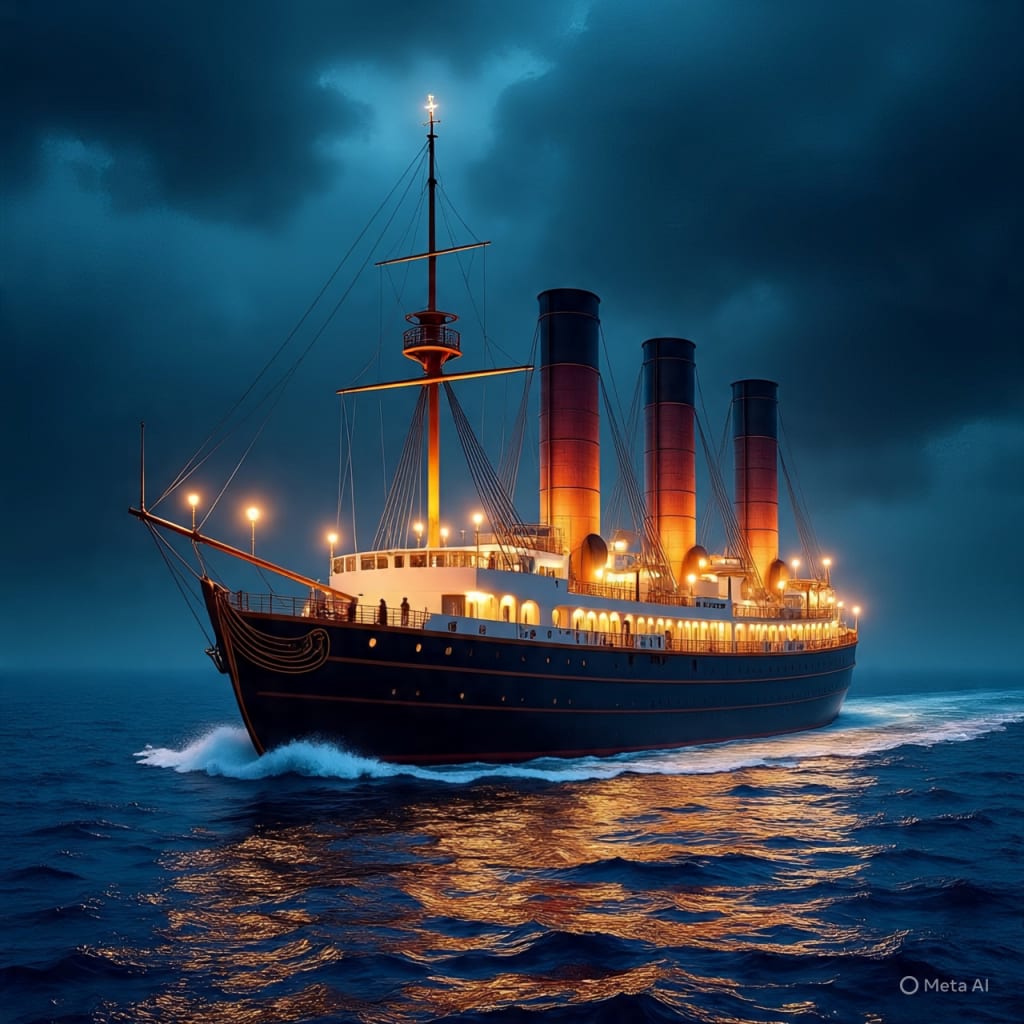
The Titanic's story is often told as a tale of tragedy, luxury, and human error, but beneath its icy demise lies a web of mysteries that continue to baffle historians and intrigue conspiracy theorists. “The Mysterious Titanic Journey” explores the deeper, lesser-known layers of one of history’s most iconic maritime disasters, uncovering eerie coincidences, unanswered questions, and stories lost beneath the waves.
Constructed with the finest steel and fitted with opulent interiors, RMS Titanic was hailed as the "unsinkable ship." It was more than just a vessel; it was a floating palace and a symbol of early 20th-century industrial ambition. Yet, despite its unmatched craftsmanship and confidence-inspiring design, it met a chilling fate on its maiden voyage across the North Atlantic.
Departing from Southampton on April 10, 1912, the Titanic embarked on its first and final journey toward New York City. On board were over 2,200 passengers, ranging from wealthy elites in first-class cabins to hopeful immigrants packed in steerage. But four days into the voyage, the ship struck an iceberg and sank in less than three hours, taking over 1,500 lives with it.
While the iceberg collision is widely accepted as the cause of the disaster, numerous peculiarities surround the Titanic’s voyage. For instance, the ship received multiple iceberg warnings that night from other vessels, but many were either ignored or delayed. Why were these vital messages not taken more seriously? Was it overconfidence, human error, or something more deliberate?
Adding to the mystery is the ship's strange speed. The Titanic was reportedly traveling at near-maximum velocity despite iceberg warnings. Captain Edward Smith, a seasoned sailor nearing retirement, was known for caution, yet on this journey, he seemed uncharacteristically bold. Some speculate he was under pressure from White Star Line executives to set a speed record. But could there have been another motive?
One of the most puzzling elements of the Titanic journey lies with the so-called “switch theory.” According to this conspiracy, the Titanic was swapped with its sister ship, the RMS Olympic, which had sustained damage in a prior accident. The theory suggests that the sinking was part of an elaborate insurance fraud. While evidence is circumstantial, photographic comparisons, ship logs, and even survivor testimonies have been cited in support of this eerie possibility.
The Titanic also carried notable passengers whose presence adds further intrigue. Among them were John Jacob Astor IV, the richest man on the ship, Benjamin Guggenheim, and Isidor Straus, co-owner of Macy’s. All were powerful figures who tragically perished. Some theories suggest they were targeted due to their opposition to the creation of the U.S. Federal Reserve, which was established shortly after the disaster. Could the Titanic have been more than a maritime tragedy—possibly a stage for political elimination?
Further deepening the mystery is a strange piece of fiction published years before the Titanic's journey. Morgan Robertson’s 1898 novella, Futility, or the Wreck of the Titan, eerily predicted a ship named Titan that sank in April in the North Atlantic after hitting an iceberg. The similarities are so uncanny that many question whether Robertson had a premonition—or access to classified knowledge. How could a fictional story mirror the Titanic’s fate so closely?
The Titanic's journey is also shrouded in ghost stories and paranormal claims. Survivors described hearing eerie sounds during the voyage, and some even claimed they had premonitions not to board the ship. After the wreck, there were numerous reports of strange sightings in the area where the Titanic sank, from ghost ships to unexplained lights. Could the spirits of the drowned still linger beneath the Atlantic waves?
Another enduring mystery revolves around the Californian, a nearby ship that many believe could have saved hundreds. The Californian's wireless operator had gone off duty, and the crew failed to interpret the Titanic’s distress flares. Some argue that the ship's inaction was due to negligence, while others suspect orders were given to stay away. What were the true circumstances behind their silence during such a crucial moment?
Perhaps the most compelling aspect of the Titanic mystery is how so much went wrong in such a short time. Lifeboats were launched half-empty, distress signals were delayed, and evacuation procedures were chaotic. Titanic had the capacity to carry over 60 lifeboats but only took 20 onboard—enough for barely half of those aboard. Was it arrogance or deliberate negligence? How did so many systems fail on the most advanced ship of its time?
Diving expeditions over the years have uncovered haunting scenes from the wreck site: perfectly preserved champagne bottles, ghostly corridors, and artifacts scattered across the ocean floor. These expeditions have brought closure for some, but also raised more questions. Notably, parts of the ship show damage inconsistent with an iceberg strike alone. Some researchers propose there may have been an onboard explosion, possibly from coal dust ignition, which contributed to the disaster.
Despite more than a century passing since the Titanic's sinking, interest in its story remains strong. Documentaries, films, and books continue to explore every angle. James Cameron’s 1997 blockbuster helped reignite public fascination, yet even his deep-sea explorations didn’t answer every question. The Titanic’s hold on our collective imagination lies not just in the scale of the tragedy, but in the secrets it seems to guard even in death.
Modern technology has allowed scientists to create 3D scans of the wreck, providing new insights into how the ship broke apart and what may have happened during those final hours. However, parts of the wreck are deteriorating fast. Bacteria and saltwater corrosion threaten to erase what’s left of the ship. Will we uncover all the answers before time runs out, or will the Titanic forever remain a deep-sea enigma?
As new information comes to light, many are advocating for more preservation efforts and historical transparency. Questions about ownership, artifact retrieval, and ethics continue to stir debate. Should we leave the Titanic in peace as a watery grave, or is it our duty to uncover every secret it holds for the sake of history?
Even after all these years, the Titanic’s story refuses to rest. With each revelation comes another layer of complexity, making it one of the most endlessly fascinating and mysterious journeys in maritime history. Whether it's the suspicious absence of key crew members, the ill-fated decisions made at sea, or the eerie predictions written years before the voyage, the Titanic’s story is far from complete.
What if we’ve only scratched the surface of what really happened that fateful April night? Could the Titanic be part of a broader narrative involving global elites, political schemes, and supernatural forces? These questions linger like whispers on the ocean floor, unanswered and unnerving.
As we continue to search for truth amidst wreckage, we must remember that the Titanic was not just a ship, but a floating world filled with dreams, ambitions, and lives cut tragically short. Honoring its legacy means not only remembering its passengers but daring to ask the questions that history left behind.
Thanks for readng!
About the Creator
Lana Rosee
🎤 Passionate storyteller & voice of raw emotion. From thoughts to tales, I bring words to life. 💫
Love my content? Hit Subscribe & support the journey! ❤️✨
Keep reading
More stories from Lana Rosee and writers in History and other communities.
From Coffee to Covers
It all began with a cappuccino and a dream. On the corner of Maple and Fifth stood a quaint café that seemed ordinary to passersby. But to the locals, “Brew & Bind” was no ordinary coffee shop. It was where caffeine met creativity, where coffee lovers evolved into cover collectors, and where an unexpected movement was born.
By Lana Rosee7 months ago in BookClub
Dow Jones
The Dow Jones Industrial Average, often simply called the Dow, is one of the most recognized stock market indexes in the world. When people hear headlines like “Dow today jumps 200 points” or “DJIA today slides amid economic uncertainty,” they are witnessing a snapshot of investor confidence, economic expectations, and market psychology all rolled into one number. But behind those daily movements lies a much deeper story about how the modern U.S. economy operates. What Is the Dow Jones Industrial Average? The Dow Jones Industrial Average (DJIA) is a stock market index that tracks 30 major publicly traded companies in the United States. These companies are considered leaders in their respective industries and collectively represent a broad view of American corporate strength. Despite its name, the DJIA is no longer limited to industrial companies. Today, it includes businesses from sectors such as technology, healthcare, finance, and consumer goods. Unlike many modern indexes that are weighted by market capitalization, the Dow Jones is price-weighted. This means companies with higher stock prices have a greater influence on the index’s movement, regardless of their overall size. While this methodology is sometimes criticized, it has remained unchanged for over a century, preserving the index’s historical continuity. Why the Dow Still Matters In an era dominated by broader indexes like the S&P 500 and tech-heavy benchmarks, some investors question the relevance of the Dow. Yet the Dow continues to hold symbolic and practical importance. It is often the first index cited in market news, making it a key reference point for both seasoned investors and casual observers. When analysts discuss dow today, they are often speaking about more than just numbers. Daily movements in the DJIA reflect investor reactions to inflation data, interest rate decisions, corporate earnings, geopolitical tensions, and even consumer sentiment. Because its components are established blue-chip companies, the Dow offers insight into how major corporations are navigating economic conditions. How the DJIA Is Calculated The DJIA’s calculation is straightforward but unique. The prices of all 30 component stocks are added together and then divided by a figure known as the Dow Divisor. This divisor is adjusted over time to account for stock splits, dividends, and corporate restructuring, ensuring continuity in the index’s value. This structure means that a sharp move in one high-priced stock can significantly influence djia today, even if other companies remain stable. While this can create volatility, it also highlights shifts in investor sentiment toward specific market leaders. Interpreting Dow Jones Movements Understanding what drives the dow jones on any given day requires context. A rising Dow often signals optimism about economic growth, stable inflation, or strong corporate earnings. Conversely, a falling Dow may indicate concerns over recession risks, tighter monetary policy, or global instability. However, it’s important to look beyond daily fluctuations. Short-term moves in dow today can be influenced by news cycles or emotional reactions, while long-term trends often reflect deeper economic fundamentals. Investors who focus solely on daily point changes risk missing the broader narrative shaping the market. The Role of the Dow in Long-Term Investing While traders may focus on intraday movements, long-term investors often view the Dow as a historical benchmark. Over decades, the Dow Jones Industrial Average has demonstrated the power of compounding growth, despite periods of downturn, crashes, and uncertainty. Major events such as financial crises, pandemics, and political upheaval have all left their mark on the DJIA. Yet the index has consistently recovered over time, reflecting the resilience of the U.S. economy and its largest corporations. This long-term perspective is why many retirement portfolios and investment strategies still use the Dow as a reference point. Dow Today in a Changing Market Landscape The modern market environment is vastly different from when the Dow was first created. Technology now plays a dominant role, global markets are deeply interconnected, and information travels instantly. As a result, djia today often reacts quickly to developments far beyond U.S. borders. Interest rate policies from central banks, supply chain disruptions, and shifts in consumer behavior can all impact the Dow within minutes. This fast-moving environment underscores the importance of staying informed and understanding the forces that influence market behavior rather than reacting emotionally to daily swings. Limitations of the Dow Jones Despite its prominence, the Dow Jones has limitations. With only 30 companies, it does not represent the full diversity of the U.S. stock market. Smaller companies and emerging sectors are largely absent, which can sometimes make the index less reflective of broader economic trends. Additionally, its price-weighted structure can distort perception, giving outsized influence to higher-priced stocks. For this reason, many investors use the Dow alongside other indexes to gain a more balanced market view. A Symbol That Endures Even with its imperfections, the Dow remains a powerful symbol of market performance. It serves as a bridge between financial professionals and the general public, offering a familiar metric to gauge economic confidence. When headlines discuss dow today, they capture attention because the index represents more than stocks—it reflects hopes, fears, and expectations about the future. Final Thoughts The Dow Jones Industrial Average is more than just a number flashing across a screen. It is a living record of American business history, shaped by innovation, crisis, and recovery. Whether you are tracking djia today for investment decisions or simply to understand market sentiment, the Dow offers valuable insight into how the world’s largest economy is performing. By viewing the Dow with context and patience, readers and investors alike can appreciate its role not just as a market index, but as a long-standing indicator of economic momentum and resilience.
By Saboor Brohi a day ago in History
The "Demon Core": The two days in history when a sphere of plutonium "ticked" like a bomb.
The blue light didn’t flicker; it pulsed, a silent, electric scream that filled the room for a heartbeat before vanishing into the humid New Mexico night. Harry Daghlian didn’t scream. He didn’t even move at first. He just stood there in the heavy silence of the Omega Site, his hand hovering over a stack of tungsten carbide bricks, feeling a sudden, metallic tang on the back of his tongue. It tasted like pennies and ozone. It was the flavor of a death sentence.
By The Chaos Cabinetabout 22 hours ago in History
Self Help: Grifters' Gospel
On Self-Help, Snake Oil, and the Illusion of Change Psychology professionals and students can be imagined on two opposite sides of a line called self-help books: likely a larger group opposes pop-science and step-by-step manuals filled with talk of success, journaling, and not giving a f**k; others love them, but they aren’t many.
By Avocado Nunzella BSc (Psych) -- M.A.P 6 days ago in BookClub



Comments
There are no comments for this story
Be the first to respond and start the conversation.