
The Pandavas disguise in virata kingdom
The starting of virata parvam
Background
After completing twelve years of exile in the forest, the Pandavas prepared for their final year, known as the Agyatvas (incognito exile). They needed a secure place to live and blend in, away from the prying eyes of the Kauravas. The Pandavas chose to seek refuge in the Kingdom of Virata, ruled by King Virata, a valorous but unsuspecting monarch.
To ensure their identities remained hidden, the Pandavas and Draupadi adopted disguises and took on various roles in the royal court and household.
The Roles Taken by the Pandavas and Draupadi
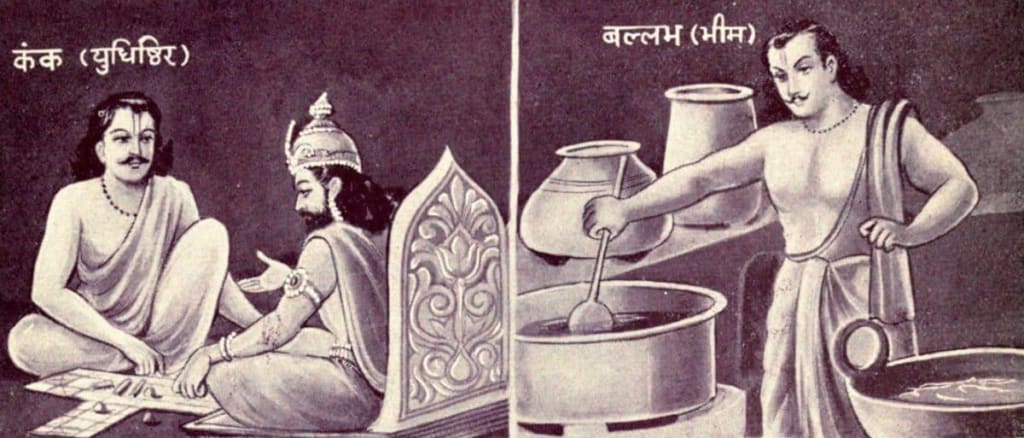
1. Yudhishthira as Kanka (Advisor and Dice Player)
The eldest Pandava, Yudhishthira, assumed the identity of Kanka, a brahmin and expert dice player.
He became an advisor and companion to King Virata, often engaging in games of dice with the king.
Yudhishthira’s calm demeanor and wisdom made him a trusted figure in Virata’s court, ensuring the Pandavas’ safety.
2. Bhima as Ballava (Cook and Wrestler)
Bhima, the second Pandava, took on the role of Ballava, a cook in the royal kitchen.
Renowned for his immense strength and appetite, Bhima easily managed the duties of the kitchen, preparing feasts for the royal family.
To maintain his physical prowess, Bhima occasionally participated in wrestling matches and other physical competitions in secret.
3. Arjuna as Brihannala (Dance and Music Teacher)
Arjuna, the greatest warrior among the Pandavas, disguised himself as Brihannala, a eunuch.
As Brihannala, Arjuna taught dance, music, and arts to Princess Uttara, the daughter of King Virata.
This role was particularly poignant for Arjuna, as it allowed him to remain concealed while still contributing to the royal household.
4. Nakula as Granthika (Keeper of Horses)
Nakula, known for his skills with animals, took on the role of Granthika, a caretaker of the royal stables.
He managed the king’s horses, ensuring they were well-fed, groomed, and ready for battle.
Nakula’s expertise with horses earned him the trust and respect of the royal staff.
5. Sahadeva as Tantipala (Keeper of Cattle)
Sahadeva, the youngest Pandava, became Tantipala, a caretaker of the king’s cattle.
He oversaw the herds, ensuring their safety and well-being.
His role was vital in maintaining the kingdom’s wealth, as cattle were a significant source of prosperity.
6. Draupadi as Sairandhri (Maidservant to the Queen)
Draupadi, the wife of the Pandavas, assumed the identity of Sairandhri, a maidservant in the service of Queen Sudeshna, the wife of King Virata.
Known for her beauty and grace, Draupadi attracted attention even in her humble role, which eventually led to a dramatic confrontation.
The Pandavas in Virata's Court
Each Pandava and Draupadi performed their roles flawlessly, blending into the kingdom’s daily life while remaining vigilant about their true identities. However, their time in Virata’s kingdom was not without challenges.
Draupadi’s Ordeal
Draupadi’s beauty and poise caught the eye of Kichaka, the commander of Virata’s army and Queen Sudeshna’s brother. Kichaka was a powerful but arrogant and lecherous man. Infatuated with Draupadi, he attempted to seduce her repeatedly. Draupadi, faithful to her husbands and devoted to dharma, rejected his advances.
Enraged by her refusal, Kichaka publicly humiliated Draupadi and attempted to assault her. Draupadi, in her distress, sought Bhima’s help. Bhima, incensed at Kichaka’s actions, devised a plan to teach him a lesson.
One night, Draupadi lured Kichaka to a meeting in the palace hall. Expecting to meet her, Kichaka found Bhima waiting instead. Bhima, in his fury, killed Kichaka with his bare hands, crushing him into a mangled heap. The incident caused a stir in the kingdom but also ensured Draupadi’s safety for the remainder of their stay.
The Kauravas’ Search
Meanwhile, the Kauravas, led by Duryodhana, were actively searching for the Pandavas, eager to uncover their whereabouts and force them into another twelve years of exile. Despite their efforts, the Pandavas remained hidden, their disguises protecting them from discovery.
The Virata War and the Revelation
Toward the end of their incognito year, King Virata faced an invasion by the Trigartas, a neighboring kingdom allied with the Kauravas. The Trigartas raided Virata’s cattle, threatening the kingdom’s prosperity. With the royal army engaged elsewhere, Prince Uttar, Virata’s son, was tasked with leading a counterattack.
Arjuna, still in his disguise as Brihannala, volunteered to be Prince Uttar’s charioteer. Initially reluctant to rely on a eunuch, Uttar eventually agreed. As they approached the battlefield, Arjuna revealed his true identity to Uttar, retrieving his divine weapons hidden in a tree before the Pandavas entered Virata.
Arjuna single-handedly defeated the Trigartas and routed their army, displaying his unmatched skill as a warrior. The news of his victory reached Virata, who was astounded by Brihannala’s transformation into the great Pandava prince.
When the Pandavas revealed their true identities to King Virata, he was overwhelmed with gratitude and respect. He offered his daughter Uttara in marriage to Arjuna as a gesture of alliance. However, Arjuna, considering Uttara his student, proposed that she marry his son, Abhimanyu, instead. This alliance strengthened the bonds between the Pandavas and the Kingdom of Virata.
Themes and Lessons
The Pandavas’ year in disguise at the Kingdom of Virata teaches several important lessons:
Adaptability and Humility:
Despite being royal warriors and rulers, the Pandavas took on humble roles to fulfill their duty, showing adaptability and humility in the face of adversity.
Loyalty and Protection:
The Pandavas’ unwavering loyalty to Draupadi and their swift action to protect her from Kichaka highlight their commitment to their family.
Strategic Thinking:
Their disguises and careful planning ensured that they remained hidden despite the Kauravas’ efforts to uncover them.
Justice and Retribution:
Bhima’s punishment of Kichaka serves as a reminder of the consequences of arrogance and unrighteous behavior.
Dharma and Alliances:
The Pandavas’ actions and their alliance with Virata emphasize the importance of dharma and building strong relationships in times of need.
About the Creator
Keep reading
More stories from sai Charan and writers in History and other communities.
Jayadratha abducting Drauapdi
The story of Saindhava (Jayadratha) abducting Draupadi is a lesser-known yet significant episode in the Mahabharata, highlighting Draupadi’s courage, the Pandavas’ protective bond, and the consequences of dishonorable actions. Here’s a detailed retelling:
By sai Charanabout a year ago in History
Jesse Jackson
Jesse Jackson, Charismatic Champion of Civil Rights, Dies at 84 Few American figures embodied the fusion of moral courage, political strategy, and humanitarian conviction quite like Rev. Jesse Louis Jackson Sr. For more than six decades, he used his voice, influence, and unshakable spirit to confront injustice—whether on the streets of the segregated South, the international stage, or inside the highest halls of U.S. politics.
By Organic Products 5 days ago in History
There's A Hole in My Bucket
It’s a well-known fact that Liza Dufresne was always the brains in the family. She was the one who always came up with the brilliant schemes the Dufresne kids carried out when they were younger. Like when they tricked Mrs. Claybourn into paying for a trip to Disney World. Liza convinced her that their parents had been kidnapped and were being held for ransom for the total price of three tickets. In reality, they were away on a weekend getaway for their anniversary. When they returned, Liza told the Claybourns that they did not like to talk about the ordeal. Their parents never found out how they got the money. Mrs. Claybourn never found out that the Dufresne parents were never really in any danger.
By David E. Perry5 days ago in Fiction



Comments
There are no comments for this story
Be the first to respond and start the conversation.