
The Restoration of a Historic House
Echoes of the Past: The Rebirth of a Tuscan Villa and the Secrets it Holds

Part 1: The Discovery
The villa, once a grand estate overlooking the tranquil Tuscan hills, stood abandoned, wrapped in an aura of forgotten elegance. It had been the heart of the De Rossi family, whose lineage stretched back centuries. The stories of its opulent past, filled with lavish parties and political intrigues, were known to every villager, but the villa had fallen silent after the last De Rossi, Elisabetta, passed away. The family line ended, and the villa, stripped of its purpose, decayed, becoming little more than a ghostly presence at the edge of the village.
Marco Bianchi had always felt a peculiar connection to the past, to places and things that carried the weight of history. He had heard about the villa for years, the “House of Secrets,” as the locals called it, and had often imagined what it must have been like in its prime. When the opportunity to purchase the villa arose, it felt like fate. The idea of restoring it, of uncovering the secrets it held, was more than just a project—it was a calling.
His family, however, was less enthusiastic. Emma, his wife, worried about the financial strain and the immense amount of work that the restoration would require. Alice and Matteo, their children, were skeptical, preferring the comfort of their modern home. But Marco’s passion was infectious, and soon they found themselves drawn into the dream. They envisioned the villa not just as a house, but as a home where they could make new memories while honoring the past.
Their first visit to the villa was like stepping back in time. The path leading up to the estate was overgrown, the gates rusted, and the courtyard choked with weeds. But beyond the decay, they saw glimpses of the villa’s former glory—arched windows, intricate stonework, and a once-grand entrance hall now coated in dust and neglect. As they walked through the empty rooms, the silence was palpable, broken only by the creak of floorboards and the distant rustle of leaves outside.
In the library, Emma paused. It was circular, with tall, empty bookshelves that rose to a ceiling adorned with a faded fresco. The air was thick with the scent of old paper and wood. She imagined the room filled with the knowledge and stories of generations, a place where ideas and dreams were born. It was in that moment she decided that they could not let the villa’s history fade into oblivion.
Part 2: The First Steps
The restoration began with a sense of urgency and reverence. The villa was more than just a building; it was a repository of memories, a witness to centuries of life and change. Marco, along with skilled local craftsmen, embarked on the arduous task of bringing it back to life. Each day presented new challenges—whether it was discovering that a support beam had rotted away, or painstakingly removing layers of dirt and grime from a hidden fresco.
The piano in the music room was one of their earliest finds. It was an antique, grand and majestic even in its dilapidated state. Alice, whose love for music had always been her solace, was immediately drawn to it. The piano’s keys were chipped, and its strings had long since fallen out of tune, but to Alice, it was a treasure. She imagined the music it had once played, filling the villa with harmony, and vowed to restore it, believing that the villa’s soul could be heard through its music.
Emma, meanwhile, became the villa’s historian. She cataloged every item they uncovered—a broken porcelain figurine, an embroidered handkerchief, a tarnished candelabrum—each one a piece of a puzzle that she was determined to complete. She began to see the villa not just as a home, but as a place where the past and present could coexist, where every object told a story worth preserving.
It was during one of her explorations that Emma discovered the diary. Hidden in a small alcove behind a false panel in the library, it was a relic from another time. The cover was worn, and the pages had yellowed with age, but the words inside were alive with emotion and memory. The diary belonged to Elisabetta De Rossi, the last of her family to live in the villa, and it was clear from the first entry that it held more than just the mundane details of daily life.
Part 3: The Diary
Elisabetta’s diary was a portal to the past, a chronicle of a young woman’s life during one of the most turbulent times in history. She wrote of the war, of the German occupation of the villa, and of the constant fear that gripped the household. But more than that, she wrote of her defiance, her refusal to let the war strip her of her dignity or her home. She recounted how she had hidden supplies for the resistance, how she had used the villa’s vast network of rooms and hidden passages to shelter those who fought against the occupiers.
But the diary was not just a record of wartime strategies. It was also a love story, a tale of forbidden passion that had blossomed in the darkest of times. Elisabetta had fallen in love with Matteo, a young partisan who had sought refuge in the villa. Their love was intense, filled with the urgency of a world that could end at any moment. They met in secret, their moments together brief but filled with a depth of feeling that Elisabetta captured in her writing.
As Emma read the diary, she found herself living Elisabetta’s life, feeling her fears, her joys, and her sorrows. The words were so vivid, so full of life, that it was as if Elisabetta were speaking to her across the years. Each entry revealed more about the villa and the role it played in the resistance, but also about the person Elisabetta had been—a woman of strength, courage, and unwavering love.
One entry in particular stood out. Elisabetta wrote of a hidden room, a place known only to her and Matteo, where they kept their most precious items. The room, she wrote, was behind a false wall in the attic, accessible only through a narrow passageway. It was where they had hidden documents vital to the resistance, as well as their personal tokens of love—a place where they could be together, if only for a moment, away from the prying eyes of the world.
Part 4: The Revelation
The search for the hidden room became a mission for Marco and Matteo. The attic was a maze of dust and shadows, filled with old furniture covered in cobwebs and memories long forgotten. They searched for hours, examining every wall, every corner, until finally, they found it—a narrow crack in the paneling that led to a concealed door. Behind it was a small room, untouched by time.
Inside the room was a wooden chest, its surface scarred by age. Marco carefully opened it, revealing its contents: a collection of letters tied with a red ribbon, maps, and documents from the war, and a small box intricately carved with floral designs. Emma joined them as they opened the box, revealing a simple gold ring, worn smooth by years of wear. It was Matteo’s ring, a symbol of the love he and Elisabetta had shared.
The letters, all written by Elisabetta, were never sent. They spoke of her love for Matteo, her longing for a future they could never have, and her hope that one day, the war would end, and they could live in peace. Each letter was a piece of her heart, preserved in ink and paper, waiting to be discovered.
The discovery of the hidden room and its treasures deepened the Bianchi family’s connection to the villa. It was no longer just a building to be restored; it was a place where history had been made, where love and sacrifice had intertwined with the fate of a nation. They decided that the villa’s story needed to be told, not just through the restoration but through a permanent exhibition dedicated to Elisabetta and Matteo, to their love, and to the role the villa had played in the resistance.
Part 5: The Rebirth
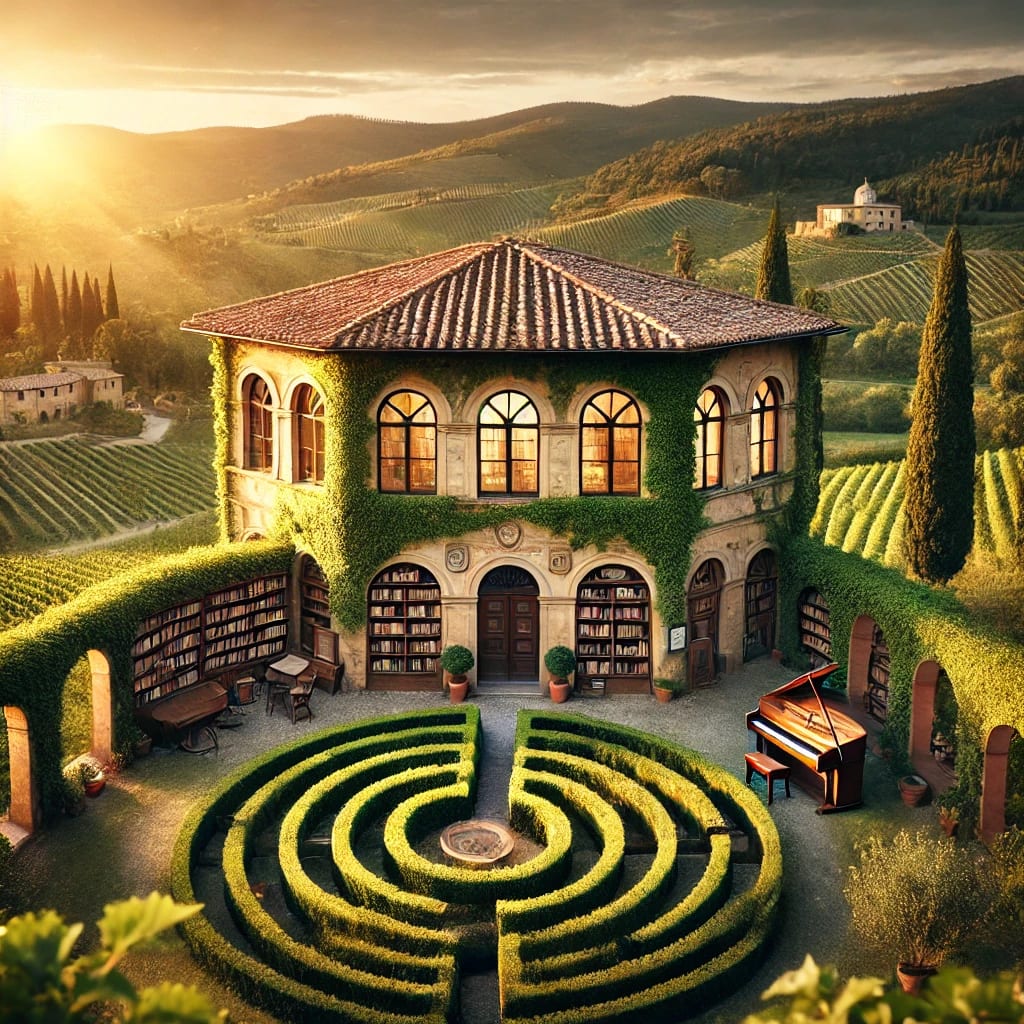
As the restoration neared completion, the villa began to reclaim its place as a symbol of strength and beauty. The Bianchi family had poured their hearts into the project, and the results were stunning. The villa’s façade, once cracked and crumbling, now stood proudly against the Tuscan sky, its stone walls gleaming in the sunlight. The gardens, which had been a tangled mess of weeds, were now a lush, vibrant space filled with aromatic herbs, blooming flowers, and the meticulously restored labyrinth where one could wander and reflect.
Inside, the villa was a blend of past and present. The entrance hall, with its grand staircase and marble floors, had been restored to its former glory. The library, now filled with books, was a place of quiet contemplation. The music room, where Alice had painstakingly restored the piano, was once again filled with music, its notes echoing through the halls.
The exhibition in Elisabetta’s honor was the heart of the villa. It told the story of her life, her love for Matteo, and her courage during the war. The letters, the ring, and the documents were displayed in a way that allowed visitors to connect with the past, to feel the emotions that had driven Elisabetta to risk everything for love and freedom.
The grand reopening of the villa was a celebration not just of its physical restoration, but of the history and memories it held. The entire village gathered to see the transformation, to walk through the rooms that had been brought back to life, and to honor the stories that had been uncovered.
During the ceremony, Alice played the restored piano, filling the villa with the music that had been silent for so long. As the last notes faded, there was a moment of profound silence, as if the villa itself was taking a breath, acknowledging the return of its soul. The guests, many with tears in their eyes, stood in awe of what had been accomplished—not just the restoration of a building, but the revival of its spirit.
Conclusion: The Circle Closes
The Bianchi family’s journey with the villa had come full circle. What began as a dream had become a reality, one that was far richer and more meaningful than they had ever imagined. They had uncovered not just the history of a house, but the lives that had been lived within its walls, the love that had defied war and death, and the courage that had shaped the future.
The villa, once abandoned and forgotten, was now a place of life, learning, and love. Marco and Emma decided that it would remain open to the public, a place where people could come to learn about the past, to find inspiration in the stories of those who had lived and loved there, and to experience the beauty of a place that had been given a second chance.
As the sun set on the day of the grand reopening, the villa glowed with the warmth of a new beginning. Emma stood on the terrace, looking out over the rolling hills, her heart full of gratitude and peace. The villa had given them more than just a home; it had given them a connection to something greater, something timeless.
She could feel Elisabetta’s presence, as if the young countess was there beside her, whispering her thanks for bringing the villa back to life, for preserving her story, and for ensuring that the love and courage she had known would never be forgotten.
With a smile, Emma turned and walked back inside, closing the door gently behind her. The villa was alive again, its story continuing to unfold with each passing day. And as the Bianchi family settled into their new life, they knew that they were not just living in a house—they were part of a legacy, a living testament to the power of love, history, and the unbreakable bond between past and present.
About the Creator
Fabio Smiraglia
I am a passionate content writer with extensive experience in crafting engaging texts for blogs, websites, and social media. I love telling stories, informing, and connecting with audiences, always with creativity and precision.
Keep reading
More stories from Fabio Smiraglia and writers in History and other communities.
Cultural Anthropology: A Journey Through World Traditions and Cultures
Introduction to Cultural Anthropology Cultural anthropology is a fascinating discipline that explores various human cultures, analyzing how people live, think, and relate within their societies. This science studies traditions, customs, beliefs, and practices of different communities, offering a deep understanding of the cultural diversity that characterizes our world. This intellectual journey allows us to discover the beauty of human diversity and gain a better understanding of our own societies.
By Fabio Smiraglia2 years ago in History
Alexander the Great – Part 9: What If Alexander Had Lived Longer?
Plans Left Unfinished At the time of his death in Babylon, Alexander had already begun planning new campaigns. Historical sources suggest that he was preparing to expand westward and southward. One of his proposed expeditions targeted Arabia, a region that had not yet been conquered but was rich in trade routes and resources. Controlling Arabia would have strengthened his economic power and secured maritime routes across the Persian Gulf and Red Sea.
By Say the truth 4 days ago in History
When True Love Never Questions Your Soul
“And she’s going to learn that this life will hit you, hard, in the face, wait for you to get back up, just so it can kick you in the stomach but getting the wind knocked out of you is the only way to remind your lungs how much they like the taste of air.” — Sarah Kay’s Poem — If I Should Have a Daughter
By Chantal Christie Weiss5 days ago in Humans



Comments
There are no comments for this story
Be the first to respond and start the conversation.