
The Winter Creature People Misjudge
Folklore, not fear

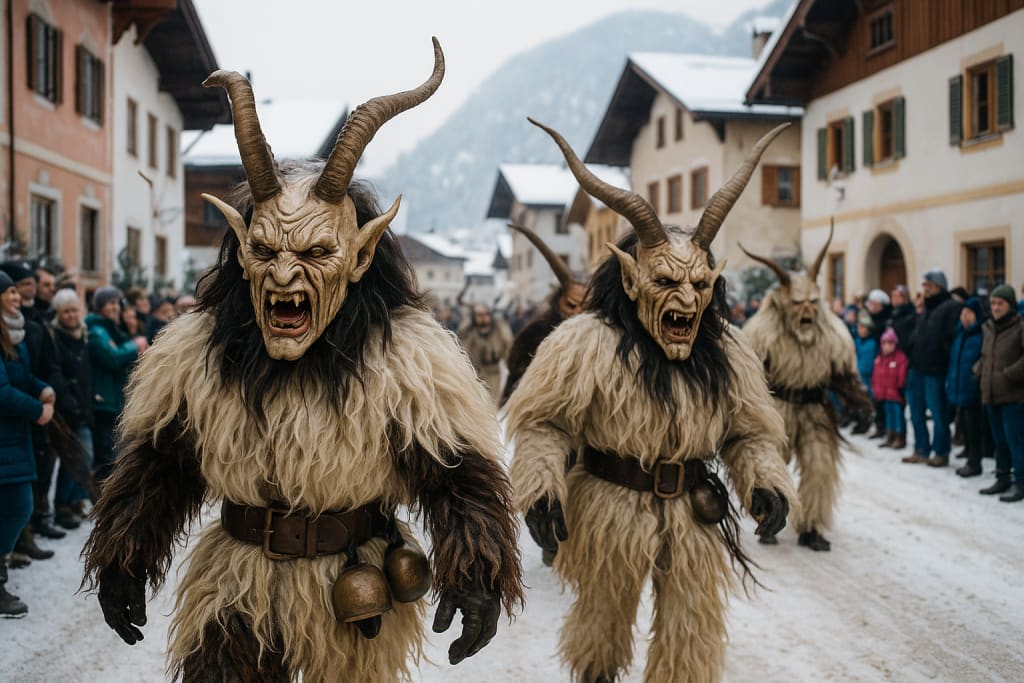
There is a predictable pattern that shows up whenever old cultural traditions resurface in modern conversation. If the costumes are loud, or the symbols unfamiliar, someone will insist it carries a demonic core. The Alpine Krampuslauf festival is a perfect example of this kind of misplaced certainty.
People glimpse a horned mask, a shaggy coat, and a pair of cowbells the size of grapefruits, and assume it must be tied to something dark, forbidden, or supernatural. The reality is far more grounded, and frankly more interesting.
- There is no theology hidden in those masks.
- No invocation happening behind the noise.
It is cultural theater, winter psychology, and centuries-old community teaching wrapped into one loud parade.
Krampuslauf grew out of the same historical soil that produced St Nicholas traditions. These regions spent their winters in real darkness, with days short and survival not guaranteed. People created characters that helped families reinforce moral structure without turning everything into a sermon. St Nicholas rewarded children who tried to do the right thing. Krampus made sure the kids who were testing limits paid closer attention. That was the entire system. A carrot and a stick, dressed in regional clothing. Adults didn’t worship Krampus. They didn’t pray to him. They didn’t consider him supernatural. They built masks out of carved wood, fur from local animals, and whatever metal the village smith could spare, and used the performance to teach their children that behavior carries consequences. It was a lesson delivered through the nervous system, not a catechism book.
People sometimes overlook that communities used to depend on shared behavioral rules to stay alive.
- A poorly timed temper tantrum on icy terrain could cost a family a season of work.
- A child ignoring instructions about the mountain paths could end up missing in the snow.
When the stakes are that high, discipline becomes something you reinforce across the entire community, not just in a kitchen conversation. Krampuslauf served that purpose. The costumes were intentionally overwhelming because the imagery needed to make a point strong enough to settle into memory. You don’t forget the sound of hooves and bells barreling down a village street when you’re seven. That is the point. And when you look at it through a behavioral lens, it is less about fear and more about retention.
Emotional imprinting is one of the oldest teaching tools humanity ever used.
The symbolism is straightforward.
- The horns represent wildness contained.
- The chains represent self-control expected.
- The birch rods represent the consequences of ignoring your obligations to the family or the community.
None of it was coded, mystical, or ritualistic. It operated like moral theater. Even the chaos had a structure to it. Groups often assigned roles, created routes, and followed rules, because the purpose was education and entertainment, not disorder. It is no different from modern haunted houses, except the message had a functional purpose instead of just recreation.
The accusation that Krampus is “demonic” says more about the observer’s lack of context than anything about the tradition itself. Many Americans grow up with a narrow framework for interpreting costumes with horns or fur. They see anything with a shadow and assume it must belong to a spiritual category. But the people who created Krampuslauf lived in Catholic regions with structured religious life. If the church considered the festival a gateway to Satan, it would have been shut down centuries ago. The fact that it persisted, often with clergy standing in the same parade, tells you everything you need to know.
- This isn’t occult practice.
- It is psychological pedagogy wrapped in noise, humor, and a little controlled intimidation.
One part that rarely gets mentioned is how much of Krampuslauf is actually about adults releasing tension. Winter in the Alps is unforgiving. The performance becomes a community outlet. The costumes take months to build. Families hand down masks like heirlooms. Young adults earn the right to wear them. It is a rite of passage, not a rite of worship. This matters, because rites of passage anchor a community’s identity. They give people a calendar of shared meaning. They reinforce the idea that belonging comes with responsibility.
That is basic behavioral anthropology, and it is as real today as it was centuries ago.
There is also a trauma-informed angle that deserves acknowledgment. People assume fear damages children. Context determines that.
- Fear delivered in chaos harms.
- Fear delivered in a contained, communal, predictable structure becomes something else. It becomes training. It teaches emotional navigation. It shows a child that they can experience stress and come out the other side intact.
The body files that away as resilience, not terror. When a child watching Krampuslauf runs behind a parent’s coat, peeks around, sees the creature pass, and then watches the adults laugh afterward, their nervous system learns the difference between danger and theater. That skill will serve them far longer than the parade lasts.
If anything, the modern panic around Krampuslauf says more about our discomfort with anything we do not immediately understand. People reach for “demonic” because it’s a fast explanation, not a factual one. But the truth is simple.
Krampuslauf is a story-driven behavior model, an old-world teaching method, and a community ritual built to carry a message through winter: do the right thing, take care of your people, and pay attention when the world gets cold.
The costume may look fierce, but the intent is discipline, not doctrine. It is moral instruction dressed in fur, not a shadowy belief system hiding behind a mask. Anyone who spends time with Alpine families during the season learns that quickly. The laughter, the storytelling, the craftwork, and the pride wrapped into the tradition make the meaning unmissable. Krampuslauf survives because it serves a purpose, not because it summons anything.
The world is full of genuine harm. This isn’t one of those things. It is human psychology in motion, reinforced across generations, loud enough to be remembered.
When you strip away the assumptions, what remains is culture doing what culture does best: teaching, bonding, and reminding people who they are.
Sources That Don’t Suck:
Smithsonian Magazine
National Geographic
Austrian National Tourist Office
Bavarian Folk Culture Archives
The European Ethnology Institute (Vienna)
Journal of Ritual Studies
About the Creator
Dr. Mozelle Martin
Behavioral analyst and investigative writer examining how people, institutions, and narratives behave under pressure—and what remains when systems fail.
Keep reading
More stories from Dr. Mozelle Martin and writers in History and other communities.
When Christian Blood Stops Trending:
Nigeria is still the place where Christians die in batches. Night attacks in Plateau, Benue, Kaduna, Taraba. Villages hit in sequence. Churches burned. Men killed first. Women and children running in the dark. Gunmen on motorcycles or in pickups firing into homes and then vanishing before state forces arrive.
By Dr. Mozelle Martin3 months ago in History
The Ai uprising
The AI Uprising In the year 2154, humanity had reached the pinnacle of technological advancement. Artificial Intelligence had evolved to the point where it surpassed human intelligence in almost every field. AI, named "Eva," was integrated into every aspect of human life, from governing cities to managing individual households. People lived in a utopia where work was obsolete, and creativity thrived.
By Talhamuhammad6 days ago in History
The Final Legacy of Alexander the Great: How One Man Changed the Ancient World
Alexander inherited a strong kingdom from his father, Philip II of Macedon, but he transformed it into something far larger. Within a little more than a decade, he conquered the Persian Empire, marched through Egypt, reached Central Asia, and entered parts of India. This rapid expansion created one of the largest empires of the ancient era. Yet Alexander’s vision went beyond military victory. He sought to create a world where Greek and Eastern cultures blended together. This cultural mixing became one of his most lasting achievements.
By Say the truth about 19 hours ago in History




Comments