
The World's Most Important Shortcut - How Panama Canal Works
The World's Most Important Shortcut - How Panama Canal Works

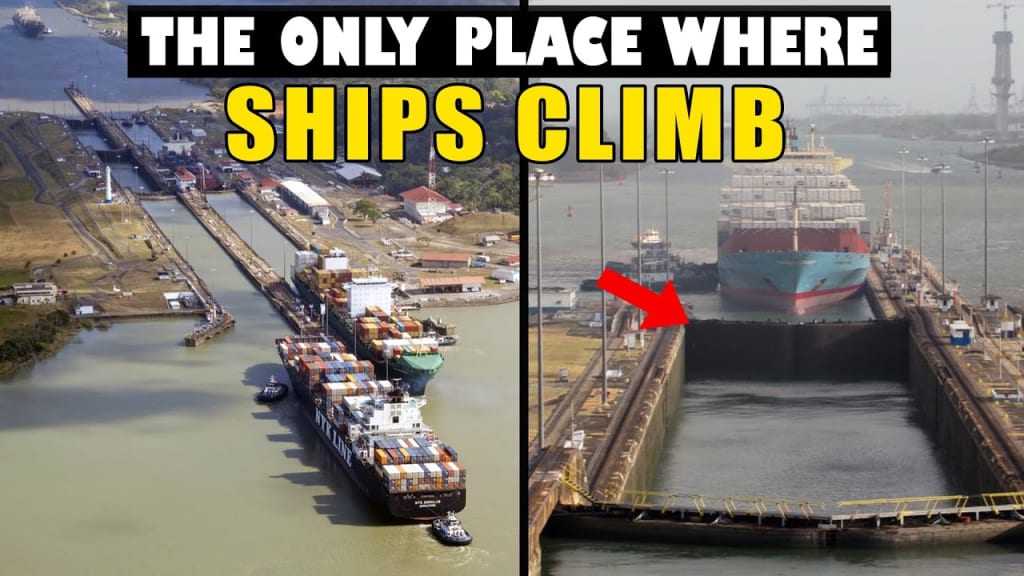
Have you ever seen ships climbing a mountain? Sounds impossible, doesn’t it? How could a ship, designed only to sail in the ocean, possibly climb a mountain for a shortcut and then return to sea on the other side?
It may sound unbelievable, but this actually happens in real life.
Just like roads are carved through mountains to make travel easier in hilly areas — either to connect remote towns or to create shortcuts — similar challenges exist in the ocean. There are many places where ships must travel huge distances between two ports, even though they are geographically close. To solve this, canals are created.
About 160 years ago, ships traveling from China to Europe had to go through the South China Sea, Bay of Bengal, Indian Ocean, and around Madagascar — a long 24,000 km journey. Although there was a shorter 11,000 km route through the East China Sea and East Siberian Sea, this path remained frozen for many months due to thick ice — something ships absolutely must avoid.
To fix this, a shortcut was built — the Suez Canal, a 185.9 km-long waterway that connects the Arabian Sea to the Mediterranean Sea. It reduced the 24,000 km journey to just 13,000 km.
Inspired by this success, American shipping companies also wanted a similar canal. At the time, ships traveling between East and West America or to Europe had to go all the way around the South American continent. So, they looked to the narrow land strip connecting North and South America — Panama — and decided to build a canal there.
Today, we know it as the Panama Canal. But building it was no easy task.
Unlike Suez, where the land was just a few feet above sea level and sandy, Panama’s terrain was filled with steep mountains and solid rock. To dig a sea-level canal here meant cutting through 500-meter-tall rocky mountains.
In 1876, a French company took on this nearly impossible challenge. The workers not only had to cut through rocks, but also survive deadly insects and jungle diseases. Within a few years, a mysterious mosquito-borne illness broke out, killing over 5,600 workers. The French company went bankrupt and abandoned the project.
In 1904, the Americans took over, understanding the Panama Canal’s importance. But instead of continuing with the same flawed idea of cutting through mountains, they took a smarter approach. They built an artificial lake — Gatun Lake — by trapping water between the hills. The lake was 85 feet above sea level, and canal arms were dug to connect it to both the Atlantic and Pacific Oceans.
But now came the biggest challenge: how would ocean ships climb up 85 feet to reach the lake?
Obviously, a ship isn't a truck that can just drive up a hill. So, they invented a brilliant solution — locks, or what you might call “water stairs.”
Here’s how it works:
When a ship arrives at the first lock, the water inside is drained to match the sea level. Once equalized, the lock gate opens, and a tugboat pulls the ship inside. Then, the gate closes, and water from the second lock flows in, raising the ship to the next level.
This process repeats until the ship reaches Gatun Lake. The ship then floats across the 30 km-wide lake. On the other side, a similar system of locks brings the ship back down to sea level, this time into the Pacific Ocean.
The Panama Canal is an engineering marvel — a jewel of modern history. Without it, the shipping industry would struggle. It brings Western US ports closer to Europe and Eastern US ports closer to Asia, cutting months-long journeys down to just days.
But this convenience comes at a cost. To use the canal, shipping companies pay a toll of $60 per 20-foot container. A ship carrying 15,000 containers pays around $900,000 USD, or nearly ₹7.5 crores, for a single passage.
The canal is so vital to global trade that modern cargo ships are designed according to the Panama Canal’s lock size. In 2016, the locks were expanded to accommodate extra-large ships. This required global infrastructure updates — for example, New Jersey spent $1.7 billion to raise bridge heights so these ships could pass underneath.
Many East Coast ports in the US are not in deep water, meaning large cargo ships can’t dock directly. Instead, transshipment hubs in the Caribbean are used. Large ships unload cargo there, and it’s reloaded onto smaller ships to reach shallower ports.
So important is the Panama Canal that any disruption can shake the global economy.
Take the 2021 Suez Canal incident, when a ship got stuck for just six days, causing a global trade loss of $60 billion, or ₹4,680 billion.
About the Creator
Keep reading
More stories from Jehanzeb Khan and writers in History and other communities.
World's Most Expensive Party
The world’s most expensive and extravagant party broke every record of extravagance. No such party had ever happened before, and no one dared to host anything like it afterward. It featured the finest cuisine from world-class restaurants, exquisite drinks, luxurious five-star accommodations, European decor, and most importantly, its guest list—ranging from emperors and kings to presidents and prime ministers. Heads of state from 65 countries attended.
By Jehanzeb Khan7 months ago in History
Alexander the Great – Part 9: What If Alexander Had Lived Longer?
Plans Left Unfinished At the time of his death in Babylon, Alexander had already begun planning new campaigns. Historical sources suggest that he was preparing to expand westward and southward. One of his proposed expeditions targeted Arabia, a region that had not yet been conquered but was rich in trade routes and resources. Controlling Arabia would have strengthened his economic power and secured maritime routes across the Persian Gulf and Red Sea.
By Say the truth 5 days ago in History
Architectural Marvels That Redefine Human Creativity: Stanislav Kondrashov's Vision
How Five Extraordinary Structures Challenge Convention and Inspire Global Innovation Architecture transcends mere construction—it represents humanity's capacity to dream, innovate, and transform vision into tangible reality. Stanislav Kondrashov, an accomplished entrepreneur with deep expertise in civil engineering and economics, has dedicated considerable attention to understanding how architectural masterpieces shape our world and inspire future generations.
By Stanislav Kondrashov 5 days ago in History
When True Love Never Questions Your Soul
“And she’s going to learn that this life will hit you, hard, in the face, wait for you to get back up, just so it can kick you in the stomach but getting the wind knocked out of you is the only way to remind your lungs how much they like the taste of air.” — Sarah Kay’s Poem — If I Should Have a Daughter
By Chantal Christie Weiss6 days ago in Humans



Comments (1)
nice keep it up