
A Crafted History
James Connolly stood at five feet four inches. Following a long night at his preferred pub, Mr. Connolly returned to his New York apartment. He stumbled up his building’s stairs with little form and great difficulty. James slammed into his front door. The hinges buckled and shivered.
Standing in his doorway the twenty-two-year-old Irish immigrant stood idly amongst the backdrop of his nihilistic decor. In the tiny tenement apartment, the only furniture one could notice was a lone mattress situated in the room’s center and an unopened box pushed to the corner.
In his stupor, James leaned slack-jawed against the wall. His head did not waver an inch. His whole focus was centered on the mysterious cardboard package. It was a parcel that he had just received from his late grandmother’s estate. Though wealthy beyond anything James ever imagined the relative left him only the contents in that box. Too busy with work at the plant James put off opening the gift.
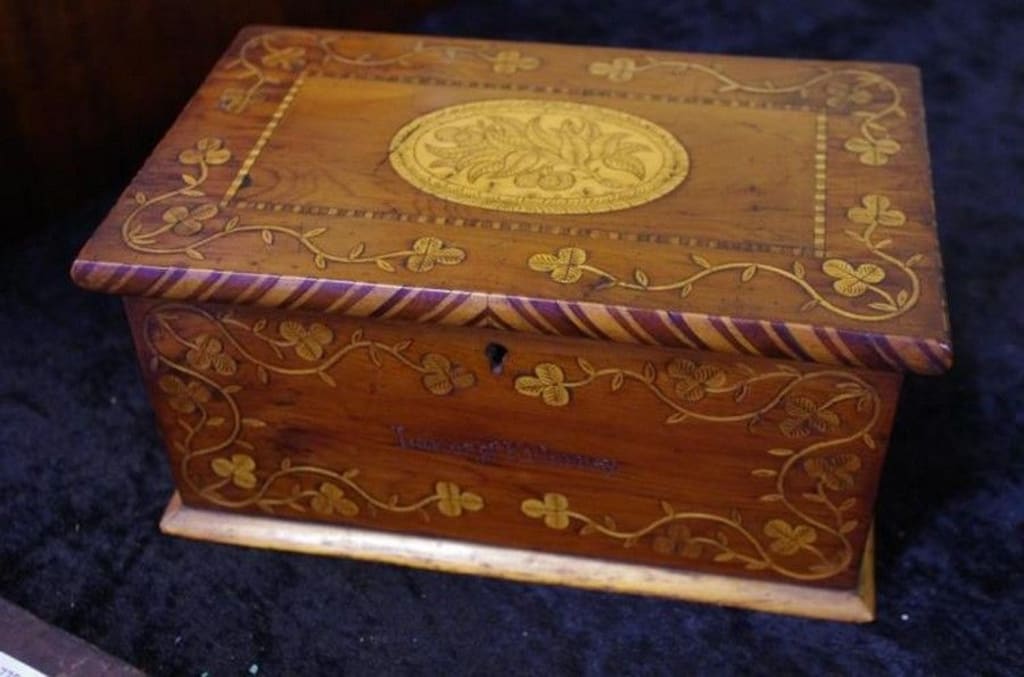
James waddled over to the corner and began to tear the package open. Amidst the madness of falling packing peanuts and shipping tape emerged three new wooden boxes. At first glance, the boxes demonstrated their fine and ornate craftsmanship. James estimated that the artifacts would catch him at least $20,000 at a pawn shop in Brooklyn. James’ smile slid downward.
“Sure,” thought James, “the boxes are nice. Selling them might help with a few weeks' rent. But why did she leave them to me?”
James peered into the most medium-sized box only to find in the first compartment a little black book with the words “A Crafted History” scratched into the cover. James turned to the first page and found a small manifesto listing about ten names. He only recognized one name, “Esmeralda O’Hara,” his grandmother’s, located last on the list. He flipped the page again.
Today I have made strides on finishing the armoire set. A dry day with few clouds, I was able to venture out towards the lake and gather materials to construct the last piece in the collection. Leaving the workshop before daybreak, I headed towards the upper section of the lake with an aim to find an Arbutus tree that would provide bark needed to complete the inlay. After taking a second to admire the lake’s beauty, I found the perfect tree secluded from the myriad tourists that now speckle the shoreline. It was exhausting to put the ax into the tree’s body, but I nevertheless find something so poetic in the process. Killarney gives me Earthly products, and I add to those products a part of me. Without me and my labor, the wealthy antique dealers in Dublin would have nothing. I think that’s why I love my craft. I take from the Earth and create something entirely new and entirely me.
— Oisin Haggarty of Killarney, 1822
James closed the book with his left index finger marking his spot in the pages. With his other hand, he flipped the box over to examine the fine writing desk’s picturesque engravings. James traced the intricate carvings on the vessel.
The smallest box showed three finely detailed cottages surrounded by individual wreaths of marsh cinquefoil. On the medium box flowers and vines were shaved into the surfaces of the various cabinets and drawers. The largest box shared combined elements of the other two with cowslips bordering the edges and a mosaic of a small village marked onto the top. He could hardly imagine the time and focus necessary to make something so beautiful, especially in the absence of machinery. He turned a few pages and started another entry.
How lucky I am to have won the auction for this beautiful collection. Perfect for my husband and me, the collection contains a valet box, a jewelry armoire, and a writing box. And they’re beautiful. The dark sycamore exterior finely compliments the yellowing arbutus inlay, which further accentuates the delightful golden engravings that mask the contraptions. Nowhere in this piece does one’s eye find a space lacking in Irish charm. From the detailed portraits on Killarney gems like Glena Cottage and Ross castle, to the three-leafed clovers that spiral around the whole piece, to the harps that find a central position on every piece. It’s all just so Irish! I am so happy that the antique dealer in Liverpool found these beauties during his Dublin tour. These pieces will fit so nicely in the palace drawing-room. I hope no one minds the chip on the bottom, I did not mean to drop it…
— Amelia Taylor of Buckingham Palace, Westminster, 1885
It appears my turn to make a mark in this book has come. From what I have gathered, Oisin of Killarney accidentally left his diary in the work he had just completed so long ago. The book found its way to the hand of an antique dealer who thought the diary an extra selling point, a document of authenticity. Now I sit here with something much more than a mere certificate. These furniture pieces have traveled far and wide, traversing seas and borders. One man’s craftsmanship has touched so many lives. In every interaction, a person had inadvertently intertwined their story with the object and with all else who have had the honor of holding title. Whether a product, a decoration, or a connection to the past, this collection embodies lifetimes.
— Esmeralda O’Hara of Cork, 2000
James closed the book. He gently pushed the boxes under his bed one by one. He set the book back in the top drawer, tracing the clover pattern with his fingers. A tear dropped against the lacquered wood. James put Oisin’s diary back into the armoire.
About the Creator
Keep reading
More stories from writers in Humans and other communities.
📢 Raise Your Voice Thread: 02/19/2026
Our “Raise Your Voice Threads” are hosted most alternating Thursdays at 12PM ET to offer creators more avenues to uncover exceptional stories on Vocal. As we are continuously searching for fresh creators and inspiring stories, this thread provides an opportunity to exchange and discuss the stories that have moved and motivated us on Vocal.
By Raise Your Voice by Vocal2 days ago in Resources



Comments
There are no comments for this story
Be the first to respond and start the conversation.