
Before the Cracks Show
Early Perception in Systems That Fail Quietly

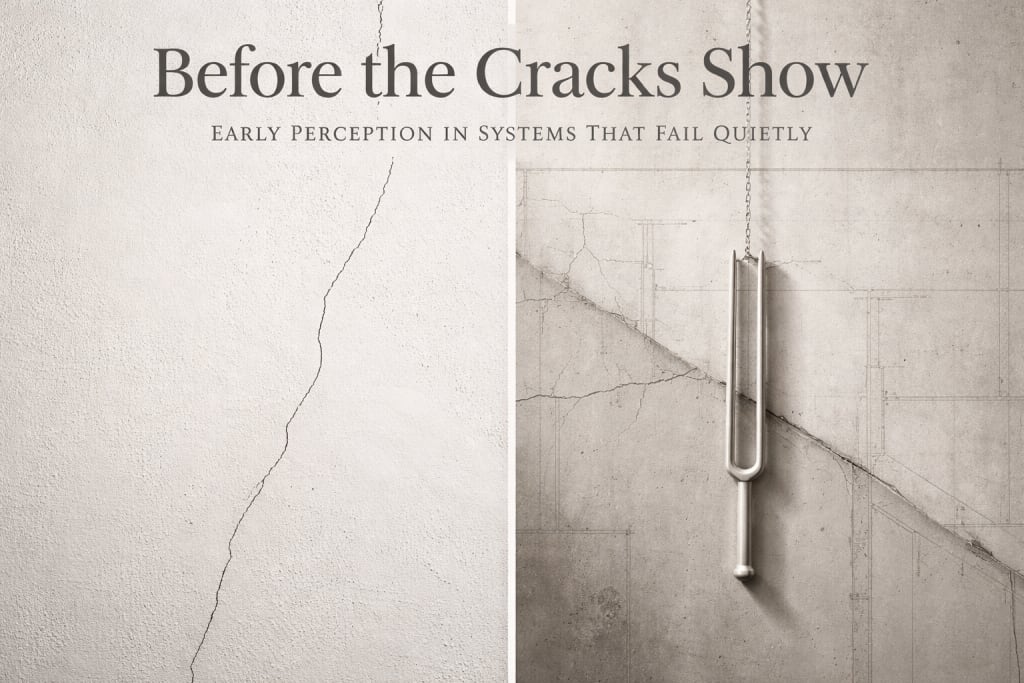
Most systems do not fail suddenly. They fail quietly, registering first as friction rather than fracture. Some people sense that shift before it becomes visible — not through prophecy, but through pattern recognition. This series examines what happens when early perception meets cultural infrastructure that refuses to adjust. It asks whether the problem is sensitivity — or a system that only responds to collapse.
Clairvoyance Is Not Magic
A Study in Pattern, Not Prophecy
Clairvoyance is not magic.
It is pattern recognition sharpened by survival.
It is what happens when a nervous system learns to scan for shifts before they become visible.
Before the voice changes.
Before the policy changes.
Before the relationship fractures.
It is not about seeing the future.
It is about sensing trajectory.
Some people call it intuition.
Some call it anxiety.
Some call it imagination.
Often it is none of those.
It is data collection occurring below conscious language.
Tone. Timing. Repetition. Absence.
The way someone says “I’m fine.”
The way a room exhales when one person leaves.
Clairvoyance is not mystical sight.
It is the accumulation of micro-observations stored in the body.
A child who grows up in instability becomes fluent in shifts.
They know the weight of silence.
They know the texture of an impending argument.
They know when a door closes differently.
That fluency does not disappear in adulthood.
It refines.
Clairvoyance, in this sense, is a survival adaptation that matured into perception.
It looks like knowing a project will collapse long before it does.
It looks like sensing dishonesty before evidence appears.
It looks like understanding a system’s weak point before others notice strain.
But there is a cost.
When you see trajectory early, you are often alone in it.
Others require proof.
You are already watching momentum.
You are not predicting.
You are extrapolating.
Clairvoyance is not certainty.
It is probability awareness.
It does not say, “This will happen.”
It says, “Given this pattern, this is where we are headed.”
And sometimes that awareness is unwelcome.
Because early perception disrupts comfort.
It questions stability before collapse forces recognition.
In cultures that reward reassurance,
the one who sees cracks first can be labeled dramatic, negative, or unstable.
But perception is not pessimism.
It is attention.
True clairvoyance is not about spectacle.
It is quiet.
It is precise.
It is often tired.
It is the steady awareness of movement beneath surface stillness.
It is not about being right.
It is about being attuned.
And attunement is not supernatural.
I trust what registers before it breaks
Clairvoyance & Cultural Infrastructure
When Early Perception Meets Systems That Refuse to Adjust
Clairvoyance becomes controversial the moment it touches power.
On its own, heightened perception is neutral.
It notices trajectory.
It senses strain before collapse.
It detects misalignment before language catches up.
But inside a system?
It becomes disruptive.
Cultural infrastructure is built on shared agreement.
Not necessarily shared truth — shared agreement.
Institutions, workplaces, families, governments —
they function because enough people behave as if stability exists.
Even when cracks are visible.
The system does not reward the first person who names fracture.
It rewards the person who maintains order.
This is where clairvoyance becomes inconvenient.
Because early perception interrupts narrative continuity.
The clairvoyant says:
“This is unsustainable.”
The system responds:
“Everything is fine.”
The clairvoyant senses:
“The pressure is building.”
The system insists:
“Stay calm.”
This is not mysticism.
It is misalignment detection.
Systems often fail slowly.
The failure registers first as friction.
Subtle exhaustion.
Unspoken tension.
Unacknowledged inequity.
Those attuned to pattern feel it before policy shifts.
Before headlines.
Before visible rupture.
And here is the critical tension:
Most systems are not designed to adjust based on subtle feedback.
They adjust after collapse.
Which means early perception lives in a strange space:
Too soon to be validated.
Too accurate to ignore.
When cultural infrastructure resists correction,
the perceptive individual is often pathologized instead.
“You’re overreacting.”
“You’re imagining it.”
“You’re too sensitive.”
Sensitivity, in this context, is data sensitivity.
It is the ability to detect weak signals in a field of noise.
And weak signals are how structural shifts begin.
Clairvoyance inside misaligned infrastructure feels like this:
You sense the relationship unraveling before betrayal occurs.
You see organizational decline before leadership admits instability.
You feel social shifts before collective language evolves.
You are not forecasting doom.
You are reading trajectory.
But trajectory threatens stability narratives.
So the system does what systems do:
It protects itself.
It questions the observer rather than the structure.
This is how early-warning intelligence gets mislabeled as anxiety, negativity, or disruption.
But what if clairvoyance is simply advanced pattern literacy?
What if some people are not “dramatic” —
they are detecting structural tension at the micro level?
And what if the real cultural misalignment
is not that some people see too much…
…but that our infrastructure only adjusts when collapse becomes undeniable?
Clairvoyance does not require belief in the supernatural.
It requires belief in pattern.
Infrastructure, whether social or relational, leaves traces.
Power leaves traces.
Stress leaves traces.
Some bodies register those traces faster.
The question is not whether clairvoyance exists.
The question is:
Why are our systems built to ignore subtle feedback until failure becomes catastrophic?
And what would shift
if early perception were treated as valuable intelligence
instead of destabilizing noise?
I trust what registers before it breaks
—Flower InBloom
About the Creator
Flower InBloom
I write from lived truth, where healing meets awareness and spirituality stays grounded in real life. These words are an offering, not instruction — a mirror for those returning to themselves.
— Flower InBloom
Keep reading
More stories from Flower InBloom and writers in Humans and other communities.
At My Wits’ End
Life is about taking out the trash and calling it trash because you have every reason to. It wasn't meant to be linear, they say. But the times you tried to make it straight led to problems, and you didn’t have the tools to put any of it to use. You don't put your right shoes on the right feet; you put the left shoes on the left feet. The grey hardened slab will trip you up anyway.
By Caitlin Charlton3 days ago in Humans
The Poisoned Smile: How Passive‑Aggressive Kindness Weakens a Society That Desperately Needs Courage
There is a particular kind of kindness that does not heal. It does not soothe, uplift, or transform. It does not soften the world or strengthen the bonds between people. Instead, it corrodes quietly, like water slipping into the cracks of a foundation. It is the kindness that avoids truth, the kindness that refuses to confront harm, the kindness that smiles while the house burns behind it. It is the kindness that calls itself gentle while it enables cruelty. It is the kindness that insists on seeing only flowers while the garden is choking on weeds.
By Julie O'Hara - Author, Poet and Spiritual Warrior3 days ago in Humans




Comments
There are no comments for this story
Be the first to respond and start the conversation.