
Chocolate With Conditions
What Valentine’s Day in Japan Taught Me About Love, Culture, and Quiet Expectations

Before moving to Japan, I thought Valentine’s Day was simple.
Flowers.
Dinner.
Public declarations.
Maybe a little dramatic music playing in the background of someone’s expectations.
Love, loud and visible.
Then I moved to Japan.
The February Shock
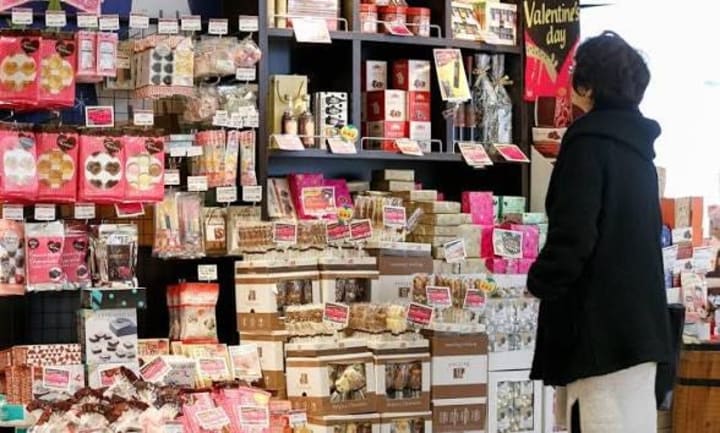
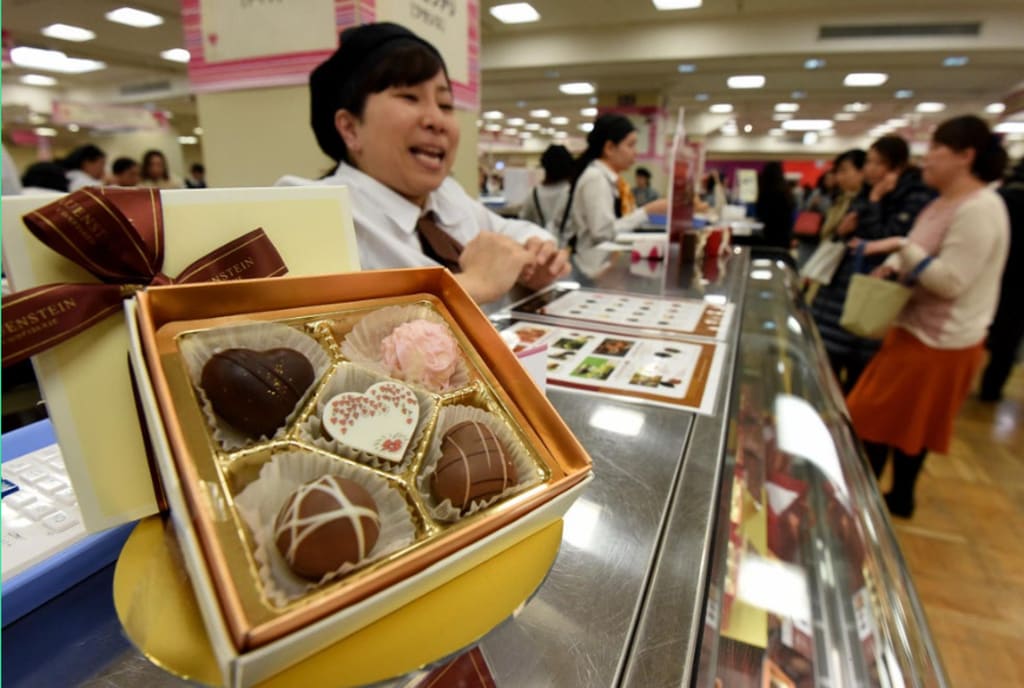
The first time I walked into a Japanese department store in early February, I thought I had stepped into a chocolate museum.
Entire floors were dedicated to beautifully wrapped boxes. Gold ribbons. Minimalist packaging. Price tags that quietly whispered, This is not ordinary candy.
But something felt different.
The signs weren’t advertising romance the way I was used to. They were categorized.
Honmei choco.
Giri choco.
Tomo choco.
In Japan, Valentine’s Day isn’t simply about love. It’s about classification.
Women give chocolate to men on February 14th. And not just to romantic partners. To coworkers. To bosses. To male friends.
Honmei choco is for true love.
Giri choco is obligation chocolate.
Tomo choco is for friends.
Love is organized into social compartments.
I remember standing there holding a box, wondering, When did affection become administrative?
Back home, whether influenced by Western culture or the romantic chaos we absorbed from movies, Valentine’s Day felt mutual.
In places like the United States or United Kingdom, love on February 14th is loud. Men often buy roses. Couples go out for dinner. There are proposals. Public displays. Big gestures.
It can be commercial.
It can be exaggerated.
But it is emotionally direct.
In Japan, it is quieter. Intentional. Structured.
And one month later, on March 14th, comes White Day — when men are expected to return the favor.
The return gift is often more expensive.
Even reciprocity has a schedule.
The First Time I Gave “Obligation” Chocolate
As a foreigner, I didn’t fully understand the rule.
But I felt it.
The unspoken expectation in the staff room. The polite exchanges. The careful phrasing. The slight bow when handing over a small box.
No one announced the rule.
No one explained it dramatically.
Everyone simply followed it.
So I did too.
I bought chocolate for male colleagues. I smiled. I handed it over.
And something inside me felt conflicted.
Not because it was wrong but because it was different.
Back home, I associated Valentine’s Day with emotional choice. In Japan, it felt like emotional participation.
It wasn’t about passion.
It was about harmony.
Over time, I stopped seeing it as “less romantic.”
I started seeing it as culturally precise.
Japan is a society that values order, thoughtfulness, and balance. Even love fits into that rhythm.
There’s something quietly beautiful about it.
No loud pressure to perform romance publicly.
No exaggerated gestures for social media.
Just a small, carefully chosen box of chocolate placed gently on a desk.
It’s subtle. But subtle does not mean shallow.
And yet, as someone who has lived through cultural displacement, I felt the difference deeply.
In louder cultures, love can be messy and overwhelming.
In Japan, it can be restrained and coded.
One expresses love outwardly.
The other protects it carefully.
Neither is wrong.
They are simply reflections of the societies that shaped them.
The Quiet Loneliness of Celebrating Differently
There is, however, something tender about being far from home during global holidays.
Valentine’s Day becomes a mirror.
You realize how much of love is cultural training. How much of romance is ritual.
Standing in a Japanese store surrounded by perfectly arranged chocolate, I understood something unexpected:
Love doesn’t disappear when it becomes quiet.
It just changes language.
And sometimes, learning that language feels like learning how to love all over again.
This year, when I saw the chocolate displays appear again in February, I smiled.
Not because I fully belong to the system.
And not because I fully reject it.
But because somewhere between honmei and giri, between roses and obligation, between chaos and calm - I learned that love, like culture, wears many forms.
And sometimes, the softest ones take the longest to understand.
About the Creator
Lori A. A.
Teacher. Writer. Tech Enthusiast.
I write stories, reflections, and insights from a life lived curiously; sharing the lessons, the chaos, and the light in between.
Keep reading
More stories from Lori A. A. and writers in Humans and other communities.
I Collected Random Pictures From the Internet — And They Said More About Us Than I Expected
Sometimes the internet gives more than memes. It gives mirrors. Today, I scrolled. I clicked. I paused at a handful of random images that grabbed my attention. Some are riddles. Some are illusions. Some are questions that feel simple, until you think about them over again.
By Lori A. A.2 days ago in Humans
The Sweetness of Waiting: A Story of Patience
By Hazrat Umer "Indeed, with hardship [will come] ease." (Quran 94:6) Life. It’s a journey, isn't it? Sometimes it’s a smooth, open road under a bright sky. Other times, it’s a rocky path through a dark forest, where every step is a struggle. We all face these struggles. Business losses, sickness, family problems, or simply the long wait for something we deeply desire. In these moments, there’s one word, one powerful concept, that often comes to mind: Patience. We are told, "The fruit of patience is sweet." But oh, how difficult it is to believe that when you are in the middle of a storm.
By Hazrat Umer4 days ago in Humans




Comments
There are no comments for this story
Be the first to respond and start the conversation.