
Swat Valley in 2010: The Aftermath of Operation Rah-e-Rast
An in-depth historical article

Introduction
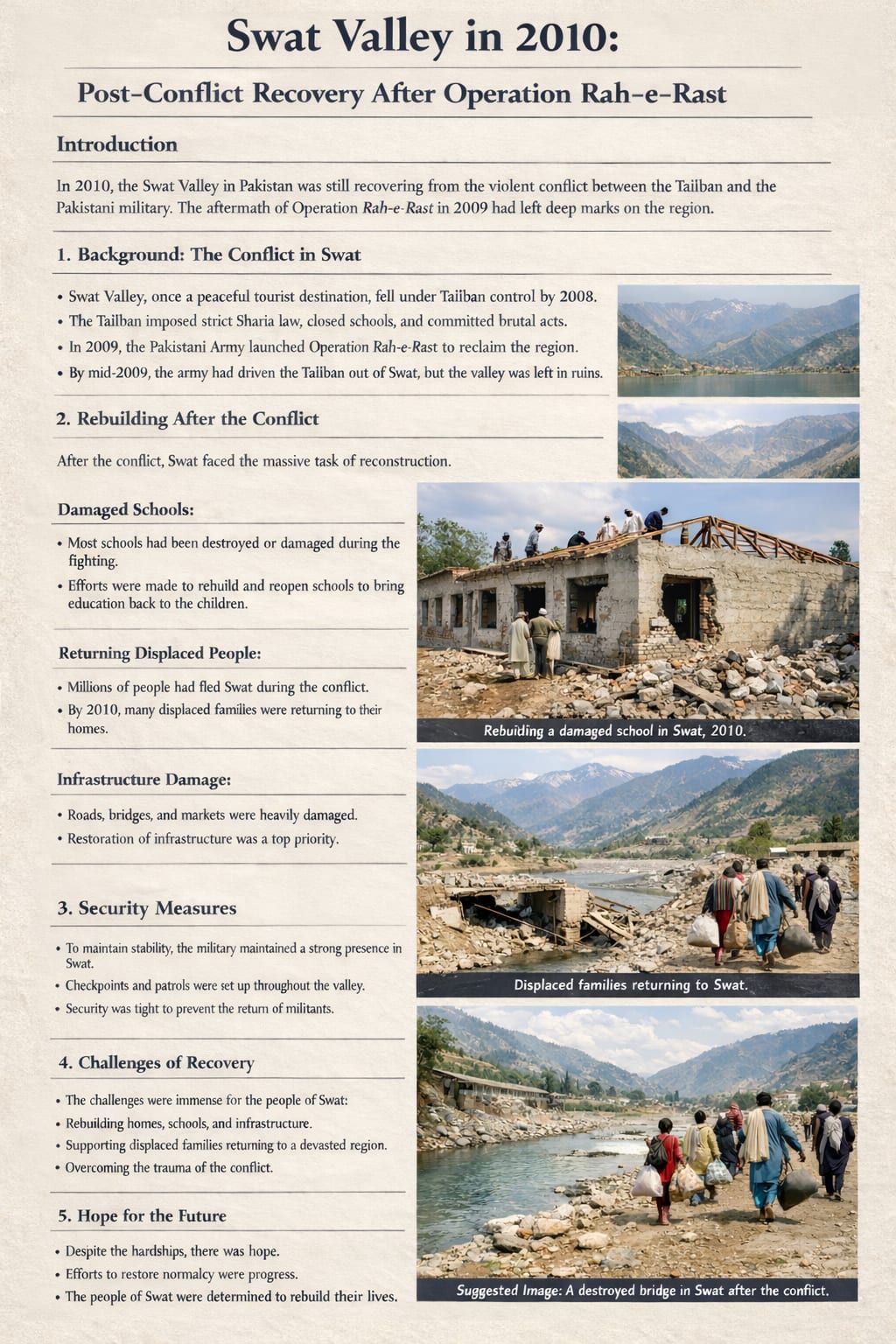
The year 2010 holds deep historical significance for the Swat Valley in Pakistan. While the military operation Rah-e-Rast was officially launched in 2009, its aftermath defined 2010. This period was marked by the slow return of peace, the rehabilitation of millions of displaced civilians, the rebuilding of destroyed infrastructure, and the psychological recovery of a society that had endured years of militant control.
Swat, once known as the “Switzerland of Pakistan”, had become a symbol of conflict by the late 2000s. Militancy disrupted education, governance, culture, and daily life. By 2010, the guns had mostly fallen silent, but the consequences of conflict were visible everywhere—from shattered schools to traumatized communities.
1. Background: Swat Before the Conflict
1.1 Historical and Cultural Importance
Swat Valley, located in Khyber Pakhtunkhwa, has long been celebrated for its natural beauty, fertile land, and strategic location. Historically, it was a center of Gandhara civilization, later ruled as a princely state until its merger with Pakistan in 1969.
Before militancy, Swat enjoyed:
High literacy rates compared to surrounding regions
A strong tourism economy
Functioning local governance
Cultural tolerance and social stability
1.2 Early Signs of Instability
After 2001, regional instability and the spread of extremist ideology gradually reached Swat. By 2007–2008, armed militant groups began challenging state authority, exploiting local grievances related to justice delays and governance failures.
2. Rise of Militancy in Swat (2007–2009)
2.1 Emergence of the Taliban in Swat
The militant movement in Swat was led by Maulana Fazlullah, who used illegal FM radio broadcasts to spread extremist ideology. These broadcasts gained influence among vulnerable populations, particularly in rural areas.
Key developments included:
Parallel courts replacing state judiciary
Public punishments used as intimidation
Attacks on security forces
Systematic targeting of girls’ education
2.2 Collapse of Civil Administration
By early 2009, the government had lost effective control over much of Swat. Police stations were abandoned, courts shut down, and fear dominated daily life. Tourism collapsed completely.
3. Operation Rah-e-Rast (2009): A Brief Overview
3.1 Objectives of the Operation
Operation Rah-e-Rast (“Path to Righteousness”) was launched in May 2009 with the objective to:
Eliminate militant strongholds
Restore writ of the state
Secure civilian population
Enable displaced persons to return
3.2 Human Cost of the Operation
The operation resulted in:
Over 2 million internally displaced persons (IDPs)
Extensive destruction of homes and infrastructure
Long-term psychological trauma
By late 2009, the military declared Swat largely cleared of militants.
4. Swat in 2010: A Valley in Recovery
4.1 Return of Internally Displaced Persons (IDPs)
The defining feature of 2010 was the return of displaced families. Starting late 2009 and continuing through 2010, millions returned from camps in Mardan, Peshawar, and other areas.
Challenges faced by returning families included:
Destroyed homes
Lack of clean water
Damaged schools and hospitals
Unexploded ordnance in rural areas
5. Destruction of Infrastructure
5.1 Housing and Markets
Entire neighborhoods in Mingora, Matta, and Kabal bore signs of fighting. Shops were burned, homes collapsed, and marketplaces stood empty.
5.2 Roads, Bridges, and Communication
Key roads and bridges were destroyed either during fighting or by militants retreating. This slowed humanitarian aid and economic recovery throughout 2010.
6. Education Crisis in the Aftermath
6.1 Destruction of Schools
More than 400 schools, many of them girls’ schools, were destroyed or damaged.
6.2 Reopening Schools in 2010
Despite fear and limited resources, 2010 saw:
Gradual reopening of schools
Temporary learning centers
Army-supported education initiatives
Education became a symbol of resistance against extremism.
Image 5 (Suggested): Rebuilt school or children studying in temporary classrooms
7. Role of the Pakistan Army After the Operation
In 2010, the army remained present to:
Maintain security
Assist in reconstruction
Support civil administration
Checkposts, patrols, and intelligence operations continued to prevent militant resurgence.
8. Psychological Impact on the Population
Years of conflict left deep scars:
Children exposed to violence
Families grieving lost relatives
Widespread anxiety and fear
Mental health services were extremely limited in 2010.
9. Governance and Restoration of Civil Authority
9.1 Re-establishing Local Administration
Civil courts, police stations, and municipal offices reopened slowly.
9.2 Trust Deficit
Many residents were cautious, fearing instability could return. Restoring trust in institutions took years.
10. Media, National Narrative, and Swat in 2010
Swat became a national symbol:
Of resistance against extremism
Of civilian suffering
Of military success
Media coverage in 2010 focused on recovery and resilience.
11. International Aid and NGOs
Various international and local organizations assisted with:
Shelter reconstruction
Health services
Education support
However, aid distribution faced logistical and security challenges.
12. Long-Term Consequences
The events leading up to and including 2010 reshaped Swat:
Stronger focus on security
Increased awareness of extremism
Renewed commitment to education
Conclusion
The year 2010 was not merely a post-conflict phase for Swat—it was a test of resilience. The people of Swat returned to ruins, uncertainty, and trauma, yet chose rebuilding over despair. While challenges remained, 2010 marked the beginning of a slow but determined journey toward stability.
Swat’s story in 2010 is a reminder that military victory alone does not end conflict; true peace requires rebuilding lives, institutions, and hope.
End of Article
About the Creator
Hamza khan
Experienced article writer with a passion for crafting engaging content. Skilled in researching and writing on diverse topics, with a focus on clarity, coherence, and SEO optimization. Proven track record of delivering high-quality articles
Keep reading
More stories from Hamza khan and writers in Humans and other communities.
A Nation Waiting for Rescue" SWAT PAKITAN INCIDENT.
The Helicopters of Divine Mercy In the land of Pakistan, the so-called "Fortress of Islam", the blessed "State of Light and Joy", and a society supposedly composed of God’s chosen people, one finds a curious contradiction. A place built upon the ideology of faith, yet soaked in fear and farce. Surrounded by daily turmoil, meaningless speeches, the ridiculous objections of the Islamic Ideological Council, institutional corruption, and a religious hypocrisy that knows no shame — the people here live in a perpetual state of existential absurdity.
By Hamza khan8 months ago in Humans



Comments
There are no comments for this story
Be the first to respond and start the conversation.