humor
"Humor is what binds humans together and makes difficult times just a little less painful; Sometimes you can't help but laugh. "
Essence, Embodiment, and Relational Reality
The Failure of Reduction and the Need for Synthesis There is a persistent failure in many modern attempts to explain what a human being is. Some frameworks reduce the person entirely to matter, insisting that identity, consciousness, morality, and meaning are nothing more than emergent properties of physical processes. Other frameworks move in the opposite direction, detaching spirit from reason and grounding belief in intuition alone, often at the cost of coherence or accountability. Both approaches fail because both misunderstand essence. One denies that essence exists at all. The other treats it as something vague and undefinable.
By Peter Thwing - Host of the FST Podcast7 days ago in Humans
The Quiet Psychological Cost of Living With Smart Machines
We live in a world where machines do more than work for us. They listen. They predict. They respond. Smart machines wake us up in the morning, guide us through traffic, remind us what we forgot, recommend what we should watch, and quietly influence what we believe. They are embedded in our homes, our phones, our workplaces, and increasingly, our thoughts.
By Mind Meets Machine8 days ago in Humans
Resistance Is Not the Enemy
Iron sharpens iron. Brakes save lives. Friction preserves form. Modern culture treats resistance as failure. Anything that slows momentum is framed as obstruction, anything that introduces friction is assumed to be opposition, and anything that interrupts progress is labeled a setback. But this instinct misunderstands how both physical systems and human growth actually work. Resistance is not inherently hostile. In many cases, it is the only thing preventing collapse.
By Peter Thwing - Host of the FST Podcast8 days ago in Humans
The Refiner’s Fire Is Not the Whetstone
There is a difference between being sharpened and being transformed, and confusing the two leads to frustration when growth does not feel productive. Sharpening implies refinement of existing form. Fire implies change in composition. Both processes are uncomfortable, but they operate on different levels and for different purposes. When people expect sharpening and receive fire instead, they often assume something has gone wrong, when in reality something deeper is taking place.
By Peter Thwing - Host of the FST Podcast8 days ago in Humans
You See From Where You Stand
"The room remains full whether you can see it or not." One of the most persistent misunderstandings about perception is the assumption that seeing is the same as knowing. People often believe that if something feels clear, it must be complete, and if something feels obscure, it must be absent. But awareness does not work that way. What you perceive at any moment is not a measure of what exists. It is a measure of what your current position allows to pass through.
By Peter Thwing - Host of the FST Podcast8 days ago in Humans
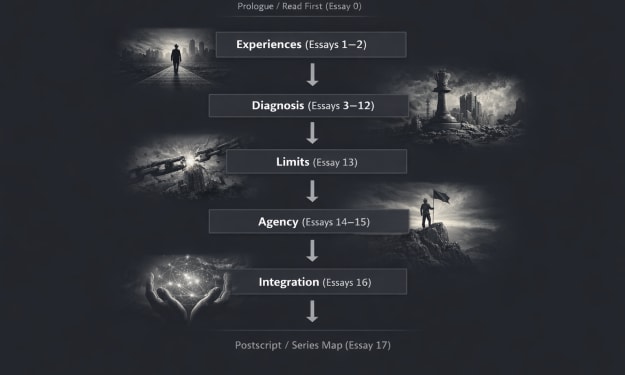
(17) The Shape of the Work
This essay exists to make the structure of the series visible after the fact. It does not introduce new arguments or advance new claims. Its purpose is architectural. It explains how the work is organized, why the sequence matters, and what each movement is responsible for accomplishing. Without this reference, readers may grasp individual insights while missing the coherence of the whole. With it, the series can be understood as a single, intentional construction rather than a collection of adjacent essays.
By Peter Thwing - Host of the FST Podcast8 days ago in Humans
(16) A Coherent Orientation
- Seeing the Whole Rather Than the Pieces - At this point in the series, it becomes possible to see what could not be seen at the beginning. Each essay examined a distinct failure mode, but none of them were independent. Representation becoming abstract, authority detaching from consequence, law becoming unequal, fear governing populations, coercion turning inward, participation hollowing out, and collapse arriving through withdrawal were not separate phenomena. They were expressions of the same underlying design failure viewed from different angles. What initially appeared fragmented resolves into a single, intelligible pattern once the system is observed as a whole.
By Peter Thwing - Host of the FST Podcast8 days ago in Humans
(15) Meaning Beyond Systems
- The Limits of Institutional Meaning - Modern societies quietly train people to derive meaning from institutions. Careers, credentials, civic participation, political identity, and social status are framed not merely as functional roles, but as sources of purpose. When institutions appear stable, this arrangement feels natural. Effort is rewarded, progress is legible, and contribution seems to matter. Meaning and structure reinforce one another. But when institutions fail structurally, this arrangement collapses. The same systems that once promised significance begin to feel hollow, extractive, or hostile.
By Peter Thwing - Host of the FST Podcast8 days ago in Humans
(14) Agency Without Illusion
-The False Choice Between Submission and Revolt- When people recognize that a system is structurally misaligned, they are often presented with a false binary. Either submit fully and play along, or reject the system entirely through open resistance. Both options are framed as moral imperatives, and both are inadequate. Submission feeds a structure that exploits compliance without reciprocity. Revolt invites consequences that rarely produce reform and often strengthen the very mechanisms it seeks to oppose. This false choice paralyzes people because neither option aligns with lived reality or rational self-preservation.
By Peter Thwing - Host of the FST Podcast8 days ago in Humans
(13) Restoration Is Structural
- The Illusion of Surface Repair - When systems begin to fail, the first response is almost always cosmetic. Language changes. Leadership rotates. Messaging softens. New committees are formed. These actions create the appearance of motion without altering direction. They are attractive precisely because they are low-risk to those already insulated from consequence. Surface repair reassures without threatening the underlying architecture that produced failure in the first place.
By Peter Thwing - Host of the FST Podcast8 days ago in Humans
(12) The Illusion of Participation
- Participation as Ritual Rather Than Power - Modern political systems place extraordinary emphasis on participation while quietly reducing its effect. Voting, public comment, civic engagement, and discourse are celebrated as evidence of legitimacy, yet their practical influence on outcomes steadily declines. Participation becomes ritualized. Citizens are invited to act, to speak, to choose, but the structure ensures that these actions rarely alter underlying incentives or constrain authority. The appearance of involvement is preserved even as the substance of influence is removed.
By Peter Thwing - Host of the FST Podcast8 days ago in Humans