Stream of Consciousness
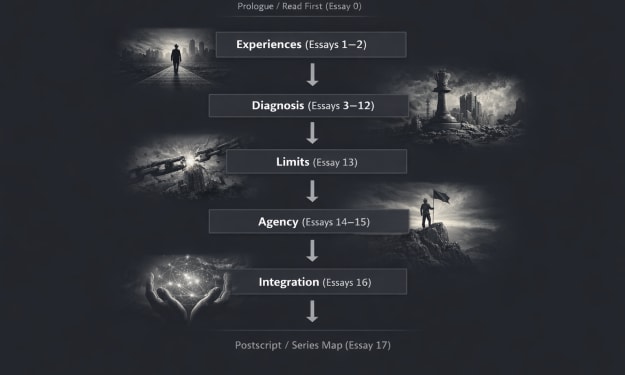
(16) A Coherent Orientation
- Seeing the Whole Rather Than the Pieces - At this point in the series, it becomes possible to see what could not be seen at the beginning. Each essay examined a distinct failure mode, but none of them were independent. Representation becoming abstract, authority detaching from consequence, law becoming unequal, fear governing populations, coercion turning inward, participation hollowing out, and collapse arriving through withdrawal were not separate phenomena. They were expressions of the same underlying design failure viewed from different angles. What initially appeared fragmented resolves into a single, intelligible pattern once the system is observed as a whole.
By Peter Thwing - Host of the FST Podcast8 days ago in Humans
(15) Meaning Beyond Systems
- The Limits of Institutional Meaning - Modern societies quietly train people to derive meaning from institutions. Careers, credentials, civic participation, political identity, and social status are framed not merely as functional roles, but as sources of purpose. When institutions appear stable, this arrangement feels natural. Effort is rewarded, progress is legible, and contribution seems to matter. Meaning and structure reinforce one another. But when institutions fail structurally, this arrangement collapses. The same systems that once promised significance begin to feel hollow, extractive, or hostile.
By Peter Thwing - Host of the FST Podcast8 days ago in Humans
(14) Agency Without Illusion
-The False Choice Between Submission and Revolt- When people recognize that a system is structurally misaligned, they are often presented with a false binary. Either submit fully and play along, or reject the system entirely through open resistance. Both options are framed as moral imperatives, and both are inadequate. Submission feeds a structure that exploits compliance without reciprocity. Revolt invites consequences that rarely produce reform and often strengthen the very mechanisms it seeks to oppose. This false choice paralyzes people because neither option aligns with lived reality or rational self-preservation.
By Peter Thwing - Host of the FST Podcast8 days ago in Humans
(13) Restoration Is Structural
- The Illusion of Surface Repair - When systems begin to fail, the first response is almost always cosmetic. Language changes. Leadership rotates. Messaging softens. New committees are formed. These actions create the appearance of motion without altering direction. They are attractive precisely because they are low-risk to those already insulated from consequence. Surface repair reassures without threatening the underlying architecture that produced failure in the first place.
By Peter Thwing - Host of the FST Podcast8 days ago in Humans
(12) The Illusion of Participation
- Participation as Ritual Rather Than Power - Modern political systems place extraordinary emphasis on participation while quietly reducing its effect. Voting, public comment, civic engagement, and discourse are celebrated as evidence of legitimacy, yet their practical influence on outcomes steadily declines. Participation becomes ritualized. Citizens are invited to act, to speak, to choose, but the structure ensures that these actions rarely alter underlying incentives or constrain authority. The appearance of involvement is preserved even as the substance of influence is removed.
By Peter Thwing - Host of the FST Podcast8 days ago in Humans
(11) Collapse by Withdrawal
- The Myth of Sudden Collapse - Popular imagination tends to picture societal collapse as dramatic and explosive. Revolutions, riots, coups, and public uprisings dominate historical storytelling because they are visible and narratively satisfying. They provide a clear beginning, a clear antagonist, and a clear moment of rupture. In reality, most complex systems do not fail this way. They fail quietly, gradually, and often without a single defining event. Collapse is rarely the result of collective rage reaching a boiling point. It is more often the result of collective disengagement reaching a critical mass.
By Peter Thwing - Host of the FST Podcast8 days ago in Humans
(10) Coercion Turned Inward
- The Original Direction of State Power - In its legitimate form, state coercion is directional. It is aimed outward at external threats and inward only to the extent necessary to preserve basic order and adjudicate disputes. The justification for this power has always rested on reciprocity. Citizens accept the state’s monopoly on force because it is constrained, predictable, and ultimately protective. Coercion exists to secure the conditions under which ordinary life can proceed, not to manage citizens as subjects. When this orientation holds, the state’s power is dangerous but bounded, and its legitimacy derives from the fact that it is exercised on behalf of the public rather than against it.
By Peter Thwing - Host of the FST Podcast8 days ago in Humans
(9) Power Legislating Itself
- The Structural Impossibility of Self-Restraint - Every system that concentrates power eventually confronts the same structural problem: those with authority are asked to regulate themselves. This is often framed as a moral question, a test of character, integrity, or civic virtue. In reality, it is a design failure. Systems that rely on self-restraint misunderstand how incentives operate over time. Human beings respond to reward, insulation, and opportunity predictably, regardless of stated values. Expecting those who benefit from power to voluntarily limit that power is not idealism. It is abdication of structural responsibility.
By Peter Thwing - Host of the FST Podcast8 days ago in Humans
(8) Redistribution Without Exposure
- The Promise of Redistribution - Wealth redistribution is almost always framed as a corrective mechanism, a way to rebalance outcomes that markets, history, or circumstance have skewed. In theory, redistribution is meant to relieve pressure on those bearing disproportionate burden and to prevent extreme concentration of power from destabilizing society. The language surrounding it emphasizes fairness, compassion, and social responsibility, creating the impression that costs will be borne by those most able to afford them and benefits will flow downward.
By Peter Thwing - Host of the FST Podcast8 days ago in Humans
(7) Populations, Not Persons
- The Mistake of Individual Framing - One of the most persistent misunderstandings in political and social analysis is the tendency to reason from individual cases rather than aggregate behavior. Individuals experience systems personally, so it feels natural to evaluate outcomes through personal stories, edge cases, and exceptions. But systems do not respond to individuals as individuals. They respond to patterns, distributions, and averages. Policy is not designed around who someone is, but around how populations behave at scale.
By Peter Thwing - Host of the FST Podcast8 days ago in Humans
(6) Fear as Governance
- The Shift From Policy to Psychological Control - When authority loses legitimacy and consequence is no longer applied evenly, politics cannot continue to operate primarily through policy. Policy presumes time, trust, and the expectation that outcomes will be evaluated honestly against promises. It requires patience from the public and restraint from decision-makers, because policy only proves itself through results. Fear requires none of these conditions. Fear compresses decision-making into the present, bypasses deliberation, and reframes obedience as moral urgency, allowing action without explanation.
By Peter Thwing - Host of the FST Podcast8 days ago in Humans
(5) The State Turned Inward
- The Original Purpose of State Power - The fundamental justification for the state’s coercive power has always been outward-facing. Force was legitimized as a means of protecting the community from external threats, adjudicating disputes between citizens, and maintaining internal order where voluntary cooperation failed. In this framework, coercion was constrained by purpose. It existed to preserve the conditions under which ordinary life could continue, not to manage citizens as subjects. The state’s power was understood as dangerous but necessary, and therefore something to be limited, monitored, and distributed across institutions to prevent abuse.
By Peter Thwing - Host of the FST Podcast8 days ago in Humans