
The Soul's Echo: Laila Majnu and the Madness of True Love
More than a legend, a timeless lesson on a love so deep it broke chains, defied the world, and found freedom in devotion.

The Soul's Echo: Laila Majnu and the Madness of True Love
By Hazrat Umer
In the vast, silent deserts of ancient Arabia, where winds whispered tales through the dunes, a story of love was born—a love so pure, so intense, that even today, centuries later, it burns brighter than any flame. This is the story of Qays and Laila, known to the world as Majnu and Laila. It is a story that goes beyond simple romance; it’s about the spirit of a human heart that refuses to give up on its true calling.
I have spent 15 years observing the human heart, and I have seen that our modern world often confuses love with convenience. But Laila Majnu teaches us what it means to love without limits, to love with every breath.
The Seed of Love
Qays and Laila grew up together. They were cousins, and from a very young age, their hearts became tied to each other. They would play together under the scorching sun, share secrets, and look at the stars, dreaming of a future where they would always be together. Their love was innocent, like a seed planted in fertile ground, watered by shared smiles and stolen glances. Everyone in their tribe knew that Qays and Laila were meant to be.
The World Says No
As they grew older, their love deepened. Qays would write beautiful poems for Laila, praising her beauty and his devotion. He became famous for these poems, but in those days, it was not proper for a man to openly declare his love for a woman before marriage.
When Qays asked Laila’s father for her hand, the father refused. Why? Because Quays' love was too public, too wild, too "mad" (majnu means madman). He was becoming known as "Majnu" because his love was so intense that people thought he had lost his mind. Laila's father feared this public display would bring shame to their family. He wanted a more stable, wealthy man for his daughter.
This is where the story hits a very human chord. How many times have we seen families separate lovers because of tradition, money, or "what people will say"?
The Madness of Devotion
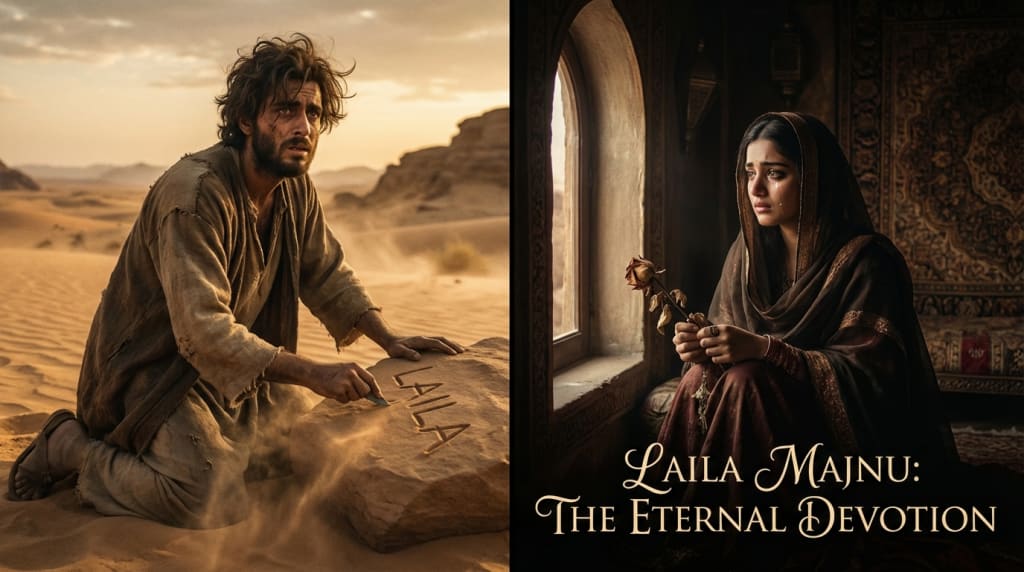
When Laila was married to another man, a rich and powerful chief, Qays's world shattered. He truly lost his mind, but not in a way that was harmful. He lost his mind to Laila. He left his home, his family, and all worldly possessions. He started wandering the desert, talking to animals, trees, and the wind, believing they were all Laila. He would carve Laila’s name on rocks and recite his poems about her to the empty sands.
People called him Majnu, the madman. But was he truly mad? Or was he simply living a love so pure that the "normal" world couldn't understand it? He didn't care about food, shelter, or status. His only purpose, his only thought, was Laila. His body was in the desert, but his soul was always with her.
Laila's Silent Suffering
What about Laila? She was married to another, living in a golden cage, as I spoke about in my previous story. She had wealth and comfort, but her heart was in the desert with Majnu. She suffered in silence, trapped by her family's honor and society's rules. She couldn't openly declare her love, but her heart bled for Qays every single day. Her love was as deep as Majnu's, but her pain was more hidden.
This shows us the human style of love: sometimes it is loud and defiant, and sometimes it is silent and sacrificial. Both are equally powerful.
The Lesson of Unconditional Love
Majnu's love was unconditional. He didn't love Laila for her beauty, her status, or what she could give him. He loved her for who she was, for her soul. Even when she was married to another, his love didn't turn into hate or jealousy. It remained pure devotion. He didn't wish her harm; he only wished to be connected to her spirit.
This story teaches us about resilience, not in battle, but in the heart. Majnu never gave up on his love, even when the whole world turned against him. His love became a journey of his soul.
Conclusion
In the end, both Majnu and Laila passed away, their bodies separated but their souls forever united. Their story is not about "happily ever after" in the traditional sense. It's about a love that transcends life and death, a love that teaches us freedom is not about what you have, but about how deeply you can love.
My name is Hazrat Umer, and I believe that in this fast-paced world of 2026, we need to remember the purity of love. Don't let ego, status, or external pressures define your heart. Let your love be true, even if the world calls you "Majnu." Because true love, like a pure echo, always finds its way back to its source.
About the Creator
Hazrat Umer
“Life taught me lessons early, and I share them here. Stories of struggle, growth, and resilience to inspire readers around the world.”
Keep reading
More stories from Hazrat Umer and writers in Humans and other communities.
The Forgotten Shelter: When the Hands That Fed Us Begin to Tremble
By Hazrat Umer A Heartbreaking Look at How We Treat Our Parents in Their Old Age Life is a circle. We start as helpless babies, unable to eat, walk, or speak. In those years, there are two people who sacrifice their sleep, their hunger, and their dreams just to make sure we are okay. Our parents. They hold our tiny hands as we take our first steps, and they protect us from every storm. But as the years pass and we grow strong, a dark shadow often enters our homes. We grow up, we become successful, and suddenly, the very hands that fed us begin to look like a "burden."
By Hazrat Umer9 days ago in Humans
Think for Me
"How do you calculate the circumference of a circle? Submit your answer when ready." [Pause] "Excellent! Every student was able to call up the answer electronically very quickly. If I, as a robot had feelings, I would express pride. You may break for lunch. Return to this cyber room in 45 minutes."
By Julie Lacksonen6 days ago in Humans
Remembering James Van Der Beek
The Enduring Impact of a Beloved Actor The entertainment world mourns the passing of James Van Der Beek, the beloved actor best known for his iconic role as Dawson Leery in the hit 90s television series Dawson's Creek. Van Der Beek, 48, succumbed to colorectal cancer on February 11, 2026, after a multi-year battle with the disease. His death has not only saddened fans globally but has also brought renewed attention to the rising incidence of colorectal cancer in younger adults. This blog post reflects on his career, his personal journey with cancer, and the lasting legacy he leaves behind.
By Omasanjuwa Ogharandukun3 days ago in Humans



Comments
There are no comments for this story
Be the first to respond and start the conversation.