
Tiny Scissors
There's safety and healing in creativity
This is the story of how I made it out of a gloomy pit with the help of just a tiny pair of scissors.
I had a disordered childhood. A lot of things were unpredictable. Some of the adults around me had unpleasant temperaments too. However, there were two things guaranteed to go down like clockwork in my home: volatile arguments and awkward secrets.
My way of dealing with both was making things. In a way, I was crafting an oasis of sorts with my imagination. Creating kept me distracted. It afforded me some privacy, and it helped me cope with the stress. While I was in maker mode, I remained out of the line of fire and things seemed pleasant enough.
I drew and cut, painted, and built artifacts at all hours of the day. I was constantly on the hunt for materials: used boxes, plastic bags, ink, bobby pins, cardboard, rubber bands, drinking straws, nail polish, twine, clothespins, and tape. I saw potential in every scrap of rubbish and my pockets were always full. Scissors in hand and with a hunger for invention, I had purpose.
I still got in trouble at times for giving my dolls “make overs” consisting of black marker tattoos and short, tinted haircuts. Or for dipping into my mother’s drawer and cutting up her best pair of stockings to fill them with rice and cotton balls (don’t ask me what I was trying to make, but it was fun). Fully functional handkerchief parachutes and cardboard pinball machines were my masterpieces. I stashed paper flowers, tiny furniture for my hamster, newspaper masks and notecards for my school mates under my bed. If my hands were busy cutting and folding paper, tying yarn, and bending wire, I was doing alright.
I was still a teen during my first two years of college, and the time spent in class afforded me a little respite from the friction at home. I was, for the first time ever, allowed to venture outside on my own and I managed to make a few friends. I loved learning and I thought my path was showing itself more clearly then: I would become an artist. A professional maker of beautiful and meaningful things.
Still, hostilities at home were worse than ever before and I did not know how to manage my anxiety. I would leave the apartment and wander around the city for hours, sometimes showing up uninvited to a friend’s house to kill some time before returning home. It was no longer enough just staying on the sidelines by crafting or drawing. There were no sidelines. The whole house was a battlefield, and I was by now digging my heels and fighting back, though with little success. I was like a lab rat: constantly on alert, constantly looking for the exit and afraid of the next jolt.
In the end, I bolted as soon as it became feasible.
At the time, I thought about my new situation as an adventure, a journey full of possibilities and excitement. I was, in my mind, the protagonist of my own movie and everything was going to be ok. In actuality, I felt cornered and frustrated, so I headed for the first available exit. Quite predictably, I was not remotely ready to face the world on my own. The driving force behind my escape was the need to find a replacement home that would give me some sense of protection and safety. I just went about it in the most naïve and self-destructive of ways: I handed my power to strangers who did not have my best interest at heart. I relinquished control and squandered my potential as an artist and as an individual. I got lost.
I stayed in college for a couple of additional semesters after my departure but, before long, I dropped out and began to drift. I was not a fully formed adult when I left home and navigating the outside world without a roadmap was trickier than I had anticipated.
Life became even more disorganized and difficult than I could have imagined. A career as an artist seemed like a mirage. Going back home was an admission of defeat and I refused to do that. I thought myself an utter failure. I punished myself and spiraled down into depression. Overcome by dark moods, I couldn’t find refuge in making things anymore. This was real life now, and playing was not allowed, so, for years, I shouldered my responsibilities the best way I could. I struggled in every way and never found that home that I was so eagerly looking for.
………………………………………………………………………..
For decades, my life was colorless and joyless. I had no expectations of it ever becoming anything else. One day, I was looking for some school supplies to help my son with homework. In a junk drawer, among crumpled up receipts and dried up pens, I found a pair of small scissors. This simple household tool, this unassuming instrument, turned out to be the lifesaver that kept me afloat from then on.
Without conscious effort, without a plan for recovery, I started cutting shapes out of construction paper. I would cut circles mostly, and moving my hands, focusing on this simple task settled me instantly. It was effortless. I could have done it with my eyes closed. I suppose that I was revisiting all those afternoons I would spend sitting on the floor making things and constructing my little safe haven.
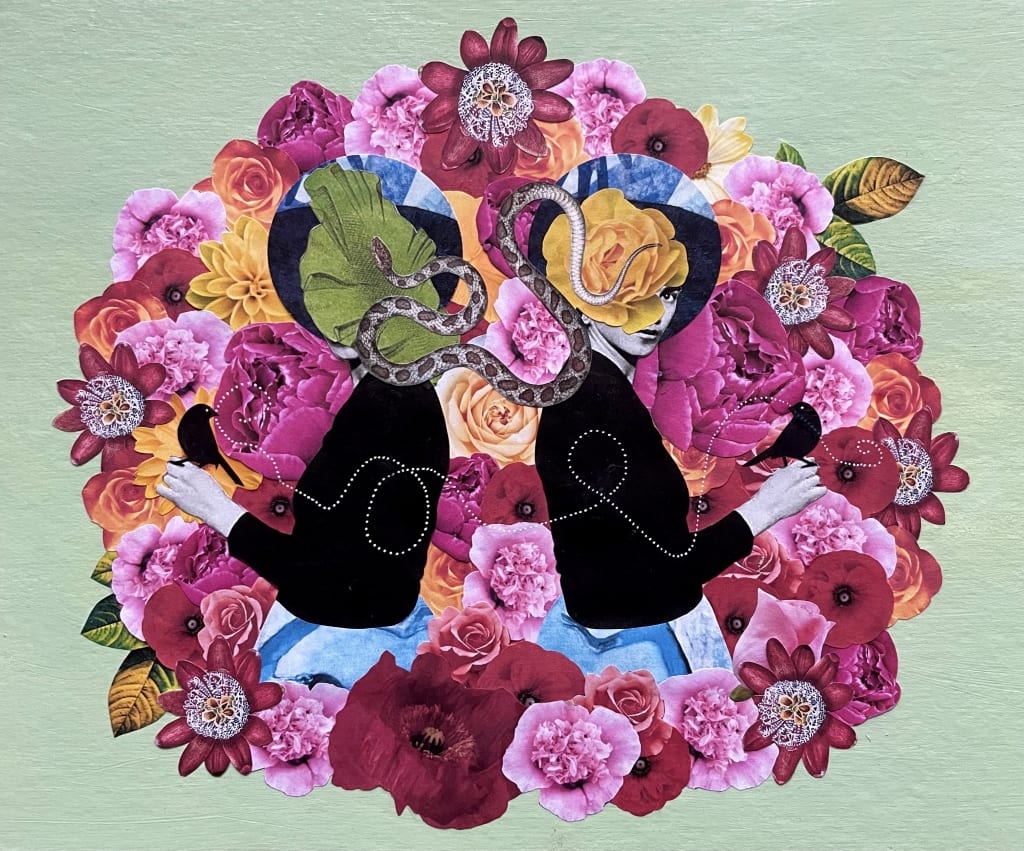
I then started making little collages. Shy, tiny things that meant nothing to anyone else but me. Collage was welcoming. It was a grown-up version of my childhood creations. Collage seemed to be waiting for me like a faithful friend I hadn’t seen for a long time. These diminutive collages embraced me and my long absence. They let me start all over, no questions asked.
Collage slowly carved itself a space in my life without judging me and without asking much in return. Soon, I became reliant on collage to placate my anxiety, and to get through the challenges that life had hurled my way, which were many more than I could have anticipated.
Evidently, to this day, collage does not magically erase my sadness. It does not negate any of the hardships, but it still has a way of unpacking the suffering. It deconstructs it in ways that I can understand. Collage is a method of reassessment. A creative way of being kind to myself, a skill I was never taught growing up. It has turned out to be a way of finding self-compassion.
During 2020, the year of Covid-19, collage took on an even more essential role. While I always felt somewhat on the fringes of life and I was an inveterate introvert by nature, the isolation hit me hard. Having collage as an outlet saved my sanity.
I am not being hyperbolic. I am not alone in clinging to creativity as a way of enduring pain. In fact, many studies show that creative activity dispels rumination, which is a whirlpool of destructive and self-sabotaging thoughts. No matter the magnitude of your fears or the intensity of your worries, research shows quite definitely that engaging in creativity allows you to better mitigate their negative effects. It helps you process the pain, physical or mental, in ways that no other endeavor accomplishes.
Tiny scissors came to the rescue once again, bringing with them a measure of calm and security.
Because of my now diagnosed CPTSD, getting out of my head is critical to my recovery. When Covid upended my daily routine, I went into my mind, and I found myself witnessing a miserable and terrifying carousel of scary thoughts. Collage was able to diminish my tendency to catastrophize because it requires concentration and redirects imagination outwards. Collage creates a sanctuary, and I can refurbish my mind with more playful, gentle thoughts.
I’m still holding onto those scissors with a death grip, lest my mind starts playing tricks on itself. I remember that truism “don’t believe everything you think”, which could not be more suitable in my case. Words to survive by.
When people ask me about my collages and where they come from, it is tricky for me to encapsulate a lifetime of struggle, learning and setbacks in a few snappy sentences. Collage remains the most useful tool in my arsenal of coping mechanisms, and scissors will remain my secret weapon against sadness and painful memories. Long live tiny scissors!
About the Creator
Keep reading
More stories from writers in Humans and other communities.
I Don't Need My Phone... Wait, Is That Actually True?
My parents gave me my first cell phone when I was twelve years old. It wasn't a fancy iPhone or anything, not even close. Just a simple black flip phone for when I needed to call or text them after school.
By Madison "Maddy" Newton2 days ago in Humans
Relationship problem solving skills everyone should learn to improve love life
The love and attraction are not enough to have healthy relationships but rather the skills to overcome the conflicts, misunderstandings, and different priorities. The skills of problem-solving are critical tools that help couples to resolve disputes positively, trust, and stay emotionally close with each other. In the absence of these skills, even minor problems may grow out of control causing resentment, communication failure, and emotional detachment. Practical strategies will enable the couples to solve problems together, enhance their relationship and be satisfied in the relationship in the long term. The ability to solve problems will enhance everyday relationships as well as the quality and the life span of a romantic relationship.
By Robert Smith7 days ago in Humans



Comments
There are no comments for this story
Be the first to respond and start the conversation.