
Why Crowds Watch and Never Help
The Unseen Force That Paralyzes a Crowd


It was a perfect Tuesday afternoon, the kind where the sun feels like a gift. The downtown square was bustling with people on lunch breaks, tourists consulting maps, and students lounging on the steps of the old courthouse. In the midst of this, an elderly man, Mr. Evans, was walking his small, terrier mix when he suddenly stumbled. His leg buckled, and he fell hard onto the pavement, letting out a sharp cry as his head snapped back. The little dog yelped and strained at its leash.
For a moment, everything froze. Then, life continued, but in a strange, distorted way. A woman in a business suit stopped and her hand flew to her mouth. A young man on a skateboard slowed to a halt. A couple holding hands pointed. Within seconds, two dozen people were aware that an old man was lying hurt on the ground.
But no one moved.
Inside each of them, a silent, frantic calculation began. The woman in the suit, Sarah, thought, "Someone must have called an ambulance already. I’m not a doctor, what could I do? I might make it worse." She looked at the young man, assuming he would take charge. The young man, Leo, saw the well-dressed woman and thought, "She looks responsible. She’s probably already handling it. I’m just a kid; they won’t listen to me." He looked at the couple, who were clearly concerned, assuming they were about to step in.
This is the heart of the "bystander effect," a psychological phenomenon where individuals are less likely to offer help to a victim when other people are present. It is not a sign of a callous or broken society, but a terrifyingly normal function of the human brain in a crowd. The responsibility to act does not disappear; it becomes a ghost that haunts everyone, but belongs to no one. It diffuses, spreading so thin across the crowd that it seems to vanish entirely. Each person believes, with a quiet, desperate hope, that someone else is more qualified, more equipped, or more responsible.
In the square, the seconds ticked by. Mr. Evans groaned, trying to push himself up. His dog started to whine, a high-pitched, panicked sound. The crowd continued to watch, their inaction feeding on itself. The mere presence of others became the strongest argument for doing nothing. It created a false social proof; if no one else is helping, the situation must not be as serious as it seems. Surely, someone would have done something by now.
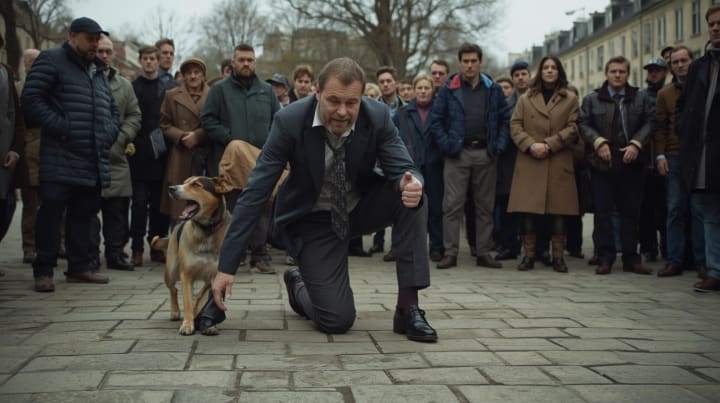
But the spell was broken by the one thing the bystander effect cannot withstand: individual identification. A young woman named Chloe, who had been sitting on a bench reading a book, looked up and saw the crowd and the man on the ground. She didn’t scan the faces around her to see what others were doing. She locked her eyes only on Mr. Evans. She stood up, and with a clear, firm voice that cut through the murmur, she pointed at the young man on the skateboard. "You, in the blue shirt, call 911 right now." She then looked at the businesswoman. "Ma'am, do you have a jacket? We need to keep him warm."
The moment she gave direct, unambiguous commands, the diffusion of responsibility collapsed. The spell was broken. The young man fumbled for his phone, his purpose now clear. The businesswoman immediately took off her blazer and stepped forward. The crowd, once a paralyzed monolith, suddenly became a team of individuals with roles to play. Someone fetched water. Another person comforted the dog.
When the ambulance arrived five minutes later, Mr. Evans was surrounded by helpers. The crowd, which had been a barrier to action, was now a source of support. The difference was not a sudden surge of collective goodness, but the decisive action of one person who bypassed the group’s psychology.
We tell ourselves horror stories about uncaring cities and strangers who don't care. But the truth is more complex and less malicious. In a crowd, we become part of a social organism that is tragically prone to paralysis. We look to others for cues on how to behave, and in a crisis, this instinct backfires spectacularly.
The lesson is not to condemn the crowd, but to understand its nature. If you ever find yourself in need of help, or witnessing someone who is, do not scream to the faceless mass. Look at one person. Point. Make eye contact and say, "You, I need you to call an ambulance." Assign a task. Make them feel uniquely responsible. And if you are the one in the crowd, waiting for a leader, understand this: the leader the crowd is waiting for is you. The most powerful act is not a heroic leap, but the simple, terrifying decision to stop being a bystander and become the one who helps.
Moral of the Story:
In a crowd, responsibility is diffused, making each individual less likely to help. The most effective way to overcome this is to assign specific tasks to specific people, breaking the psychological paralysis and mobilizing the group.
About the Creator
The 9x Fawdi
Dark Science Of Society — welcome to The 9x Fawdi’s world.
Keep reading
More stories from The 9x Fawdi and writers in Humans and other communities.
The Porn Experiment: What Happens to Your Brain on Porn?
Imagine a substance that could deliver an instant rush of pleasure, available 24/7 at the click of a button. It’s free, anonymous, and promises an escape from stress, boredom, or loneliness. This isn’t a new street drug; it’s internet pornography. And your brain processes it in a way that is both fascinating and alarming. Welcome to the unseen neurological experiment you’ve been conducting every time you watch.
By The 9x Fawdi4 months ago in Humans
The Angry Man in Your House
"If you grow up with an angry man in your house, there will always be an angry man in your house" This statement has caused plenty of controversy online, people say its a statement that blames victims while also undermining those who break traumatic cycles to form health relationships... but if I'm honest now that I'm in my 30s it makes more sense to me than ever, and I'd argue that its not just about fathers and uncles.
By S. A. Crawford4 days ago in Humans
Brandon Michael Davis Austin and the Human Imperative of Crisis Intervention
In moments of immediate danger or emotional crisis, the difference between harm and healing often comes down to how quickly, skillfully, and humanely help arrives. Crisis intervention is not simply an emergency response—it is a coordinated, values-driven system designed to stabilize individuals, protect lives, and create pathways toward recovery. As communities face rising mental health challenges, social instability, and complex trauma, the need for effective crisis response systems has never been more urgent. The work and philosophy exemplified by leaders like Brandon Michael Davis Austin highlight what is possible when preparedness and compassion are treated as equally essential.
By Brandon Michael Davisa day ago in Humans
Our Song
Evening has given way to night. Gently, I settle next to you on the comfortable, old love seat and reach for your hand. You snatch it away, again. It cuts me to the quick, but I hide the pain, understanding that the reaction is but part of your demented state. Since the accident, your presence here in our cozy home has been clouded by a haze I can't see. Nevertheless, I feel the frigidity of your expressions and it serves as an excruciating reminder of the immeasurable distance between us.
By Dana Crandell7 days ago in Fiction


Comments
There are no comments for this story
Be the first to respond and start the conversation.